
Hanwha C9083R vs i-PRO U85402-V2L: Specification Comparison
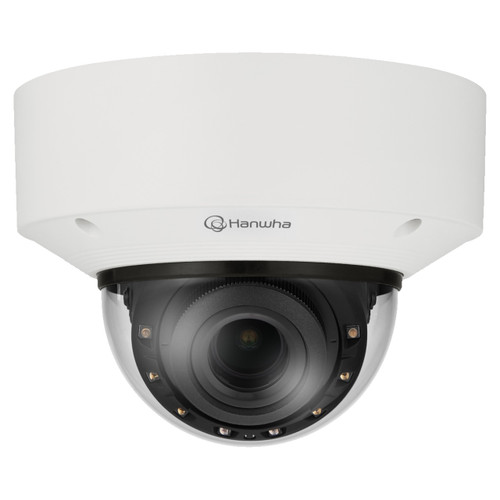
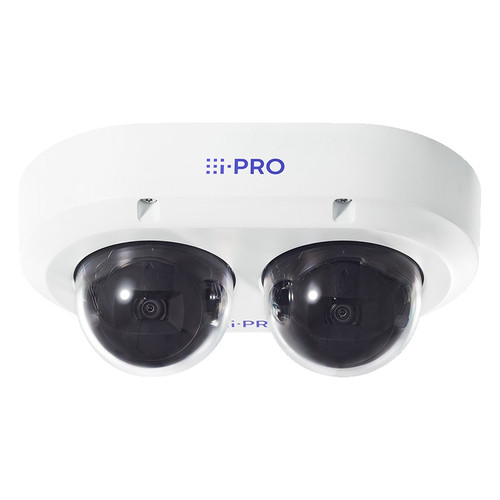
Both the Hanwha XNV-C9083R and the i-PRO WV-U85402-V2L are outdoor IP dome cameras positioned for commercial and enterprise surveillance. However, they differ in a fundamental architectural way: the Hanwha is a single-sensor 8MP 4K unit, while the i-PRO is a dual-sensor design delivering 4MP per sensor for a combined 2×4MP output. Buyers comparing these products are typically evaluating single-sensor 4K coverage against a dual-sensor wide-plus-tele approach at lower per-sensor resolution, making direct spec comparison nuanced but relevant for perimeter and area-coverage applications.
In This Guide
How do the imaging specs compare?
The Hanwha XNV-C9083R uses a single 1/1.8" progressive CMOS sensor capturing a true 3840×2160 (8MP) image, with a motorized varifocal lens spanning 4.4–9.3mm (2.1× zoom) at F1.3 wide and F2.15 tele. Minimum illumination is 0.04 Lux in color and 0 Lux with IR active, supported by WiseIR to 40m. Its extremeWDR is rated at 120dB. DORI tele reach extends to 176.6m detect / 35.3m recognize. The i-PRO WV-U85402-V2L deploys two 1/2.7" CMOS sensors, each at 2688×1520 (4MP), with a 2.9–7.3mm lens (2.5× optical zoom, up to 10.5× at 640×360 crop) at F2.0 wide and F3.0 tele. Minimum illumination is 0.12 Lux (BW, 50IRE), and WDR peaks at Super Dynamic 108dB. DORI tele reach is 136.5m detect / 27.3m recognize.
On raw light sensitivity, the Hanwha has a clear advantage: 0.04 Lux color versus 0.12 Lux monochrome for the i-PRO, a meaningful delta in low-ambient scenes. WDR also favors the Hanwha at 120dB versus 108dB. The i-PRO's per-sensor resolution is 4MP, so it does not match the Hanwha's 8MP pixel density for single-field-of-view detail; however, the dual-sensor architecture provides simultaneous multi-angle or wide-plus-tele coverage from one housing. The Hanwha's larger 1/1.8" sensor versus the i-PRO's 1/2.7" sensors is consistent with the Hanwha's superior low-light figures. Both cameras deliver 30fps and share H.265/H.264/MJPEG compression.
What about installation and environment?
Both cameras carry IP66/IP67 and NEMA 4X ratings alongside IK10 impact resistance, so ingress and vandal protection are equivalent. Operating temperature ranges differ slightly: the Hanwha is rated -40°C to +55°C, while the i-PRO extends to an upper limit of +60°C (with a power-on minimum of -20°C per spec), giving the i-PRO a 5°C high-temperature advantage. The i-PRO also adds a NEMA TS 2 rating and a wind-resistance spec of up to 40 m/s (~89 mph), plus an anti-condensation Temish element — specs absent from the Hanwha data.
Power requirements differ: the Hanwha operates on PoE IEEE 802.3af Class 3 (max 12.95W) or 12VDC, while the i-PRO requires PoE+ IEEE 802.3at (18.9W) or DC 54V to power its dual-sensor assembly. Installers must confirm PoE+ switch availability for the i-PRO, whereas the Hanwha runs on standard PoE switches. The Hanwha's network interface is 10/100BASE-T; the i-PRO supports Gigabit 10/100/1000BASE-T. Physically, the Hanwha is a compact ø160×118mm dome at 1,450g; the i-PRO is a larger 250×150×105mm form at approximately 1,800g.
Which fits your VMS and analytics better?
The Hanwha XNV-C9083R supports ONVIF Profile S/G/T/M and Hanwha's SUNAPI/Wisenet ecosystem. Its on-camera AI analytics are fully specified: Person, Face, Vehicle, and License Plate detection; vehicle type classification (car, bus, truck, motorcycle, bicycle); virtual line crossing with direction; virtual area intrusion; people counting; queue management; and heatmap. Privacy masking supports 32 zones with mosaic options. It includes a built-in gyro for digital image stabilization. Audio I/O uses selectable mic/line in (2.5VDC supply) and line out (max 1Vrms). Alarm I/O offers 2 configurable ports. Edge storage reaches 512GB via MicroSD, backed by 4GB RAM and 512MB Flash.
The i-PRO WV-U85402-V2L supports ONVIF Profile G/S/T and runs on an Ambarella CV22 SoC. On-camera analytics are VMD (4 areas), Scene Change Detection (1 area), and Audio Detection; AI analytics and AI Sound Classification are listed as not specified in the provided data. Privacy masking is limited to 8 zones; VIQS supports up to 8 zones. Audio I/O uses 3.5mm jacks (stereo in, mono out). Alarm I/O provides 3 terminals. Edge storage is MicroSD/SDHC/SDXC up to 512GB. The i-PRO carries FIPS 140-2 Level 3 cybersecurity certification — a significant differentiator for federal, critical-infrastructure, or high-compliance deployments. The i-PRO also supports 24 simultaneous unicast streams versus the Hanwha's 20.
Which should you choose: the C9083R or the U85402-V2L?
Our take: The XNV-C9083R is the stronger choice when a single wide-area field of view at full 8MP 4K resolution, superior low-light performance, and fully specified on-camera AI analytics are the primary requirements. Its 0.04 Lux color sensitivity outperforms the i-PRO's 0.12 Lux monochrome figure, its extremeWDR of 120dB exceeds the i-PRO's 108dB, and its DORI tele recognize distance of 35.3m outreaches the i-PRO's 27.3m — all from a lighter, smaller housing drawing only 12.95W on standard PoE 802.3af. The XNV-C9083R also delivers a fully enumerated AI analytics suite (LPR, vehicle classification, people counting, heatmap) versus the i-PRO's on-camera analytics, which do not confirm AI capabilities in the provided specifications. Conversely, the WV-U85402-V2L is the correct choice when FIPS 140-2 Level 3 cybersecurity compliance is mandated, when simultaneous dual-sensor multi-angle coverage from one mount is operationally necessary, or when the +60°C upper operating temperature or NEMA TS 2 traffic-cabinet rating is required by the installation environment.
Side-by-Side Comparison
Spec-for-spec, from manufacturer data.
| Specification | Hanwha C9083R | i-PRO U85402-V2L |
|---|---|---|
| Resolution | 3840×2160 (8MP, single sensor) | 2× 2688×1520 (4MP per sensor, dual sensor) |
| Sensor Size | 1/1.8" CMOS | 2× 1/2.7" CMOS |
| Lens Range | 4.4–9.3mm, 2.1× motorized varifocal | 2.9–7.3mm, 2.5× optical (up to 10.5× crop at 640×360) |
| Max Aperture (Wide) | F1.3 | F2.0 |
| Min Illumination | 0.04 Lux color / 0 Lux IR | 0.12 Lux BW (50IRE, F2.0) |
| WDR | 120dB (extremeWDR) | 108dB (Super Dynamic, level 31) |
| IR Range | 40m WiseIR | 40m (30IRE) / 30m (50IRE) |
| DORI Detect (tele) | 176.6m | 136.5m |
| DORI Recognize (tele) | 35.3m | 27.3m |
| Power / Max Draw | PoE 802.3af Class 3 / 12VDC; 12.95W max | PoE+ 802.3at / DC 54V; 18.9W max |
| Network Interface | 10/100BASE-T | 10/100/1000BASE-T (Gigabit) |
| Operating Temp | -40°C to +55°C | -40°C to +60°C (power-on min -20°C) |
| IP / IK Rating | IP66/IP67, NEMA 4X, IK10 | IP67/IP66, NEMA 4X (UL50E), IK10 |
| ONVIF Profiles | S/G/T/M | G/S/T |
| On-Camera AI Analytics | Person, Face, Vehicle, LPR, vehicle type, counting, queue, heatmap | VMD, SCD, Audio Detection; AI analytics not specified in provided data |
| FIPS 140-2 Level 3 | — | Yes |
| Privacy Mask Zones | 32 (4-point quadrangle, mosaic) | 8 zones |
| Edge Storage | MicroSD/SDHC/SDXC up to 512GB | MicroSD/SDHC/SDXC up to 512GB |
| Weight | 1,450g | ~1,800g |
| Warranty | 3 years | 3 years |
Frequently Asked Questions
Which should you choose: the C9083R or the U85402-V2L?
The XNV-C9083R is the stronger choice when a single wide-area field of view at full 8MP 4K resolution, superior low-light performance, and fully specified on-camera AI analytics are the primary requirements. Its 0.04 Lux color sensitivity outperforms the i-PRO's 0.12 Lux monochrome figure, its extremeWDR of 120dB exceeds the i-PRO's 108dB, and its DORI tele recognize distance of 35.3m outreaches the i-PRO's 27.3m — all from a lighter, smaller housing drawing only 12.95W on standard PoE 802.3af. The XNV-C9083R also delivers a fully enumerated AI analytics suite (LPR, vehicle classification, people counting, heatmap) versus the i-PRO's on-camera analytics, which do not confirm AI capabilities in the provided specifications. Conversely, the WV-U85402-V2L is the correct choice when FIPS 140-2 Level 3 cybersecurity compliance is mandated, when simultaneous dual-sensor multi-angle coverage from one mount is operationally necessary, or when the +60°C upper operating temperature or NEMA TS 2 traffic-cabinet rating is required by the installation environment.
Is the XNV-C9083R or WV-U85402-V2L better for low-light performance?
The XNV-C9083R has a clear advantage. Its minimum illumination is 0.04 Lux in color and 0 Lux with IR active, compared to the WV-U85402-V2L's 0.12 Lux in black-and-white (50IRE, F2.0). The Hanwha's larger 1/1.8" sensor versus the i-PRO's 1/2.7" sensors is consistent with its better low-light figures. Both cameras share a 40m IR range, though the i-PRO's 40m figure is measured at 30IRE and drops to 30m at the more demanding 50IRE standard.
Do I need a PoE+ switch for either of these cameras?
Yes, but only for the i-PRO WV-U85402-V2L. It requires PoE+ IEEE 802.3at and draws up to 18.9W to power its dual-sensor assembly. The Hanwha XNV-C9083R operates on standard PoE IEEE 802.3af Class 3 at a maximum of 12.95W, meaning it works with any compliant 802.3af switch. If your existing infrastructure is 802.3af-only, the Hanwha avoids the cost of switch upgrades or PoE+ injectors.
Which camera is better suited for a government or compliance-regulated deployment?
The i-PRO WV-U85402-V2L is the appropriate choice in that scenario. It carries FIPS 140-2 Level 3 certification for its cryptographic module, which is a mandated requirement in many federal, defense, and critical-infrastructure procurement standards. The Hanwha XNV-C9083R is not listed as FIPS 140-2 certified in the provided specifications. Both cameras support IEEE 802.1X network authentication and HTTPS/SSL, but FIPS 140-2 Level 3 is a materially higher bar that only the i-PRO meets per available specs.
Get a Second Opinion on Your Camera Choice
Share your site layout, coverage goals, and budget. Our team will validate the camera selection, flag anything we would change, and recommend products that match the use case.