
Hanwha C9083R vs i-PRO S85402-V2L1: Specification Comparison
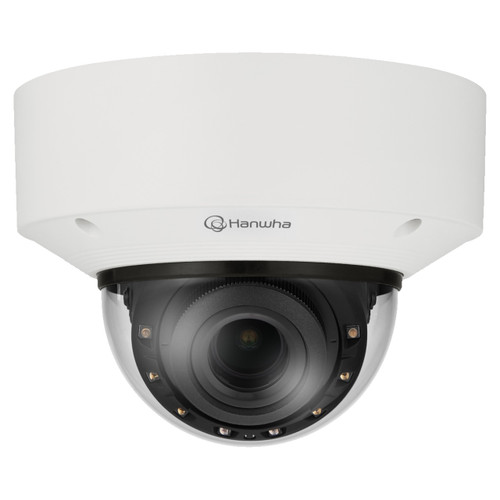
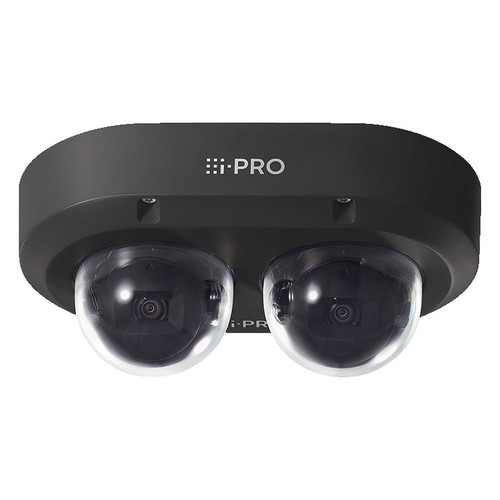
Both the Hanwha XNV-C9083R and the i-PRO WV-S85402-V2L1 are outdoor fixed IP dome cameras rated at a combined 8MP output, PoE-powered, IK10-rated, and ONVIF-compliant — placing them squarely in the same procurement category for perimeter and general surveillance installations. The Hanwha achieves 8MP through a single 4K sensor, while the i-PRO uses two independent 4MP sensors in a dual-dome housing. This comparison examines how each approaches imaging, environmental hardening, and platform integration to help integrators and IT buyers select the right unit for their deployment.
In This Guide
How do the imaging specs compare?
The Hanwha XNV-C9083R uses a single 1/1.8" progressive CMOS sensor delivering a native 3840×2160 (8MP 4K) image at 30 fps, with a 4.4–9.3mm motorized varifocal lens (2.1× zoom) and a maximum aperture of F1.3 at wide. Its WDR is specified at 120 dB (extremeWDR). Minimum illumination is 0.04 lux color and 0 lux with IR active. WiseIR reaches 40m. DORI detect range extends to 176.6m at tele. The i-PRO WV-S85402-V2L1 pairs two 1/2.7" CMOS sensors, each outputting up to 2688×1520 (approx. 4MP per channel) at 30 fps, with a 2.9–7.3mm motorized varifocal lens (2.5× zoom) and a maximum aperture of F2.0 at wide. Its Super Dynamic WDR is rated at 108 dB maximum. Minimum illumination is specified at 0.12 lux (BW, 50IRE, F2.0, 1/30s); a 0 lux figure is not listed in the provided specs. IR LED range is 40m (high) or 30m at 50IRE.
On raw low-light sensitivity, the Hanwha's 0.04 lux color figure and larger 1/1.8" sensor offer a measurable advantage over the i-PRO's 0.12 lux BW figure on its 1/2.7" sensors. The Hanwha's 120 dB WDR also exceeds the i-PRO's 108 dB Super Dynamic specification. For long-range identification, the Hanwha reaches 17.7m at tele (250 PPM) versus 13.6m for the i-PRO at the same PPM density, owing to the higher native resolution. The i-PRO's dual-sensor architecture, however, provides two independently adjustable fields of view within a single housing — a capability the single-sensor Hanwha does not replicate.
What about installation and environment?
Both cameras carry IP66, IP67, NEMA 4X, and IK10 ratings, making them equivalently hardened for outdoor vandal-prone environments. Operating temperature ranges differ slightly: the Hanwha is specified for −40°C to +55°C, while the i-PRO is rated −40°C to +60°C — a 5°C advantage at the upper end for the i-PRO. The i-PRO also lists a wind resistance rating of up to 40 m/s (approx. 89 mph) and includes an anti-condensation Temish element; neither spec is listed for the Hanwha. The i-PRO additionally cites NEMA TS 2 (2.2.7–2.2.9) compliance, which is relevant for traffic and roadway installations.
Power requirements differ in PoE class: the Hanwha draws a maximum of 12.95W and is powered by PoE IEEE 802.3af (Class 3), while the i-PRO requires PoE+ IEEE 802.3at (Class 4) at 22.2W. Buyers must verify switch port budgets accordingly — PoE+ ports are not universal. The Hanwha includes a Micro USB Type B port for on-site installation and adjustment video output at 1280×720. The Hanwha dimensions are ø160×118mm (1,450g); the i-PRO measures 250mm(D)×150mm(W)×105mm(H) at approximately 1.8kg — a larger footprint due to its dual-dome housing.
Which fits your VMS and analytics better?
Both cameras support ONVIF Profiles G, M, S, and T, ensuring broad VMS compatibility. The Hanwha supports up to 20 unicast users and up to 10 streaming profiles with 3 virtual channels; the i-PRO supports 24 simultaneous users. The Hanwha's protocol list includes SRTP and MQTT; the i-PRO also lists MQTT and LLDP. Security credentials differ notably: the i-PRO cites FIPS 140-2 Level 3 compliance in addition to HTTPS and IEEE 802.1X — a requirement in some federal and critical-infrastructure deployments. The Hanwha offers 802.1X (EAP-TLS, EAP-LEAP, EAP-PEAP MSCHAPv2) and a pre-installed Hanwha Techwin Root CA device certificate but does not list FIPS 140-2 in the provided specs. The i-PRO also lists signed firmware support; this is not specified for the Hanwha in the provided data.
On edge analytics, the Hanwha classifies persons, faces, vehicles (type: car/bus/truck/motorcycle/bicycle), and license plates using an AI engine, and adds business intelligence functions including people counting, queue management, and heatmap. It supports 8 polygonal motion detection zones and 32 privacy masking zones. The i-PRO provides AI Video Analytics (6 types per spec), AI Sound Classification (gunshot, yell, vehicle horn, glass break), scene change detection, and audio detection, with 4 VMD areas and 8 privacy zones. Both support microSD/SDXC edge storage up to 512GB. The Hanwha provides 2 configurable alarm I/O ports; the i-PRO provides 3 alarm terminals (IN/OUT/AUX) and 3 audio input jacks (3.5mm stereo) versus the Hanwha's selectable mic/line-in with a single audio out.
Which should you choose: the C9083R or the S85402-V2L1?
Our take: The XNV-C9083R is the stronger choice when single-sensor 4K resolution, superior low-light performance, and richer on-camera business intelligence are the primary requirements. Its 1/1.8" sensor and 0.04 lux color minimum illumination outperform the i-PRO's 1/2.7" sensors at 0.12 lux BW; its 120 dB extremeWDR exceeds the i-PRO's 108 dB Super Dynamic; and its tele DORI identify range reaches 17.7m versus the i-PRO's 13.6m. Conversely, the WV-S85402-V2L1 is the better fit when dual independent fields of view are operationally required, when FIPS 140-2 Level 3 and signed firmware are mandated (federal, critical infrastructure), when the upper operating temperature of +60°C matters, or when NEMA TS 2 roadway compliance is needed. The i-PRO's PoE+ requirement (22.2W, Class 4) versus the Hanwha's PoE af (12.95W, Class 3) must be factored into switch-port budget planning.
Side-by-Side Comparison
Spec-for-spec, from manufacturer data.
| Specification | Hanwha C9083R | i-PRO S85402-V2L1 |
|---|---|---|
| Camera Architecture | Single-sensor (1× 8MP) | Dual-sensor (2× 4MP) |
| Image Sensor | 1/1.8" progressive CMOS | 2× 1/2.7" type CMOS |
| Resolution | 3840×2160 (8MP 4K) | 2688×1520 per channel (~4MP each) |
| Max Frame Rate | 30 fps @ 8MP | 30 fps |
| Focal Length / Zoom | 4.4–9.3mm, 2.1× motorized varifocal | 2.9–7.3mm, 2.5× motorized varifocal |
| Max Aperture (Wide) | F1.3 | F2.0 |
| Min Illumination | 0.04 lux color / 0 lux IR | 0.12 lux BW (50IRE, F2.0, 1/30s) |
| IR Range | 40m WiseIR | 40m (high) / 30m (50IRE) |
| Wide Dynamic Range | 120 dB (extremeWDR) | 108 dB max (Super Dynamic On, Level 31) |
| Video Compression | H.265, H.264 (Main/Baseline/High), MJPEG | H.265, H.264 (CBR/VBR), MJPEG |
| IP / Impact Rating | IP66/IP67, NEMA 4X, IK10 | IP67/IP66, NEMA 4X, IK10 |
| Operating Temperature | −40°C to +55°C | −40°C to +60°C |
| Power Input / PoE Class | PoE IEEE 802.3af, Class 3, 12.95W max | PoE+ IEEE 802.3at, Class 4, 22.2W |
| Network Interface | 10/100BASE-T, RJ-45 | 10/100/1000BASE-T, RJ-45 |
| Edge Storage | microSD/SDHC/SDXC, 1 slot, up to 512GB | microSD up to 2GB, SDHC up to 32GB, SDXC up to 512GB |
| ONVIF Profiles | S, G, T, M | G, M, S, T |
| FIPS 140-2 / Signed Firmware | Not specified in provided specs | FIPS 140-2 Level 3; Signed firmware listed |
| Alarm I/O | 2 configurable I/O ports | 3 alarm terminals (IN/OUT/AUX) |
| Audio I/O | Mic/line in (selectable), line out | 3× 3.5mm stereo input, 1× 3.5mm stereo output |
| Dimensions | ø160×118mm | 250mm(D)×150mm(W)×105mm(H) |
| Weight | 1,450g (3.20 lb) | Approx. 1,800g |
| Warranty | 3-year | 3-year |
Frequently Asked Questions
Which should you choose: the C9083R or the S85402-V2L1?
The XNV-C9083R is the stronger choice when single-sensor 4K resolution, superior low-light performance, and richer on-camera business intelligence are the primary requirements. Its 1/1.8" sensor and 0.04 lux color minimum illumination outperform the i-PRO's 1/2.7" sensors at 0.12 lux BW; its 120 dB extremeWDR exceeds the i-PRO's 108 dB Super Dynamic; and its tele DORI identify range reaches 17.7m versus the i-PRO's 13.6m. Conversely, the WV-S85402-V2L1 is the better fit when dual independent fields of view are operationally required, when FIPS 140-2 Level 3 and signed firmware are mandated (federal, critical infrastructure), when the upper operating temperature of +60°C matters, or when NEMA TS 2 roadway compliance is needed. The i-PRO's PoE+ requirement (22.2W, Class 4) versus the Hanwha's PoE af (12.95W, Class 3) must be factored into switch-port budget planning.
Is the XNV-C9083R or the WV-S85402-V2L1 better for low-light performance?
Based on the provided specifications, the XNV-C9083R has a lower minimum illumination figure — 0.04 lux color / 0 lux IR — compared to the WV-S85402-V2L1's specified 0.12 lux (BW, 50IRE, F2.0, 1/30s). The Hanwha also uses a larger 1/1.8" sensor versus the i-PRO's dual 1/2.7" sensors, which typically correlates with better light-gathering capability. A 0 lux color figure is not listed for the i-PRO in the provided specs.
Which camera is required for federal or FIPS-compliant deployments?
The i-PRO WV-S85402-V2L1 specifies FIPS 140-2 Level 3 compliance and signed firmware support in its provided specs. The Hanwha XNV-C9083R does not list FIPS 140-2 compliance in the provided specifications. Buyers with federal or critical-infrastructure mandates requiring FIPS 140-2 Level 3 should select the i-PRO, subject to verification against current project security requirements.
Can I power both cameras from a standard PoE switch?
The Hanwha XNV-C9083R draws a maximum of 12.95W and is powered by PoE IEEE 802.3af (Class 3), which is supported on standard PoE switches. The i-PRO WV-S85402-V2L1 requires PoE+ IEEE 802.3at (Class 4) at 22.2W; not all PoE switches supply PoE+, so switch compatibility must be confirmed before deploying the i-PRO.
Get a Second Opinion on Your Camera Choice
Share your site layout, coverage goals, and budget. Our team will validate the camera selection, flag anything we would change, and recommend products that match the use case.