
Hanwha C9083R vs Hanwha XNV-9082R: Specification Comparison
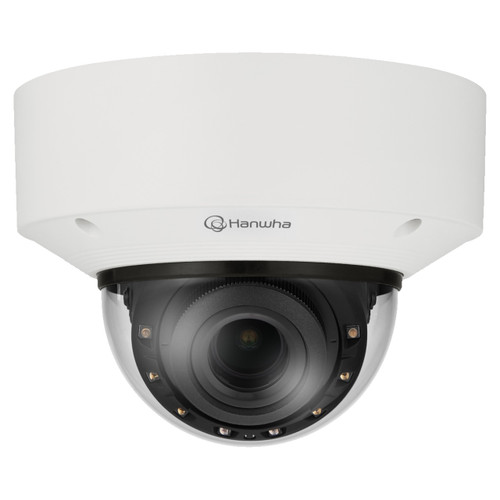
Both the Hanwha XNV-C9083R and the XNV-9082R are 8MP (3840×2160) outdoor fixed vandal dome cameras in the Wisenet lineup, offering motorized varifocal lenses, WiseIR at 40 m, 120 dB extremeWDR, PoE Class 3 power, and IK10-class impact resistance. Buyers evaluating either camera for perimeter surveillance, parking structures, or industrial yards will find them dimensionally close on paper, but meaningfully different in sensor size, lens range, smart-codec generation, AI analytics depth, physical ruggedness certification, and Ethernet throughput.
In This Guide
How do the imaging specs compare?
The C9083R uses a larger 1/1.8" progressive CMOS sensor versus the XNV-9082R's 1/2.8" sensor. The larger sensor in the C9083R produces a lower minimum color illumination of 0.04 Lux compared to 0.05 Lux on the 9082R — a marginal but measurable advantage in near-dark conditions. Both reach 0 Lux with IR active and both achieve 30 fps at full 8MP. The C9083R's P-iris (IR-corrected) lens spans 4.4–9.3 mm at 2.1× motorized zoom (max aperture F1.3 wide), while the 9082R's DC Auto Iris / P-iris lens covers a wider 2.8–8.4 mm range at 3× zoom (max aperture F1.2 wide). The 9082R's wider aperture at the wide end (F1.2 vs F1.3) offers a slight light-gathering edge, and its 3× zoom ratio provides greater telephoto reach in the Tele DORI band: Detect at 211 m (Tele) vs 176.6 m on the C9083R.
Both cameras deliver 120 dB extremeWDR and support BLC, HLC, and SSDR. Digital noise reduction differs: the C9083R adds AI-based WiseNR II on top of SSNR V, while the 9082R ships with SSNR V only. The C9083R also supports Digital Image Stabilization via built-in gyro sensor; so does the 9082R. Both offer Defog, LDC, Flip/Mirror/Hallway view, and the same electronic shutter floor of 1/12,000 s. WDR performance is spec-identical at 120 dB on both units.
What about installation and environment?
The XNV-9082R carries a more demanding environmental certification set: IP66/IP67/IP6K9K, IK10+, and NEMA 4X. IP6K9K (ISO 20653) certifies resistance to high-pressure, high-temperature washdowns — relevant for food processing, transit, and coastal industrial sites. IK10+ exceeds the standard IK10 rating. The C9083R is rated IP66/IP67 and IK10 (standard), with NEMA 4X — solid for outdoor general use but not rated for high-pressure washdown. Operating temperature also differs significantly: the 9082R is rated –50 °C to +60 °C, while the C9083R is rated –40 °C to +55 °C. For extreme-cold or desert-heat deployments, the 9082R's wider thermal envelope is a concrete advantage.
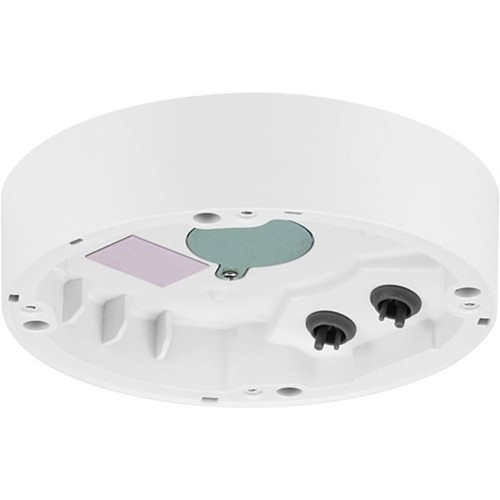
Both cameras draw the same maximum 12.95 W and are powered by PoE IEEE 802.3af Class 3 or 12 VDC. The 9082R additionally accepts 24 VAC (via accessory), giving installers a legacy-power fallback the C9083R does not list. The 9082R ships with a Gigabit Ethernet port (10/100/1000BASE-T), while the C9083R tops out at 10/100BASE-T — relevant in high-bandwidth multi-stream or future-proofing contexts. The 9082R is physically larger and heavier (ø180×125 mm, 1,900 g) versus the C9083R (ø160×118 mm, 1,450 g) and uses a 3/4" conduit knockout (M25) compared to the C9083R's 1/2" (M20). Each ships with a model-specific hanging mount (SBP-187HMW vs SBP-167HMW).
Which fits your VMS and analytics better?
Both cameras support ONVIF Profile S/G/T, SUNAPI, and the Wisenet open platform, so either integrates with major VMS platforms. The C9083R adds ONVIF Profile M, which is the newer metadata profile enabling standardized AI event streaming (object classification metadata over ONVIF) — the 9082R does not list Profile M in the provided specs. The C9083R's analytics engine is explicitly AI-powered: it classifies Person, Face, Vehicle (with sub-type: car/bus/truck/motorcycle/bicycle), and License Plate, and supports Business Intelligence features (AI-powered people counting, queue management, heatmap). The 9082R lists traditional video analytics — Defocus detection, Directional detection, Appear/Disappear, Enter/Exit, Loitering, Tampering, Fog detection, Virtual line, Audio detection, Sound classification, and Shock detection — as well as people counting, queue management, and heatmap, but its analytics are not described as AI-engine-based in the provided specs.
For edge storage, the 9082R offers a dual-slot microSD configuration supporting up to 1 TB (512 GB × 2), while the C9083R provides a single slot capped at 512 GB. Both support SD/SDHC/SDXC. The C9083R supports WiseStream II and WiseStream III smart codecs; the 9082R supports Manual (5-area) and WiseStream II only — WiseStream III is not listed for the 9082R. Audio I/O specs are identical on both: selectable mic/line in and line out. Both units carry identical protocol stacks including MQTT, SRTP, SNMPv1/v2c/v3, and full IPv4/IPv6 support. RAM and Flash are identical: 4 GB RAM / 512 MB Flash.
Which should you choose: the C9083R or the XNV-9082R?
Our take: The C9083R is the stronger choice when the deployment prioritizes AI-driven object classification, ONVIF Profile M metadata streaming, or next-generation codec efficiency (WiseStream III). Its 1/1.8" sensor is larger than the 9082R's 1/2.8", its analytics engine explicitly classifies vehicle sub-types and license plates, and it adds WiseStream III for bandwidth-constrained networks. The XNV-9082R is the stronger choice for physically demanding environments: its IP6K9K high-pressure washdown certification and IK10+ impact rating exceed what the C9083R specifies, its operating range extends to –50 °C vs –40 °C, it offers a 3× zoom ratio (vs 2.1×) for greater standoff identification reach (Tele Detect: 211 m vs 177 m), dual-slot storage doubling onboard capacity to 1 TB, Gigabit Ethernet, and a 24 VAC legacy-power option. Choose the C9083R for smart-city or retail analytics; choose the 9082R for coastal, industrial, or transit infrastructure subject to washdown or severe impact.
Side-by-Side Comparison
Spec-for-spec, from manufacturer data.
| Specification | Hanwha C9083R | Hanwha XNV-9082R |
|---|---|---|
| Resolution | 3840×2160 (8MP) | 3840×2160 (8MP) |
| Image Sensor | 1/1.8" progressive CMOS | 1/2.8" progressive CMOS |
| Focal Length / Zoom | 4.4–9.3 mm, 2.1× motorized varifocal | 2.8–8.4 mm, 3× motorized varifocal |
| Max Aperture (Wide) | F1.3 | F1.2 |
| Min. Illumination (Color / IR) | 0.04 Lux / 0 Lux | 0.05 Lux / 0 Lux |
| IR Range | WiseIR 40 m (131 ft) | WiseIR 40 m (131 ft) |
| WDR | extremeWDR 120 dB | extremeWDR 120 dB |
| Max Frame Rate | 30 fps @ 8MP | 30 fps @ 8MP |
| Video Compression | H.265, H.264, MJPEG | H.265, H.264, MJPEG |
| Smart Codec | WiseStream II, WiseStream III | WiseStream II (Manual 5-area) |
| IP Rating | IP66 / IP67 / NEMA 4X | IP66 / IP67 / IP6K9K / NEMA 4X |
| IK / Impact Rating | IK10 | IK10+ |
| Operating Temperature | –40 °C to +55 °C | –50 °C to +60 °C |
| Power Input | PoE 802.3af Class 3, 12 VDC | PoE 802.3af Class 3, 12 VDC, 24 VAC (accessory) |
| Ethernet | 10/100BASE-T | 10/100/1000BASE-T |
| Edge Storage | 1× microSD, max 512 GB | 2× microSD, max 1 TB (512 GB × 2) |
| ONVIF Profiles | S / G / T / M | S / G / T |
| Analytics Engine | AI-based (Person, Face, Vehicle sub-type, License Plate) | Traditional VCA (Loitering, Enter/Exit, Shock Detection, Sound Classification, etc.) |
| Noise Reduction | WiseNR II (AI) + SSNR V | SSNR V |
| Audio | Mic/Line in, Line out | Mic/Line in, Line out |
| Dimensions | ø160×118 mm | ø180×125 mm |
| Weight | 1,450 g (3.20 lb) | 1,900 g (4.19 lb) |
| Warranty | 3-year | 3-year |
Frequently Asked Questions
Which should you choose: the C9083R or the XNV-9082R?
The C9083R is the stronger choice when the deployment prioritizes AI-driven object classification, ONVIF Profile M metadata streaming, or next-generation codec efficiency (WiseStream III). Its 1/1.8" sensor is larger than the 9082R's 1/2.8", its analytics engine explicitly classifies vehicle sub-types and license plates, and it adds WiseStream III for bandwidth-constrained networks. The XNV-9082R is the stronger choice for physically demanding environments: its IP6K9K high-pressure washdown certification and IK10+ impact rating exceed what the C9083R specifies, its operating range extends to –50 °C vs –40 °C, it offers a 3× zoom ratio (vs 2.1×) for greater standoff identification reach (Tele Detect: 211 m vs 177 m), dual-slot storage doubling onboard capacity to 1 TB, Gigabit Ethernet, and a 24 VAC legacy-power option. Choose the C9083R for smart-city or retail analytics; choose the 9082R for coastal, industrial, or transit infrastructure subject to washdown or severe impact.
Is the C9083R or XNV-9082R better for low-light performance?
The C9083R has a larger 1/1.8" sensor and a slightly lower minimum color illumination (0.04 Lux vs 0.05 Lux on the 9082R). The 9082R's lens opens to F1.2 at the wide end versus F1.3 on the C9083R, which partially offsets the sensor-size difference. Both reach 0 Lux with IR active and share the same 40 m WiseIR range. For color low-light the C9083R has a marginal sensor advantage; real-world difference will be small.
Can the XNV-9082R handle industrial washdowns or high-humidity coastal sites that the C9083R cannot?
Yes, based on provided specs. The 9082R is rated IP6K9K (ISO 20653 high-pressure, high-temperature water jet resistance) and IK10+, certifications not listed for the C9083R. The 9082R also carries a wider operating temperature range (–50 °C to +60 °C vs –40 °C to +55 °C). For coastal industrial, transit terminal, or food-processing environments requiring washdown tolerance, the 9082R's certification set is more appropriate.
Does the C9083R support AI analytics that the XNV-9082R does not?
Based on the provided specifications, yes. The C9083R's analytics are explicitly described as AI-engine-based and include classified object detection for Person, Face, Vehicle (with sub-types: car, bus, truck, motorcycle, bicycle), and License Plate, plus DetectionShot. It also lists ONVIF Profile M for standardized metadata streaming. The 9082R's analytics include traditional event rules (loitering, enter/exit, tampering, shock detection, sound classification) and people counting/heatmap, but the provided specs do not describe its analytics as AI-engine-based and do not list Profile M or license plate detection.
Get a Second Opinion on Your Camera Choice
Share your site layout, coverage goals, and budget. Our team will validate the camera selection, flag anything we would change, and recommend products that match the use case.