
Hanwha C8303RW vs i-PRO X66600-Z3LS: Specification Comparison
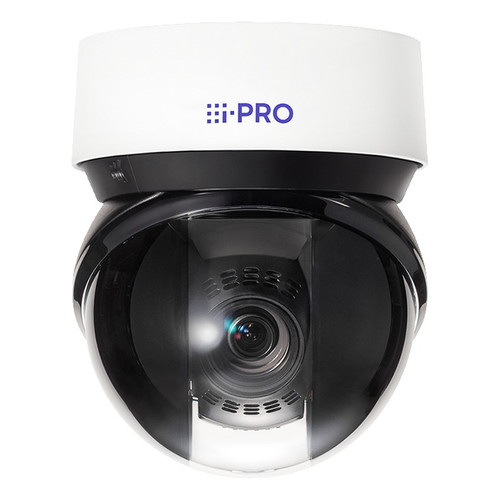
Both the Hanwha XNP-C8303RW and i-PRO WV-X66600-Z3LS are outdoor 6MP AI PTZ dome cameras targeting perimeter surveillance at similar resolution and zoom ratios. Each ships with 30x optical zoom, PoE++ power, IP66/IK10 ratings, and on-board AI analytics, making them genuine cross-shop candidates for integrators specifying long-range PTZ installations. The comparison below is drawn strictly from published specifications for both models.

In This Guide
How do the imaging specs compare?
Both cameras use a 1/2.8" CMOS sensor and deliver 3328×1872 (6MP) resolution at up to 60fps. The XNP-C8303RW specifies 30x optical zoom across a 5–150mm focal length at F1.6 (wide) to F4.56 (tele), yielding a wide-end horizontal FoV of 57.42°. The WV-X66600-Z3LS covers 4.5–135mm at F1.8 (wide) to F4.7 (tele), with a horizontal FoV of 62° (wide) to 2.5° (tele), and adds an extended digital zoom to 78x when resolution drops to 1280×720. Color minimum illumination is 0.1 Lux on both units; the i-PRO also quotes 0.1 Lux (BW) but does not separately publish a color Lux floor in the provided specs.
WDR is a meaningful differentiator: Hanwha claims Extreme WDR at 120dB, while i-PRO's Super Dynamic reaches a stated maximum of 132dB (at level 31). IR illumination diverges significantly — the XNP-C8303RW is rated for Wise IR at 200m (656ft), while the WV-X66600-Z3LS is rated 280m at 30IRE / 200m at 50IRE. DORI detection distances also differ: at tele, the Hanwha reaches 3,482m detect vs. the i-PRO's 3,050m detect, reflecting the Hanwha's slightly longer focal length. Both include built-in gyro-based digital image stabilization and IR cut filter (ICR) for day/night operation.
What about installation and environment?
Both cameras carry IP66 and IK10 ratings and are certified to NEMA-TS2 (vibration/shock). The i-PRO spec sheet additionally lists NEMA 4X explicitly under its IP rating field; the Hanwha lists NEMA4X under its certification field (EN IEC 63000; IEC 60529 IP66; NEMA 250 type 4X), so both meet that standard. Operating temperature ranges diverge: the XNP-C8303RW is rated –40°C to +55°C (power-on), while the WV-X66600-Z3LS is rated –30°C to +60°C (power-on) with a storage/ambient spec of –50°C to +60°C. The Hanwha's lower cold-start threshold (–40°C vs. –30°C) is relevant for northern or high-altitude deployments. The i-PRO adds a stated wind resistance rating of up to 40m/s (~89mph), which the Hanwha spec does not publish.
Power draw differs: Hanwha specifies typical 26W / max 46W via PoE++ (802.3bt Class 6); i-PRO specifies 45.9W via PoE++ 54V. Both require an 802.3bt-capable injector or switch port. The Hanwha includes the PoE++ injector in the package per its spec listing. Form factor also differs in footprint: the XNP-C8303RW measures ø184.9×318.8mm and weighs 5,600g; the WV-X66600-Z3LS measures ø167mm×205mm(H) and weighs approximately 3,000g — the i-PRO is meaningfully more compact and lighter, which matters for pole or parapet installations. The Hanwha also includes an integrated wiper and lens heater; no wiper or heater is listed in the i-PRO specifications.
Which fits your VMS and analytics better?
Both cameras support ONVIF Profiles G, M, S, and T, and both support H.265, H.264, and MJPEG compression with VBR/CBR control. The XNP-C8303RW supports up to 20 unicast users and 128 multicast users across up to 10 stream profiles; the WV-X66600-Z3LS supports up to 14 simultaneous users. Hanwha includes its WiseStream II/III smart codec; i-PRO uses GOP control-based smart coding. The Hanwha additionally lists SUNAPI and Wisenet native API; i-PRO does not publish a proprietary SDK name in the provided specs. Edge storage on the Hanwha uses dual microSD slots supporting up to 1TB (2×512GB); the i-PRO supports a single microSD slot up to 512GB (64GB–512GB SDXC). Both support MQTT and SNMPv1/v2/v3.
On AI analytics, Hanwha classifies Person, Face, Vehicle (with sub-type: car/bus/truck/motorcycle/bicycle), and License Plate, and includes AI auto-tracking, virtual line crossing, virtual area loitering, and DetectionShot. i-PRO's analytics cover AI motion, face, people, and vehicle detection, and uniquely adds AI Sound Classification (gunshot, yell, vehicle horn, glass break) via its built-in audio pipeline. The i-PRO includes 3.5mm stereo audio input and output jacks and 3 alarm inputs / 1 alarm output; the Hanwha's alarm I/O requires an optional SPM-4210 I/O box per the spec notes. Security credentials also differ: Hanwha publishes TPM 2.0 with FIPS 140-2 Level 2 certification and a device certificate tied to Hanwha Private Root CA; i-PRO lists signed firmware but does not cite a TPM or FIPS level in the provided specs.
Which should you choose: the C8303RW or the X66600-Z3LS?
Our take: The XNP-C8303RW is the stronger choice when cold-start temperature, built-in wiper/heater, dual-slot storage, or license plate analytics are primary requirements; the WV-X66600-Z3LS is the stronger choice when compact/lightweight mounting, longer-range IR illumination, audio event detection, or a higher stated WDR ceiling are priorities. Three concrete spec deltas: (1) IR range — i-PRO 280m at 30IRE vs. Hanwha 200m; (2) cold-start operating temperature — Hanwha –40°C vs. i-PRO –30°C; (3) edge storage — Hanwha dual-slot up to 1TB vs. i-PRO single-slot up to 512GB. Warranty terms also differ: i-PRO publishes a 5-year warranty vs. Hanwha's 3-year warranty. Integrators on Hanwha/Wisenet VMS platforms will leverage WiseStream and SUNAPI natively; i-PRO installations benefit from the onboard audio classification, particularly in city surveillance or critical-infrastructure contexts.
Side-by-Side Comparison
Spec-for-spec, from manufacturer data.
| Specification | Hanwha C8303RW | i-PRO X66600-Z3LS |
|---|---|---|
| Resolution | 6MP (3328×1872) | 6MP (3328×1872) |
| Image Sensor | 1/2.8" CMOS | Approx. 1/2.8" type CMOS |
| Focal Length / Optical Zoom | 5–150mm / 30x optical | 4.5–135mm / 30x optical (78x extended at 720p) |
| Max Aperture (Wide) | F1.6 | F1.8 |
| Min. Illumination | 0.1 Lux color / 0 Lux IR | 0.1 Lux (BW); color floor not specified |
| IR Range | 200m (Wise IR) | 280m @ 30IRE / 200m @ 50IRE |
| WDR | 120dB (Extreme WDR) | 132dB max (Super Dynamic, level 31) |
| Max Frame Rate | 60fps | 60fps |
| Pan Speed (Preset) | Max 500°/s | 700°/s |
| Tilt Speed (Preset) | Max 350°/s | 500°/s |
| Video Compression | H.265, H.264, MJPEG | H.265, H.264, MJPEG (JPEG) |
| IP / Impact Rating | IP66 / IK10 / NEMA 4X | IP66 / IK10 / NEMA 4X |
| Operating Temperature (Power-On) | –40°C to +55°C | –30°C to +60°C |
| Power Input / PoE Class | PoE++ 802.3bt, Class 6; Max 46W | PoE++ 54V, 45.9W; Class 6 |
| Edge Storage | Dual microSD, up to 1TB (2×512GB) | Single microSD, up to 512GB |
| Audio I/O | Not listed (I/O box required for alarm) | 3.5mm stereo in/out; 3 alarm in / 1 alarm out |
| Integrated Wiper / Heater | Yes (wiper + lens heater) | Not specified |
| AI Analytics | Person, Face, Vehicle (sub-type), License Plate, Auto-Track | Motion, Face, People, Vehicle; AI Sound Classification |
| ONVIF Profiles | G / M / S / T | G / M / S / T |
| Dimensions (H) | ø184.9×318.8mm / 5,600g | ø167×205mm / ~3,000g |
| Warranty | 3-year | 5-year |
Frequently Asked Questions
Which should you choose: the C8303RW or the X66600-Z3LS?
The XNP-C8303RW is the stronger choice when cold-start temperature, built-in wiper/heater, dual-slot storage, or license plate analytics are primary requirements; the WV-X66600-Z3LS is the stronger choice when compact/lightweight mounting, longer-range IR illumination, audio event detection, or a higher stated WDR ceiling are priorities. Three concrete spec deltas: (1) IR range — i-PRO 280m at 30IRE vs. Hanwha 200m; (2) cold-start operating temperature — Hanwha –40°C vs. i-PRO –30°C; (3) edge storage — Hanwha dual-slot up to 1TB vs. i-PRO single-slot up to 512GB. Warranty terms also differ: i-PRO publishes a 5-year warranty vs. Hanwha's 3-year warranty. Integrators on Hanwha/Wisenet VMS platforms will leverage WiseStream and SUNAPI natively; i-PRO installations benefit from the onboard audio classification, particularly in city surveillance or critical-infrastructure contexts.
Is the XNP-C8303RW or WV-X66600-Z3LS better for low-light and IR coverage?
Both cameras share a 0.1 Lux color minimum illumination spec and 1/2.8" CMOS sensors. For raw IR reach, the i-PRO WV-X66600-Z3LS has the advantage: it is rated at 280m at 30IRE versus the Hanwha XNP-C8303RW's 200m Wise IR rating. If IR distance is the primary low-light criterion, the i-PRO reaches farther; both are equivalent on stated color Lux floor.
Which camera handles extreme weather and temperature better?
Both are rated IP66 and IK10 and meet NEMA 4X. For cold climates, the Hanwha XNP-C8303RW operates down to –40°C (power-on) versus the i-PRO WV-X66600-Z3LS's –30°C power-on minimum — a 10°C advantage in harsh northern deployments. The Hanwha also includes an integrated wiper and lens heater for precipitation management, which is not listed in the i-PRO's specifications. The i-PRO does publish a wind resistance rating of up to 40m/s (~89mph); the Hanwha does not publish a wind resistance figure.
Can either camera record audio, and which has better on-board analytics?
The i-PRO WV-X66600-Z3LS includes 3.5mm stereo audio input and output jacks and adds AI Sound Classification for gunshot, yell, vehicle horn, and glass break — capabilities not listed in the Hanwha XNP-C8303RW specifications. The Hanwha's alarm I/O also requires an optional SPM-4210 I/O box per its spec notes, while the i-PRO includes 3 alarm inputs and 1 alarm output natively. For video analytics depth, the Hanwha adds vehicle sub-type classification (car/bus/truck/motorcycle/bicycle), license plate detection, and virtual line/area events; i-PRO's video analytics cover motion, face, people, and vehicle but do not list license plate or vehicle sub-type in the provided specs.
Get a Second Opinion on Your Camera Choice
Share your site layout, coverage goals, and budget. Our team will validate the camera selection, flag anything we would change, and recommend products that match the use case.