
Hanwha C8253 vs i-PRO S66600-Z3N: Specification Comparison
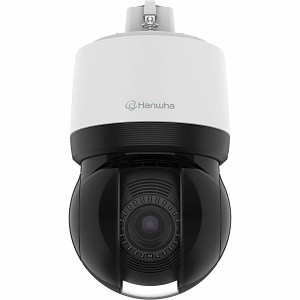
Both the Hanwha XNP-C8253 and the i-PRO WV-S66600-Z3N are 6MP outdoor AI PTZ dome cameras aimed at wide-area surveillance deployments requiring long-range optical zoom, fast pan/tilt tracking, and AI-assisted analytics. Installers and IT buyers evaluating either model are likely specifying a single follow-me PTZ for perimeter, parking, or campus coverage. This comparison draws exclusively from the published specifications for each model to highlight where the two converge and where they diverge on imaging, installation, and integration.
In This Guide
How do the imaging specs compare?
Both cameras use a 1/2.8" CMOS sensor at 6MP resolution. The XNP-C8253 provides an explicit pixel-level resolution of 3328×1872 and a 5–125mm DC auto-iris lens delivering 25× optical zoom (plus 32× digital for a stated 800× total). The WV-S66600-Z3N offers 30× optical zoom from a 4.5mm wide-end focal length, giving it a 20% zoom-ratio advantage at the tele end. Maximum frame rate for the Hanwha is specified at 30fps at 6MP; i-PRO does not publish a frame-rate figure in the provided specs. The Hanwha separately lists a 60fps feature flag, but the per-resolution spec caps at 30fps@6MP — buyers should verify the actual 60fps operating resolution with Hanwha.
In low light, the XNP-C8253 specifies 0.1 lux color and 0.01 lux B/W with built-in IR effective to 5m and 120dB Extreme WDR. The WV-S66600-Z3N specifies approximately 0.13 lux color, IR range of 3.0m, and a higher 132dB WDR rating. The i-PRO unit's wider dynamic range (132dB vs 120dB) is an advantage in high-contrast scenes such as entrance canopies or loading docks with mixed artificial and daylight. The Hanwha's lower minimum illumination figure (0.01 lux B/W vs. a B/W figure not stated for the i-PRO) and longer stated IR range (5m vs. 3.0m) favor it in completely unlit environments, though both rely on optical IR rather than thermal. The Hanwha also documents a built-in gyro-based digital image stabilization; the i-PRO lists image stabilization as supported but does not specify gyro-based implementation.
What about installation and environment?
Both cameras are rated IP66 and IK10, making them suitable for outdoor exposed mounting with vandal resistance. The Hanwha additionally carries NEMA 4X and NEMA-TS 2 (2.2.7, 2.2.8, 2.2.9) certifications, which are relevant for U.S. traffic and roadway deployments. The XNP-C8253 operates from −40°C to +55°C; the WV-S66600-Z3N's operating temperature is not provided in the supplied specs (a storage temperature of −50°C to +60°C is listed, but that is not the operating range). Installers must confirm the i-PRO's operating temperature range directly from the i-PRO datasheet before specifying it in extreme-climate sites.
Power requirements differ meaningfully: the XNP-C8253 draws up to 25.5W and is powered by PoE+ (IEEE 802.3at, Class 4). The WV-S66600-Z3N requires PoE++ (IEEE 802.3bt, Class 6), which demands a switch or injector capable of delivering higher wattage — an infrastructure cost that must be factored into switch upgrades. The Hanwha weighs 3,200g (7.05 lb) with an aluminum body and polycarbonate head; the i-PRO weighs approximately 3kg with an aluminum die-cast body and polycarbonate dome. Hanwha publishes an extensive compatible accessory list covering hanging, ceiling, wall, pole, in-ceiling, parapet, corner, and cabinet mounts. The i-PRO's provided specs list wall, ceiling, and rack mount types only; additional mount accessories are not enumerated. The Hanwha also includes a water-removal feature (spin dry + lens heater) not mentioned in the i-PRO specs.
Which fits your VMS and analytics better?
Both cameras support ONVIF (the i-PRO confirms ONVIF; the Hanwha supports ONVIF Profile S/G/T/M), H.265, H.264, and MJPEG compression, and on-board microSD storage. The Hanwha XNP-C8253 supports ONVIF Profiles S, G, T, and M — a broader profile set than the i-PRO's stated ONVIF compliance (profile specifics not listed for the i-PRO). The Hanwha also adds WiseStream II/III smart codecs and supports up to 10 simultaneous streaming profiles with unicast for 20 users and multicast for 128 users; equivalent i-PRO streaming figures are not provided. Network protocol support on the Hanwha is extensive (MQTT, NTCIP1205, SNMPv1/v2c/v3, SRTP, and more); the i-PRO's protocol list is not enumerated in the supplied specs.
On analytics, the Hanwha XNP-C8253 includes built-in AI classification for persons, faces, vehicles, and license plates, with auto-tracking of persons and vehicles, virtual line crossing, virtual area detection, and up to 32 privacy mask zones. The WV-S66600-Z3N is specified to support up to 3 edge AI analytic apps and includes facial recognition; however, the list of available apps, whether they are bundled or licensed separately, and whether auto-tracking is included are not detailed in the provided specs. Audio input is documented for the i-PRO; the Hanwha's alarm events reference audio capability via an optional I/O box but audio input/output are not independently confirmed in the spec sheet provided. Hanwha's edge storage supports dual microSD slots up to 1TB (512GB×2); the i-PRO lists microSD support without specifying capacity or slot count. Security features are more fully documented for the Hanwha (TPM, FIPS 140-2 Level 2, secure boot, signed firmware, AES encryption, 802.1X); the i-PRO confirms signed firmware and HTTPS but does not enumerate equivalent security stack details.
Which should you choose: the C8253 or the S66600-Z3N?
Our take: The XNP-C8253 is the stronger choice when installation infrastructure, compliance certifications, VMS integration breadth, and fully documented analytics matter most. Concretely: (1) The Hanwha operates on PoE+ (Class 4, max 25.5W) versus the i-PRO's PoE++ (Class 6) requirement, reducing switch upgrade costs on existing 802.3at infrastructure. (2) The Hanwha ships with NEMA 4X and NEMA-TS 2 certifications and a documented operating range of −40°C to +55°C — critical for U.S. traffic/roadway applications — while the i-PRO's operating temperature range is not stated in the provided specs. (3) The Hanwha provides a fully detailed analytics suite (auto-tracking, LPR, virtual line/area) and ONVIF Profiles S/G/T/M out of the box; the i-PRO supports up to 3 edge AI apps but their scope and licensing terms are unspecified here. The i-PRO's 132dB WDR and 30× optical zoom are genuine advantages for high-contrast or long-range scenes — buyers prioritizing those two specs should request the i-PRO's full datasheet to verify operating temperature and analytic licensing before deciding.
Side-by-Side Comparison
Spec-for-spec, from manufacturer data.
| Specification | Hanwha C8253 | i-PRO S66600-Z3N |
|---|---|---|
| Resolution | 6MP (3328×1872) | 6MP (exact pixel dimensions not stated) |
| Image Sensor | 1/2.8" CMOS | 1/2.8" CMOS |
| Optical Zoom | 25× (5–125mm DC auto-iris) | 30× (4.5mm wide end) |
| Digital Zoom | 32× (total 800×) | — |
| Min. Illumination (Color) | 0.1 lux | ~0.13 lux |
| Min. Illumination (B/W) | 0.01 lux | — |
| IR Range | 5m | 3.0m |
| Wide Dynamic Range | 120dB Extreme WDR | 132dB WDR |
| Max Frame Rate | 30fps @ 6MP (60fps feature listed) | — |
| Pan Speed (Max) | 700°/s | Up to 700°/s |
| Tilt Speed (Max) | 500°/s | Up to 500°/s |
| Video Compression | H.265 / H.264 / MJPEG | H.265 / H.264 / MJPEG |
| IP Rating | IP66 | IP66 |
| Impact Rating | IK10 | IK10 |
| Additional Certifications | NEMA 4X, NEMA-TS 2, UL 62368-1 | — |
| Power Input / PoE Class | PoE+ (802.3at, Class 4) — max 25.5W | PoE++ (802.3bt, Class 6) |
| Operating Temperature | −40°C to +55°C | — |
| Edge Storage | Dual microSD up to 1TB (512GB×2) | microSD (capacity/slots not stated) |
| ONVIF Profiles | S / G / T / M | Yes (profiles not specified) |
| Audio | — (optional I/O box referenced) | Audio input confirmed |
| Image Stabilization | Yes (built-in gyro) | Yes (implementation not specified) |
| Weight | 3,200g (7.05 lb) | ~3kg (~6.6 lb) |
| Warranty | 3 years | — |
Frequently Asked Questions
Which should you choose: the C8253 or the S66600-Z3N?
The XNP-C8253 is the stronger choice when installation infrastructure, compliance certifications, VMS integration breadth, and fully documented analytics matter most. Concretely: (1) The Hanwha operates on PoE+ (Class 4, max 25.5W) versus the i-PRO's PoE++ (Class 6) requirement, reducing switch upgrade costs on existing 802.3at infrastructure. (2) The Hanwha ships with NEMA 4X and NEMA-TS 2 certifications and a documented operating range of −40°C to +55°C — critical for U.S. traffic/roadway applications — while the i-PRO's operating temperature range is not stated in the provided specs. (3) The Hanwha provides a fully detailed analytics suite (auto-tracking, LPR, virtual line/area) and ONVIF Profiles S/G/T/M out of the box; the i-PRO supports up to 3 edge AI apps but their scope and licensing terms are unspecified here. The i-PRO's 132dB WDR and 30× optical zoom are genuine advantages for high-contrast or long-range scenes — buyers prioritizing those two specs should request the i-PRO's full datasheet to verify operating temperature and analytic licensing before deciding.
Is the XNP-C8253 or WV-S66600-Z3N better for low-light performance?
The Hanwha XNP-C8253 specifies a lower minimum illumination (0.1 lux color / 0.01 lux B/W) and longer built-in IR range (5m) versus the i-PRO's 0.13 lux color and 3.0m IR. However, the i-PRO's 132dB WDR exceeds the Hanwha's 120dB, which is more relevant in mixed-lighting or high-contrast environments. For completely dark scenes the Hanwha's published figures edge ahead; for scenes with bright artificial lighting combined with shadow, the i-PRO's wider dynamic range is the advantage. The i-PRO's B/W minimum illumination is not stated in the provided specs, so a direct apples-to-apples low-light comparison cannot be fully completed without the i-PRO datasheet.
Can both cameras run on a standard PoE switch, or do I need to upgrade my infrastructure?
No — they have different power requirements. The XNP-C8253 uses PoE+ (IEEE 802.3at, Class 4, up to 25.5W), which is supported by the majority of installed managed switches. The WV-S66600-Z3N requires PoE++ (IEEE 802.3bt, Class 6), which delivers higher wattage and is only available on switches or injectors that explicitly support 802.3bt. If your existing switch fabric is 802.3at-only, deploying the i-PRO will require switch replacement or per-port 802.3bt injectors — a cost that should be included in the project budget.
Which camera gives me more optical zoom reach — the XNP-C8253 or the WV-S66600-Z3N?
The WV-S66600-Z3N provides 30× optical zoom versus the XNP-C8253's 25× optical zoom, a 20% advantage at the tele end. At tele, the Hanwha's Identify range (DORI 250PPM) is specified at 281.4m and its Detect range at 2,813.9m. Equivalent DORI figures are not published for the i-PRO in the provided specs, so a direct range comparison cannot be completed from available data alone. Buyers with coverage distances where those extra five zoom increments matter — such as very large open perimeters — should request the i-PRO's DORI table from i-PRO before finalizing the specification.
Get a Second Opinion on Your Camera Choice
Share your site layout, coverage goals, and budget. Our team will validate the camera selection, flag anything we would change, and recommend products that match the use case.