
Hanwha C7083RVD vs i-PRO S35402-F2LG: Specification Comparison
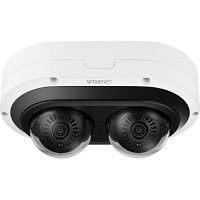
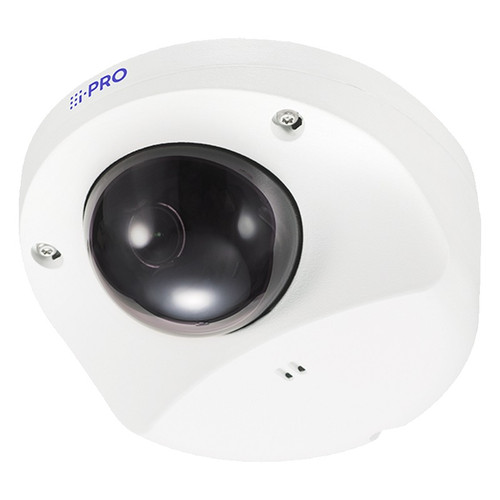
Both the Hanwha PNM-C7083RVD and i-PRO WV-S35402-F2LG are outdoor-rated 4MP dome IP cameras aimed at the same resolution tier, but they diverge sharply in lens design, IR reach, power budget, and analytics architecture. The Hanwha is a dual-sensor motorized varifocal model with a higher PoE draw and longer IR throw; the i-PRO is a compact fixed-lens unit drawing under 9 W with a wider native field of view. This comparison covers imaging, installation, and integration trade-offs drawn strictly from published specifications.
In This Guide
How do the imaging specs compare?
The Hanwha PNM-C7083RVD uses two 1/2.8" CMOS sensors, each delivering 2MP (1920×1080) at 30 fps, for a combined 4MP dual-channel output. Its motorized varifocal lens spans 3–6 mm (2× optical zoom), yielding a horizontal field of view that adjusts from 107° (wide) to 56° (tele). Minimum illumination is 0.035 lux in color with IR active down to 0 lux; IR illumination reaches 15 m typical, 25 m scene-dependent. Extreme WDR is rated at 120 dB. The i-PRO WV-S35402-F2LG uses a single 1/2.8" CMOS sensor producing 4MP at 25/30 fps, with resolutions up to 2560×1440 (16:9) or 2048×1536 (4:3). Its fixed 2.4 mm lens covers 121° H / 68° V with no optical zoom. Minimum illumination is 0.19 lux color / 0.16 lux B&W (at 30 IRE); IR reach is 14 m high / 10 m medium. Super Dynamic WDR is rated at 132 dB max.
On paper, the i-PRO edges out the Hanwha in peak WDR headroom (132 dB vs. 120 dB) and delivers a single-stream 4MP image versus the Hanwha's dual-channel 2MP architecture, which matters for VMS channel licensing. The Hanwha's motorized varifocal lens provides optical zoom and remote focus adjustment that the fixed-lens i-PRO cannot match; conversely, the i-PRO's 2.4 mm lens delivers a 121° H field of view that exceeds the Hanwha's widest setting of 107° H. The Hanwha's published IR distance (25 m scene-dependent) is meaningfully longer than the i-PRO's 14 m high-power figure.
What about installation and environment?
Both cameras are rated IP66 and IK10, and both carry NEMA 4X compliance, making them equally suitable for exposed outdoor installations subject to high-pressure wash-down and physical impact. Operating temperature ranges differ slightly: the Hanwha is specified from -40°C to +55°C, while the i-PRO is rated -40°C to +50°C — a 5°C advantage at the high end for the Hanwha in heat-stressed environments. The i-PRO additionally publishes a wind resistance spec of up to 40 m/s (≈89 mph), which the Hanwha specification does not include.
Power requirements diverge significantly. The Hanwha requires PoE+ (IEEE 802.3at, Class 4) with a maximum draw of 20 W (typical 15.5 W), demanding a PoE+ capable switch port. The i-PRO operates on standard PoE (IEEE 802.3af, PoE Class 0) at a maximum of 8.6 W — less than half the Hanwha's peak draw — which lowers infrastructure cost and expands compatible switch options. The Hanwha is notably larger (215 × 135 × 93.2 mm, 1,330 g) compared to the i-PRO's compact footprint (109 × 119 × 53 mm, 475 g), a relevant factor in flush-mount or ceiling-tile installations. The Hanwha includes a micro USB video output (1280×720) for installation alignment; the i-PRO specification does not list an equivalent.
Which fits your VMS and analytics better?
The Hanwha PNM-C7083RVD supports ONVIF Profile S and T, Hanwha's SUNAPI (HTTP API), and an open platform SDK. It outputs 5 stream profiles per channel across two channels and supports unicast (up to 10 users) and multicast. Video compression covers H.265, H.264 (Main/Baseline/High), and MJPEG with CBR or VBR bitrate control. WiseStream II and III smart codec are included. On-board storage supports microSD/SDHC/SDXC up to 512 GB. The i-PRO WV-S35402-F2LG supports ONVIF Profiles G, M, S, and T — adding Profile G (edge recording) and Profile M (metadata/analytics) over the Hanwha's declared profiles. It supports up to 14 simultaneous users, H.265/H.264 with constant/variable bitrate, JPEG, and microSDXC/SDHC/SD up to 512 GB. The i-PRO also supports SFTP and MQTT in its protocol stack; the Hanwha specification does not list those protocols.
On analytics, both cameras embed AI-based detection. The Hanwha classifies person, face, vehicle (type: car/bus/truck/motorcycle/bicycle), and license plate, and supports virtual line crossing, virtual area loitering, and best-shot capture — all AI-engine driven. The i-PRO provides AI Motion Detection, Face, People, Vehicle, Mask/Non-Mask, and Occupancy Detection, and adds AI Sound Classification (gunshot, yell, vehicle horn, glass break) via a built-in microphone. Audio on the Hanwha requires the optional SPM-4210 I/O box; audio in and out are not native. The i-PRO has a built-in microphone and supports G.726, G.711, and additional audio compression natively. Security posture: the Hanwha includes TPM 2.0 (FIPS 140-2 Level 2), 802.1X (EAP-TLS/LEAP/PEAP), and a pre-installed Hanwha Techwin Root CA device certificate; the i-PRO lists signed firmware and 802.1X but does not publish a TPM specification in the provided data.
Which should you choose: the C7083RVD or the S35402-F2LG?
Our take: The PNM-C7083RVD is the stronger choice when the installation demands flexible optical zoom, longer IR coverage, or AI-based license plate and vehicle-type classification — while the WV-S35402-F2LG is the stronger choice when power budget, compact form factor, native audio, or broader ONVIF profile support (G/M/S/T) are the deciding factors. Key spec deltas: the Hanwha's motorized 3–6 mm lens versus the i-PRO's fixed 2.4 mm lens gives the Hanwha on-axis flexibility but the i-PRO a wider 121° H native view; the i-PRO's 132 dB Super Dynamic WDR exceeds the Hanwha's 120 dB extreme WDR; and the i-PRO's 8.6 W PoE (802.3af) draw is less than half the Hanwha's 20 W PoE+ requirement. For sites standardized on 802.3af infrastructure or requiring native audio and ONVIF Profile G edge recording, the i-PRO fits without a switch upgrade; for sites needing optical zoom, 25 m IR reach, or TPM 2.0 hardware security, the Hanwha is the appropriate specification.
Side-by-Side Comparison
Spec-for-spec, from manufacturer data.
| Specification | Hanwha C7083RVD | i-PRO S35402-F2LG |
|---|---|---|
| Resolution | 4MP dual-channel (2×2MP, 1920×1080 each) | 4MP single-stream (max 2560×1440) |
| Image Sensor | 1/2.8" CMOS × 2 channels | Approx. 1/2.8" CMOS × 1 channel |
| Lens / Focal Length | 3–6 mm motorized varifocal (2× optical zoom) | 2.4 mm fixed |
| Horizontal Field of View | 107° (wide) – 56° (tele) | 121° |
| Min. Illumination (Color) | 0.035 lux | 0.19 lux @ 30 IRE |
| Min. Illumination (B&W / IR) | 0 lux (IR on) | 0.16 lux B&W; 0 lux (IR on) |
| IR Range | 15 m typical; 25 m scene-dependent | 14 m (high); 10 m (medium) |
| WDR | 120 dB (extremeWDR) | 132 dB max (Super Dynamic Level 31) |
| Max Frame Rate | 30 fps @ 2MP per channel | 25/30 fps |
| Video Compression | H.265, H.264 (Main/Baseline/High), MJPEG | H.265, H.264, JPEG |
| IP Rating | IP66 / IP67, NEMA 4X | IP66, NEMA 4X |
| IK / Impact Rating | IK10 | IK10 |
| Operating Temperature | -40°C to +55°C | -40°C to +50°C |
| Power Input / PoE Class | PoE+ (802.3at, Class 4); max 20 W | PoE (802.3af, Class 0); max 8.6 W |
| ONVIF Profiles | S, T | G, M, S, T |
| Edge Storage | microSD/SDHC/SDXC, 1 slot, max 512 GB | microSDXC/SDHC/SD, max 512 GB |
| Audio | Via optional SPM-4210 I/O box only | Built-in microphone; G.726, G.711 native |
| AI Analytics | Person, Face, Vehicle (type), License Plate, Line/Area crossing, Loitering | AI Motion, Face, People, Vehicle, Mask/Non-Mask, Occupancy, AI Sound Classification |
| Hardware Security | TPM 2.0 (FIPS 140-2 Level 2), 802.1X, device certificate | Signed firmware, 802.1X; TPM not specified |
| Dimensions (W×D×H) | 215 × 135 × 93.2 mm (8.46" × 5.31" × 3.67") | 109 × 119 × 53 mm (4.30" × 4.69" × 2.09") |
| Weight | 1,330 g (2.93 lb) | 475 g (1.05 lb) |
| Warranty | 3 years | 5 years |
Frequently Asked Questions
Which should you choose: the C7083RVD or the S35402-F2LG?
The PNM-C7083RVD is the stronger choice when the installation demands flexible optical zoom, longer IR coverage, or AI-based license plate and vehicle-type classification — while the WV-S35402-F2LG is the stronger choice when power budget, compact form factor, native audio, or broader ONVIF profile support (G/M/S/T) are the deciding factors. Key spec deltas: the Hanwha's motorized 3–6 mm lens versus the i-PRO's fixed 2.4 mm lens gives the Hanwha on-axis flexibility but the i-PRO a wider 121° H native view; the i-PRO's 132 dB Super Dynamic WDR exceeds the Hanwha's 120 dB extreme WDR; and the i-PRO's 8.6 W PoE (802.3af) draw is less than half the Hanwha's 20 W PoE+ requirement. For sites standardized on 802.3af infrastructure or requiring native audio and ONVIF Profile G edge recording, the i-PRO fits without a switch upgrade; for sites needing optical zoom, 25 m IR reach, or TPM 2.0 hardware security, the Hanwha is the appropriate specification.
Is the PNM-C7083RVD or WV-S35402-F2LG better for low-light performance?
The Hanwha PNM-C7083RVD reaches a lower published color minimum illumination — 0.035 lux versus the i-PRO's 0.19 lux at 30 IRE — and its IR range extends to 25 m scene-dependent versus 14 m (high mode) for the i-PRO. Both cameras drop to 0 lux with IR active. For scenes with longer dark-area coverage, the Hanwha's IR throw is the larger differentiator; for WDR headroom in high-contrast lit scenes, the i-PRO's 132 dB rating exceeds the Hanwha's 120 dB.
Can I power the WV-S35402-F2LG from a standard PoE switch, or do I need PoE+?
The i-PRO WV-S35402-F2LG draws a maximum of 8.6 W and is specified as IEEE 802.3af (PoE Class 0) compliant, so a standard PoE switch port is sufficient. The Hanwha PNM-C7083RVD requires PoE+ (IEEE 802.3at, Class 4) and draws up to 20 W maximum, so it requires a PoE+ capable switch port. If your existing switch infrastructure is 802.3af only, the i-PRO avoids a switch upgrade.
Does either camera include built-in audio, or do I need extra hardware?
The i-PRO WV-S35402-F2LG includes a built-in microphone and supports G.726 (ADPCM 32/16 kbps), G.711 (64 kbps), and additional audio compression natively — no extra hardware required. The Hanwha PNM-C7083RVD does not include native audio in or out; both audio input and output require the optional SPM-4210 I/O box, which adds cost and installation complexity.
Get a Second Opinion on Your Camera Choice
Share your site layout, coverage goals, and budget. Our team will validate the camera selection, flag anything we would change, and recommend products that match the use case.