
Hanwha C4950TD vs i-PRO U85402-V2L: Specification Comparison
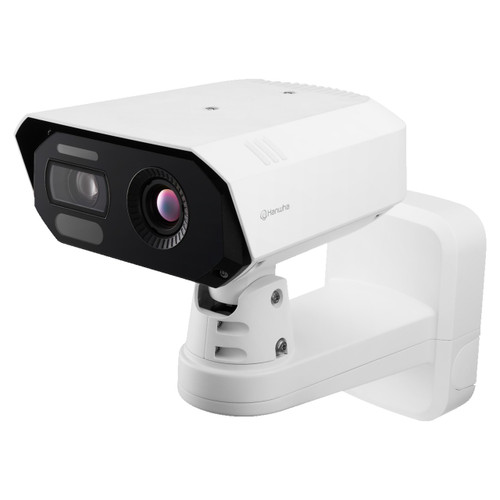
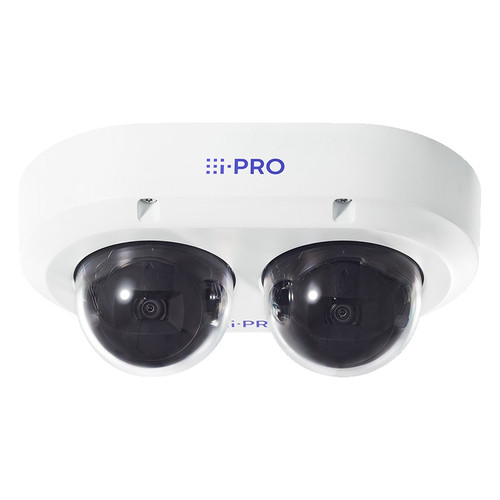
Both the Hanwha TNM-C4950TD and the i-PRO WV-U85402-V2L are dual-sensor, outdoor-rated fixed dome cameras aimed at perimeter protection and AI-assisted detection. The Hanwha pairs an 8MP visible sensor with an uncooled thermal sensor, while the i-PRO pairs two 4MP visible sensors with a 40-meter IR illuminator. Buyers evaluating premium outdoor AI domes for perimeter, detection, and 24/7 surveillance will encounter both products; the core trade-off is thermal night vision and fire/temperature analytics versus conventional IR with higher concurrent-user streaming.
In This Guide
How do the imaging specs compare?
The TNM-C4950TD's visible channel uses a 1/1.8" CMOS sensor delivering 8MP resolution at 30fps, with a 10.9–29mm motorized varifocal lens (2.6x zoom, F1.7–F1.73) and a minimum illumination of 0.06 lux color / 0.005 lux B/W. Its WDR is rated at 120dB. The thermal channel uses an uncooled micro-bolometer with a 13.5mm fixed lens, VGA resolution, <60mK NETD, 12µm pixel pitch, and detection color palettes including Whitehot, Blackhot, Rainbow, and Iron. Thermal-based DRI ranges reach 583.4m detect / 233.3m observe / 116.7m recognize / 58.3m identify at tele on the visible channel. The WV-U85402-V2L uses two 1/2.7" CMOS sensors each at 4MP (2688×1520), 30fps, with a 2.9–7.3mm motorized varifocal lens (2.5x optical zoom, F2.0–F3.0). Minimum illumination is 0.12 lux (B/W, 50IRE, F2.0, 1/30s). WDR (Super Dynamic) is rated at 108dB maximum. IR LEDs provide 40m illumination at 30IRE / 30m at 50IRE. DRI ranges for the i-PRO are significantly shorter: 136.5m detect / 54.6m observe / 27.3m recognize / 13.6m identify at tele.
In low-light and nighttime imaging, the Hanwha's thermal channel operates at 0 lux with no dependency on illumination, while the i-PRO relies on its 40m IR LEDs — effective for shorter-range targets but limited in range compared to thermal. The Hanwha's visible sensor also has a notably wider aperture (F1.0 thermal / F1.7 visible vs F2.0–F3.0 for the i-PRO), lower minimum illumination (0.005 lux B/W vs 0.12 lux), and higher WDR (120dB vs 108dB). The i-PRO offers digital noise reduction adjustable from 0–255 in granular steps, fog compensation at 0–8 levels, and adaptive black stretch (0–255), providing more tunable image processing controls in its specification. The i-PRO also supports extra digital zoom up to 10.5x at 640×360 resolution, versus the Hanwha's 2.6x optical only.
What about installation and environment?
Both cameras share an operating temperature range of -40°C to +60°C and carry IP66/IP67 and IK10 ratings, with NEMA 4X compliance on both. The Hanwha adds IP67 and NEMA TS 2 (2.2.8, 2.2.9) certification. The i-PRO adds UL (UL62368-1), c-UL, CE, IEC62368-1, FCC Part 15 Class A, ICES-003, and EN55032/EN55035, and specifically lists wind resistance up to 40 m/s (approx. 89 mph) — a specification not stated for the Hanwha. The i-PRO also incorporates an anti-condensation Temish element, not listed for the Hanwha.
Power input differs slightly in practice: both are PoE+ (IEEE 802.3at, Class 4), but the Hanwha draws up to 23.5W and also accepts 12VDC. The i-PRO draws 18.9W on PoE+ and also accepts DC 54V. The Hanwha is physically larger and heavier at 353.4 × 287.5 × 191.2mm / 4.533kg versus the i-PRO at 250mm(D) × 150mm(W) × 105mm(H) / approx. 1.8kg — a significant difference for bracket selection, pole loading, and installation labor. Both are wired Ethernet (RJ-45, 10/100/1000BASE-T). The Hanwha includes a Micro USB Type B port for 1280×720 installation video output; the i-PRO does not list a comparable local video output. The Hanwha provides 4 configurable alarm I/O ports; the i-PRO provides 3 alarm I/O terminals.
Which fits your VMS and analytics better?
The Hanwha TNM-C4950TD supports ONVIF Profile S/T, SUNAPI, and Wisenet Open API. Edge analytics include AI thermal analytics (fire detection, perimeter breach, temperature anomaly), motion detection across 8 polygonal zones, and vehicle counting on both channels. Smart codec options include WiseStream II and WiseStream III. Edge storage supports dual Micro SD/SDHC/SDXC slots up to 512GB total. Security credentials include TPM 2.0 (FIPS 140-2 Level 2), 802.1X (EAP-TLS, EAP-LEAP, EAP-PEAP MSCHAPv2), IP filtering, digest authentication, and a pre-installed Hanwha Techwin Root CA device certificate. Simultaneous unicast streaming supports up to 6 users across up to 3 profiles.
The i-PRO WV-U85402-V2L supports ONVIF Profile G/S/T — adding Profile G (on-camera recording management) which the Hanwha does not list. AI analytics on the i-PRO include Video Motion Detection (4 areas), Scene Change Detection (1 area), and Audio Detection; AI Sound Classification and additional AI analytics fields are listed as '—' (not specified) in the provided spec. The i-PRO supports up to 24 simultaneous users — four times the Hanwha's 6-user unicast limit — and includes MQTT protocol support. Security is rated FIPS 140-2 Level 3 (one level above the Hanwha's Level 2). Edge storage supports microSD/SDHC/SDXC up to 512GB (single slot). Both cameras provide audio input and output with G.711 and G.726 support. The i-PRO specifies mobile compatibility with iOS 8.0+ and Android terminals; the Hanwha does not list equivalent mobile browser specifications.
Which should you choose: the C4950TD or the U85402-V2L?
Our take: The TNM-C4950TD is the stronger choice when the application demands detection beyond 40 meters in total darkness, fire/temperature anomaly alerting, or thermal-based perimeter analytics. Its thermal channel eliminates dependence on IR illumination entirely, its visible sensor minimum illumination is 0.005 lux B/W versus the i-PRO's 0.12 lux, and its WDR advantage (120dB vs 108dB) supports high-contrast scenes. Conversely, the WV-U85402-V2L is the better fit for integrations requiring ONVIF Profile G for on-camera recording management, FIPS 140-2 Level 3 security hardening, or environments with up to 24 simultaneous VMS/viewer connections. The i-PRO is also substantially lighter (1.8kg vs 4.533kg) and draws less power (18.9W vs 23.5W), reducing infrastructure costs at scale. Choose the Hanwha for thermal detection and AI fire/temp analytics; choose the i-PRO for standards-compliance-heavy or multi-client VMS deployments where IR range (40m) is sufficient.
Side-by-Side Comparison
Spec-for-spec, from manufacturer data.
| Specification | Hanwha C4950TD | i-PRO U85402-V2L |
|---|---|---|
| Sensor Technology | Dual: 1/1.8" CMOS (visible) + uncooled micro-bolometer (thermal) | Dual: 2× 1/2.7" CMOS (visible only) |
| Visible Resolution | 8MP (visible) + VGA (thermal) | 4MP per sensor (2688×1520) |
| Lens / Focal Length | 10.9–29mm motorized varifocal (visible); 13.5mm fixed (thermal) | 2.9–7.3mm motorized varifocal (2.5x optical) |
| Min. Illumination | 0.005 lux (B/W) / 0 lux (thermal active) | 0.12 lux (B/W, 50IRE, F2.0, 1/30s) |
| IR / Thermal Range | Thermal (no IR LEDs); detect up to 583.4m (tele) | IR LED: 40m (30IRE) / 30m (50IRE) |
| WDR (Dynamic Range) | 120dB | 108dB (Super Dynamic, level 31) |
| Max Frame Rate | 30fps | 30fps |
| Video Compression | H.265 / H.264 / MJPEG | H.265 / H.264 / MJPEG |
| IP Rating | IP66 / IP67 / NEMA 4X | IP67 / IP66 / NEMA 4X |
| Impact / Vandal Rating | IK10 | IK10 |
| Operating Temperature | -40°C to +60°C | -40°C to +60°C (Power On: -20°C to +60°C) |
| Power Input / Max Draw | PoE+ (802.3at) or 12VDC; 23.5W max | PoE+ (802.3at) or DC 54V; 18.9W |
| ONVIF Profiles | Profile S / T | Profile G / S / T |
| Simultaneous Users | 6 (unicast) | 24 |
| Edge Storage | 2× microSD/SDHC/SDXC slots; up to 512GB | 1× microSD/SDHC/SDXC; up to 512GB |
| Security Standard | FIPS 140-2 Level 2; TPM 2.0 | FIPS 140-2 Level 3 |
| Dimensions (mm) | 353.4 × 287.5 × 191.2mm | 250(D) × 150(W) × 105(H) mm |
| Weight | 4.533kg | Approx. 1.8kg |
| Alarm I/O | 4 configurable I/O ports | 3 alarm I/O terminals |
| Warranty | 3 years | 3 years |
Frequently Asked Questions
Which should you choose: the C4950TD or the U85402-V2L?
The TNM-C4950TD is the stronger choice when the application demands detection beyond 40 meters in total darkness, fire/temperature anomaly alerting, or thermal-based perimeter analytics. Its thermal channel eliminates dependence on IR illumination entirely, its visible sensor minimum illumination is 0.005 lux B/W versus the i-PRO's 0.12 lux, and its WDR advantage (120dB vs 108dB) supports high-contrast scenes. Conversely, the WV-U85402-V2L is the better fit for integrations requiring ONVIF Profile G for on-camera recording management, FIPS 140-2 Level 3 security hardening, or environments with up to 24 simultaneous VMS/viewer connections. The i-PRO is also substantially lighter (1.8kg vs 4.533kg) and draws less power (18.9W vs 23.5W), reducing infrastructure costs at scale. Choose the Hanwha for thermal detection and AI fire/temp analytics; choose the i-PRO for standards-compliance-heavy or multi-client VMS deployments where IR range (40m) is sufficient.
Is the TNM-C4950TD or WV-U85402-V2L better for detecting intruders in complete darkness?
The TNM-C4950TD is better suited for complete darkness because its uncooled thermal sensor operates at 0 lux with no IR illuminator required, and its thermal detection range reaches up to 583.4m at tele. The WV-U85402-V2L relies on its 40m IR LED illuminator (30m at 50IRE), which limits effective night detection range significantly and can be defeated by IR-blocking materials or extreme range. If your perimeter exceeds 40m or you need detection without any active illumination, the Hanwha's thermal channel is the specified advantage.
Can either camera detect fire or temperature anomalies on-site?
Yes — but only the TNM-C4950TD specifies fire detection and temperature anomaly detection as part of its AI thermal analytics suite, directly enabled by its uncooled micro-bolometer thermal sensor. The WV-U85402-V2L does not list fire detection or temperature anomaly analytics in its provided specifications. If fire or heat-based alerting is a project requirement, the Hanwha is the only option between these two that addresses it per spec.
Which camera is easier to integrate with third-party VMS platforms?
Both cameras support ONVIF (S and T profiles), H.265/H.264/MJPEG, and standard IP protocols. The i-PRO WV-U85402-V2L adds ONVIF Profile G support (on-camera recording management) not listed for the Hanwha, and supports up to 24 simultaneous users versus the Hanwha's 6 unicast users — giving the i-PRO an edge in multi-client or recording-server-centric VMS environments. The Hanwha offers SUNAPI and Wisenet Open API for deeper integration with Wisenet-ecosystem VMS platforms. For purely ONVIF-neutral deployments, either camera will integrate; for Wisenet VMS or thermal-analytics middleware, the Hanwha is the appropriate choice.
Get a Second Opinion on Your Camera Choice
Share your site layout, coverage goals, and budget. Our team will validate the camera selection, flag anything we would change, and recommend products that match the use case.