
Hanwha C4950TD vs Hanwha XNV-9083R: Specification Comparison
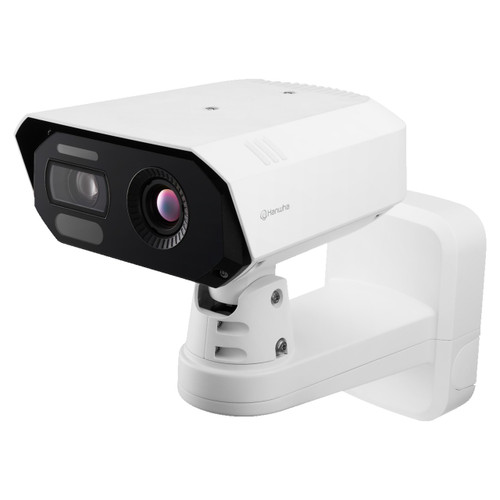
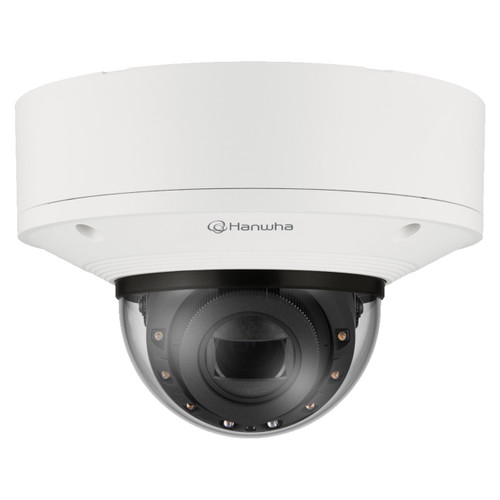
Both the Hanwha TNM-C4950TD and XNV-9083R are outdoor-rated, 8MP fixed dome IP cameras sharing the same 1/1.8" CMOS sensor format and PoE+ power input — making them legitimate cross-shop candidates for 4K perimeter deployments. The core distinction is sensor philosophy: the C4950TD adds a second uncooled thermal sensor with AI bi-spectrum analytics, while the XNV-9083R is a conventional 4K IR dome with a wider-angle varifocal lens and richer standard AI video analytics. Buyers choosing between them are typically weighing thermal detection capability against broader VMS integration depth and IR low-light performance.
In This Guide
How do the imaging specs compare?
Both cameras deliver 8MP (3840×2160) at 30fps using a 1/1.8" CMOS sensor. The C4950TD pairs its visible sensor with an uncooled micro-bolometer thermal sensor (VGA resolution, 12μm pixel pitch, NETD <60mK), covering a fixed 13.5mm thermal lens (H: 31.9°, V: 24.2°) alongside a 10.9–29mm (2.6×) motorized varifocal visible lens. The XNV-9083R uses a single visible sensor behind a 4.4–9.3mm (2.1×) P-iris IR-corrected motorized varifocal, providing a substantially wider horizontal field of view — 113° at wide end versus the C4950TD's visible wide angle, which is not explicitly stated in degrees for the visible channel beyond the thermal FOV. The XNV-9083R also adds HLC (highlight compensation) and a dedicated defog mode absent from the C4950TD spec sheet.
For low-light performance in visible mode, the XNV-9083R reaches 0.04 lux color / 0 lux IR, backed by 50m WiseIR illumination — making it capable in complete darkness. The C4950TD lists 0.06 lux color / 0.005 lux B/W for the visible channel, but its true darkness capability relies on the thermal sensor, which provides passive detection regardless of light level. Both cameras specify 120dB WDR (labeled extremeWDR on the XNV-9083R). The C4950TD's thermal detection range reaches 200.1m (detect) / 583.4m (tele detect) per the DORI table, far exceeding the XNV-9083R's 50.8m (wide detect) / 176.6m (tele detect) — a fundamental advantage for perimeter screening at range.
What about installation and environment?
Both cameras are white aluminum domes rated IP66/IP67 and IK10, powered by PoE+ (IEEE 802.3at, Class 4) or 12VDC. The C4950TD draws up to 23.5W; the XNV-9083R draws up to 22.5W — a negligible 1W difference for switch budget planning. The C4950TD adds NEMA TS 2 (2.2.8, 2.2.9) certification relevant for traffic/transportation installations. The XNV-9083R carries IK10+ (noted as IK10+ in the certification field, versus IK10 for the C4950TD) and adds IP6K9K (ISO 20653) high-pressure/high-temperature wash resistance — meaningful for food-processing or industrial wash-down environments.
Temperature range differs: the C4950TD operates from −40°C to +60°C, while the XNV-9083R operates from −50°C to +55°C. The C4950TD has the edge at the high end (+60°C vs +55°C); the XNV-9083R goes 10°C colder. Physically, the C4950TD is substantially larger — 353.4×287.5×191.2mm at 4.533kg — due to its dual-sensor housing, versus the XNV-9083R's compact ø180×125mm dome at 1.9kg. The XNV-9083R supports conduit knock-outs (19.1mm/M25) and lists compatible gang-box types; the C4950TD spec sheet does not enumerate conduit options. The XNV-9083R also provides pan/tilt/rotate adjustment (0°–360° / −45°–85° / 0°–355°), facilitating aiming flexibility during installation.
Which fits your VMS and analytics better?
The XNV-9083R carries ONVIF Profile S/G/T/M — four profiles including the newer Profile M (metadata/analytics interoperability). The C4950TD is listed as ONVIF Profile S/T only, lacking Profile G (recording) and Profile M. Both support SUNAPI and Wisenet open platform. For protocol depth, the XNV-9083R adds MQTT and CDP to its stack; the C4950TD does not list either. The XNV-9083R supports up to 20 unicast users and 10 streaming profiles (with 3 virtual channels), while the C4950TD supports 6 unicast users and 3 profiles — a significant gap for multi-VMS or multi-operator deployments.
On analytics, the C4950TD's strength is thermal: fire detection, perimeter breach, and temperature anomaly are spec-listed capabilities unavailable on the XNV-9083R. The XNV-9083R offers AI-classified object detection (person, face, vehicle, license plate, with vehicle sub-types), people counting, queue management, and heatmap — richer standard video analytics. The C4950TD lists vehicle counting as business intelligence; the XNV-9083R's privacy masking supports 32 zones (4-point quadrangle, with mosaic option) versus the C4950TD's 6 rectangular zones. Both provide dual Micro SD slots; the XNV-9083R supports up to 1TB (2×512GB) versus the C4950TD's single-slot 512GB maximum. Both include audio in/out and alarm I/O, though the C4950TD provides 4 configurable I/O ports versus 2 on the XNV-9083R. Both share 4GB RAM / 512MB Flash.
Which should you choose: the C4950TD or the XNV-9083R?
Our take: The C4950TD is the stronger choice when passive thermal detection, long-range perimeter screening, or fire/temperature-anomaly alerting is a project requirement — its uncooled bi-spectrum sensor detects targets to 200m (wide) or 583m (tele) versus the XNV-9083R's 50.8m (wide) / 176.6m (tele) DORI detect range, and no amount of IR illumination substitutes for true thermal imaging in smoke, fog, or zero-lux conditions. The XNV-9083R is the stronger choice for dense VMS environments: it supports 20 unicast streams and 10 profiles versus 6 streams and 3 profiles on the C4950TD, carries ONVIF Profile M for metadata interoperability, and includes MQTT for IoT/event-bus integration absent from the C4950TD. The XNV-9083R is also physically far smaller (1.9kg vs 4.533kg) and carries IK10+ and IP6K9K ratings for wash-down resistance. Choose the C4950TD for thermal perimeter and detection missions; choose the XNV-9083R for high-density IP video deployments requiring broad VMS compatibility and compact installation.
Side-by-Side Comparison
Spec-for-spec, from manufacturer data.
| Specification | Hanwha C4950TD | Hanwha XNV-9083R |
|---|---|---|
| Resolution | 8MP (visible) + VGA (thermal) | 8MP — 3840×2160 |
| Image Sensor | 1/1.8" CMOS (visible) + uncooled micro-bolometer (thermal) | 1/1.8" progressive CMOS |
| Lens / Focal Length | 10.9–29mm (2.6×) varifocal visible; 13.5mm fixed thermal | 4.4–9.3mm (2.1×) P-iris IR-corrected varifocal |
| Horizontal FOV | Thermal: 31.9° (13.5mm fixed); visible FOV not stated in spec | 113° (wide) — not stated at tele |
| Min. Illumination | 0.06 lux color / 0.005 lux B/W (visible); 0 lux (thermal) | 0.04 lux color / 0 lux (IR on) |
| IR Range | — (thermal; no IR illuminator) | 50m WiseIR |
| Thermal Sensor | Yes — uncooled micro-bolometer, VGA, NETD <60mK, 12μm | — |
| WDR | 120dB WDR | 120dB extremeWDR |
| Max Frame Rate | 30fps | 30fps @ 8MP |
| Video Compression | H.265 / H.264 (Main/High) / MJPEG | H.265 / H.264 (Main/Baseline/High) / MJPEG |
| IP / Ingress Rating | IP66 / IP67 / NEMA 4X / NEMA TS 2 | IP66 / IP67 / IP6K9K / NEMA 4X |
| IK / Impact Rating | IK10 | IK10+ |
| Operating Temperature | −40°C to +60°C | −50°C to +55°C |
| Power Input / PoE Class | PoE+ (802.3at, Class 4) / 12VDC — 23.5W max | PoE+ (802.3at, Class 4) / 12VDC — 22.5W max |
| Edge Storage | 2× Micro SD — max 512GB (single slot spec) | 2× Micro SD — max 1TB (512GB × 2) |
| ONVIF Profiles | Profile S / T | Profile S / G / T / M |
| Unicast Users / Stream Profiles | 6 users / 3 profiles | 20 users / 10 profiles (3 virtual channels) |
| Alarm I/O Ports | 4 configurable I/O | 2 configurable I/O + DC 12V output (max 50mA) |
| DORI Detect Range (tele) | 583.4m (1913.89ft) | 176.6m (579.49ft) |
| Dimensions / Weight | 353.4×287.5×191.2mm / 4.533kg | ø180×125mm / 1.9kg |
| Warranty | 3-year | 3-year |
Frequently Asked Questions
Which should you choose: the C4950TD or the XNV-9083R?
The C4950TD is the stronger choice when passive thermal detection, long-range perimeter screening, or fire/temperature-anomaly alerting is a project requirement — its uncooled bi-spectrum sensor detects targets to 200m (wide) or 583m (tele) versus the XNV-9083R's 50.8m (wide) / 176.6m (tele) DORI detect range, and no amount of IR illumination substitutes for true thermal imaging in smoke, fog, or zero-lux conditions. The XNV-9083R is the stronger choice for dense VMS environments: it supports 20 unicast streams and 10 profiles versus 6 streams and 3 profiles on the C4950TD, carries ONVIF Profile M for metadata interoperability, and includes MQTT for IoT/event-bus integration absent from the C4950TD. The XNV-9083R is also physically far smaller (1.9kg vs 4.533kg) and carries IK10+ and IP6K9K ratings for wash-down resistance. Choose the C4950TD for thermal perimeter and detection missions; choose the XNV-9083R for high-density IP video deployments requiring broad VMS compatibility and compact installation.
Is the C4950TD or XNV-9083R better for detecting intruders in complete darkness?
The C4950TD is better suited for complete-darkness detection because its uncooled thermal sensor operates passively — detecting body heat regardless of ambient light — with a DORI detect range of up to 583.4m (tele). The XNV-9083R relies on its 50m WiseIR illuminator for zero-lux visible imaging; it can capture detail at 0 lux within that 50m range, but cannot detect beyond the IR throw distance and produces no image if the target is outside IR range. For long-range or smoke/fog-penetrating detection, the thermal sensor in the C4950TD has a fundamental physical advantage.
Can both cameras integrate with third-party VMS platforms?
Both cameras support ONVIF, SUNAPI, and Wisenet APIs, making them broadly compatible with major VMS platforms. However, the XNV-9083R supports ONVIF Profile S, G, T, and M — including Profile M for AI metadata streaming and Profile G for ONVIF-native recording — while the C4950TD is listed as Profile S and T only. The XNV-9083R also supports MQTT, enabling integration with IoT event buses and modern open-platform VMS environments. If your VMS leverages Profile M metadata or MQTT event triggers, the XNV-9083R is the better-specified option.
Which camera handles more simultaneous viewing clients?
The XNV-9083R supports up to 20 unicast users and 10 simultaneous streaming profiles (with 3 virtual channels). The C4950TD supports up to 6 unicast users and 3 streaming profiles. If your deployment involves multiple operators, redundant recording servers, or a high-client-count VMS environment, the XNV-9083R's streaming capacity is substantially higher per the published specifications.
Get a Second Opinion on Your Camera Choice
Share your site layout, coverage goals, and budget. Our team will validate the camera selection, flag anything we would change, and recommend products that match the use case.