
ACTi A421 vs ACTi Z310: Specification Comparison
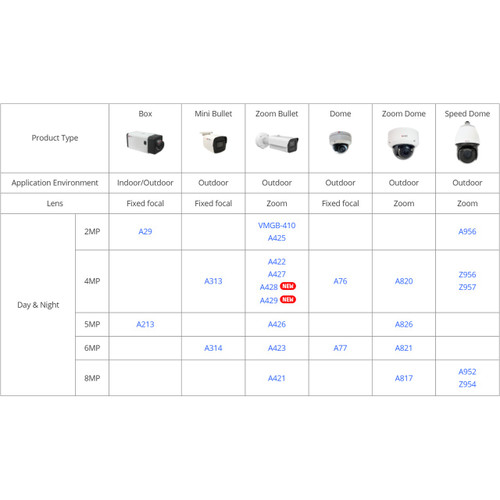
Both the ACTi A421 and ACTi Z310 are 8MP outdoor bullet IP cameras from the same manufacturer, making them direct cross-shop candidates for installers weighing a feature-rich zoom platform against a compact fixed-lens unit. The A421 is a video-analytics zoom bullet with a varifocal lens and deep-learning edge processing, while the Z310 is a mini bullet with a wide fixed lens optimized for cost-efficient coverage. This comparison examines how their imaging, environmental, and integration specs differ to help buyers match each model to the right deployment scenario.
In This Guide
How do the imaging specs compare?
Both cameras share an 8MP resolution, but their lens and low-light characteristics diverge significantly. The A421 uses a varifocal 2.8–12mm lens with 4.3x optical zoom, enabling forensic detail at variable distances, while the Z310 uses a fixed 2.8mm f/1.6 lens with a 99° horizontal field of view, optimized for wide-area coverage at a fixed standoff. The A421 delivers a maximum output of 3864×2192 at 30 fps; the Z310 is specified at 1440p (2560×1440) at 30 fps, so while both are labeled 8MP, only the A421's resolution figure is confirmed at the pixel-count level in the provided specs.
In low-light performance, the A421 specifies adaptive IR LED illumination to 40m range, a minimum illumination of 0.03 lux (color, 30 IRE) and 0 lux in B/W with IR active, alongside 150dB Extreme WDR. The Z310 lists adaptive IR with SLLS (Super Low Light Sensitivity) technology but provides no IR range figure, no minimum lux value, and no WDR dB rating in the supplied specifications—only 'WDR' is noted. Buyers requiring confirmed low-light numbers or high-dynamic-range performance should note that the A421's specs are fully quantified while the Z310's are not.
What about installation and environment?
The A421 carries IP68 and IK10 ratings with a metal casing, indicating full dust ingress protection, continuous submersion resistance, and resistance to 20-joule impacts—suitable for high-vandal or wash-down environments. Its operating temperature range is −30°C to 50°C (−22°F to 122°F), covering cold-climate outdoor deployments without a heater enclosure. The Z310 is rated IP67 (dust-tight, temporary immersion up to 1m), with no IK impact rating listed in the provided specs, and an operating temperature range of 0°C to 50°C, making it unsuitable for sub-freezing environments without supplemental housing.
Power requirements also differ: the A421 is specified as PoE++ (802.3bt) Class 3 in one field but also references IEEE 802.3af Class 3 and DC 12V in other fields—buyers should verify the exact power draw with ACTi before switch selection. The Z310 operates on standard 802.3af PoE at under 13W, compatible with virtually any managed switch or injector without budget-class concerns. Mounting options for the A421 are listed as pole; the Z310 supports wall, soffit, and pole, offering broader bracket flexibility for indoor-adjacent installs.
Which fits your VMS and analytics better?
The A421 supports ONVIF Profiles S, G, Q, T, and M, providing the broadest VMS compatibility of the two, including Profile G for on-camera recording and Profile M for metadata/analytics. It incorporates a Deep Learning Processing Unit (DLPU) for on-board analytics beyond basic Video Motion Detection. The Z310 supports ONVIF Profiles S and T only; no edge analytics capability beyond IR/SLLS is specified in the provided data.
For audio, the A421 offers two-way audio with mic-in, line-in, and line-out connections. The Z310 includes only a built-in microphone with no line-level inputs or outputs noted. On-board storage is specified for the Z310 (MicroSDHC/MicroSDXC slot), while no local storage specification is provided for the A421 in the supplied data. Buyers who require edge recording failover should confirm A421 SD card support with ACTi directly.
Which should you choose: the A421 or the Z310?
Our take: The A421 is the stronger choice when the deployment demands variable standoff distance, confirmed low-light performance, or vandal-hardened housing in sub-freezing environments. Its 4.3x optical zoom and varifocal 2.8–12mm lens allow scene adjustment post-install, while its 40m IR range and 0.03 lux minimum illumination are fully specified versus the Z310's unquantified low-light claims. The A421's IP68/IK10 rating and −30°C floor extend its envelope well beyond the Z310's IP67/0°C limits. Conversely, the Z310's fixed 2.8mm f/1.6 lens at 99° HOV, sub-13W 802.3af power budget, and wall/soffit/pole mount options make it the more practical and cost-efficient choice for high-camera-count wide-area installs on standard PoE infrastructure where zoom and extreme weather hardening are not required.
Side-by-Side Comparison
Spec-for-spec, from manufacturer data.
| Specification | ACTi A421 | ACTi Z310 |
|---|---|---|
| Resolution | 8MP (3864×2192) | 8MP (1440p / 2560×1440 implied) |
| Lens / Focal Length | Varifocal 2.8–12mm (4.3x optical zoom) | Fixed 2.8mm f/1.6 |
| Horizontal Field of View | — | 99° |
| Sensor Size | — | 1/2.8" |
| Min Illumination | 0.03 lux (color, 30 IRE); 0 lux (B/W, IR on) | — |
| IR Range | 40m | — |
| WDR | Extreme WDR (150dB) | WDR (dB not specified) |
| Max Frame Rate | 30 fps @ 3840×2160 (4K) | 30 fps @ 1440p |
| Video Compression | H.265 adaptive stream; H.264; MJPEG | H.265; H.264; MJPEG |
| IP Rating | IP68 | IP67 |
| IK / Impact Rating | IK10 (metal casing) | — |
| Operating Temperature | −30°C to 50°C (−22°F to 122°F) | 0°C to 50°C |
| Power Input / PoE Class | PoE++ (802.3bt) Class 3; DC 12V | PoE (802.3af) < 13W |
| ONVIF Profiles | S, G, Q, T, M | S, T |
| Edge Analytics | Deep Learning (DLPU); VMD | — |
| Audio | Two-way; mic-in; line-in; line-out | Built-in microphone only |
| Edge Storage | — | MicroSDHC / MicroSDXC |
| Mount Type | Pole | Wall; Soffit; Pole |
| Weight | 1260g (2.78 lb) | — |
| Warranty | 3 years | — |
Frequently Asked Questions
Which should you choose: the A421 or the Z310?
The A421 is the stronger choice when the deployment demands variable standoff distance, confirmed low-light performance, or vandal-hardened housing in sub-freezing environments. Its 4.3x optical zoom and varifocal 2.8–12mm lens allow scene adjustment post-install, while its 40m IR range and 0.03 lux minimum illumination are fully specified versus the Z310's unquantified low-light claims. The A421's IP68/IK10 rating and −30°C floor extend its envelope well beyond the Z310's IP67/0°C limits. Conversely, the Z310's fixed 2.8mm f/1.6 lens at 99° HOV, sub-13W 802.3af power budget, and wall/soffit/pole mount options make it the more practical and cost-efficient choice for high-camera-count wide-area installs on standard PoE infrastructure where zoom and extreme weather hardening are not required.
Is the A421 or Z310 better for low-light and nighttime surveillance?
Based on the provided specifications, the A421 is better documented for low-light use: it lists a minimum illumination of 0.03 lux (color) and 0 lux (B/W with IR active) with a confirmed 40m IR range and 150dB Extreme WDR. The Z310 lists adaptive IR and SLLS technology but provides no lux rating, no IR range figure, and no WDR dB value in its specifications, so a direct quantitative comparison cannot be made.
Can either camera handle freezing temperatures without an additional enclosure?
Only the A421 is rated for sub-freezing operation: its specified operating range is −30°C to 50°C. The Z310's specified range begins at 0°C, meaning it is not rated for below-freezing environments per its published specs and would require a supplemental heated enclosure for cold-climate outdoor use.
Which camera works better with third-party VMS platforms?
The A421 supports ONVIF Profiles S, G, Q, T, and M, offering broader compatibility including metadata and on-camera recording profiles. The Z310 supports ONVIF Profiles S and T. Buyers integrating with VMS platforms that leverage Profile G (edge recording) or Profile M (analytics metadata) should select the A421; for standard live-view and event-driven recording, both cameras meet the minimum ONVIF S/T baseline.
Get a Second Opinion on Your Camera Choice
Share your site layout, coverage goals, and budget. Our team will validate the camera selection, flag anything we would change, and recommend products that match the use case.