
Hanwha C9083R vs i-PRO X15700-V2L: Specification Comparison
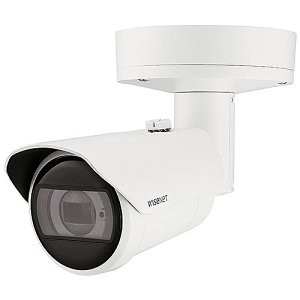
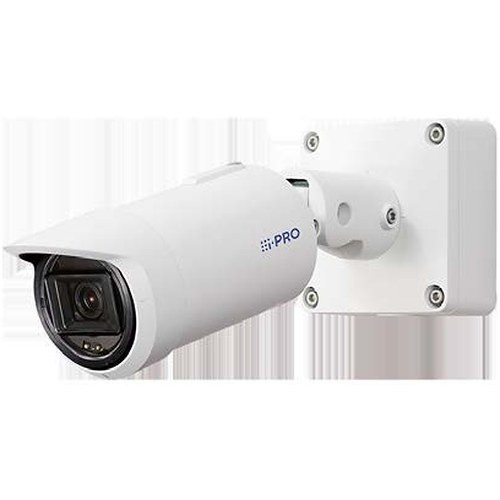
Both the Hanwha XNO-C9083R and the i-PRO WV-X15700-V2L are 8MP 4K fixed outdoor bullet cameras sharing the same 1/1.8" CMOS sensor format, identical resolution (3840×2160 at 30 fps), motorized varifocal lenses, IR illumination, IP66/IK10 environmental ratings, and ONVIF compatibility. They are direct cross-shop candidates for integrators specifying 4K perimeter or façade coverage where AI analytics, low-light performance, and VMS flexibility are the primary decision drivers.
In This Guide
How do the imaging specs compare?
Both cameras use an approximately 1/1.8" progressive CMOS sensor at 3840×2160 and 30 fps. The XNO-C9083R specifies a minimum illumination of 0.04 lux (color) with 0 lux in IR mode, while the WV-X15700-V2L specifies 0.03 lux (B&W, 50IRE, F1.5, 1/30s). The i-PRO's F1.5 maximum aperture (wide) is faster than the Hanwha's F1.3 wide aperture — note these are expressed differently in the datasheets, so direct comparison requires site verification. The WV-X15700-V2L's IR illuminator is rated at 70m (230 ft), whereas the XNO-C9083R's WiseIR reaches 40m (131 ft) — a 75% range advantage for the i-PRO.
On WDR, the XNO-C9083R claims extremeWDR at 120 dB, while the WV-X15700-V2L specifies Super Dynamic at up to 132 dB (level 31). The Hanwha's varifocal range is 4.4–9.3mm (2.1x) with a 113° wide FOV; the i-PRO covers 4.3–8.6mm (2.0x) with a 104° wide FOV — marginally narrower. In DORI terms, the i-PRO's tele-end detect distance reaches 154m vs. the Hanwha's 176.6m, while observe distances are 61.6m (i-PRO) vs. 70.7m (Hanwha) at tele — giving the Hanwha a slight DORI advantage at tele. The i-PRO also specifies up to 12x extra digital zoom (at reduced resolution) and discloses its SoC as an Ambarella CV52; Hanwha does not disclose the SoC in the provided specs.
What about installation and environment?
Both cameras share IP66/IP67, NEMA 4X, and IK10 ratings, and both are rated for –40°C to +55°C operation. The i-PRO additionally specifies wind resistance up to 40 m/s (~89 mph), which is absent from the Hanwha spec sheet. Power requirements differ materially: the XNO-C9083R draws a maximum of 12.95W and is powered by PoE IEEE 802.3af (Class 3) or 12VDC, while the WV-X15700-V2L consumes up to 14W and requires PoE+ (802.3at, Class 4) or DC12V — meaning the i-PRO mandates a PoE+ switch port or injector. The Hanwha is lighter and more compact at 1,640g and ø93.4×276.6mm; the i-PRO is heavier at approximately 2.5 kg and 133×133×383mm. The Hanwha ships with a backbox included and lists compatibility with single/double/4" octagon/4" square gang boxes. Hanwha specifies a digital image stabilizer with built-in gyro; i-PRO also lists a gyro-based stabilizer limited to 30fps — both on par.
Which fits your VMS and analytics better?
Both cameras support ONVIF Profiles S, G, T, and M, and both compress via H.265, H.264, and MJPEG with CBR/VBR bitrate control. The XNO-C9083R supports up to 20 unicast users across up to 10 stream profiles with 3 virtual channels; the WV-X15700-V2L supports up to 14 simultaneous users. The Hanwha adds WiseStream II/III smart codec and SRTP. Both support up to 512GB microSD/SDXC edge storage. Protocol depth differs: the Hanwha lists MQTT, SNMPv1/v2c/v3, LLDP, CDP, and SRTP; i-PRO's protocol list is less detailed in the provided specs, though IPv6 support is explicitly confirmed for both.
On analytics, the XNO-C9083R classifies persons, faces, vehicles (car/bus/truck/motorcycle/bicycle), and license plates, and adds business intelligence functions (people counting, queue management, heatmaps). The WV-X15700-V2L offers AI motion, face, people, and vehicle detection plus AI sound classification (gunshot, yell, vehicle horn, glass break) — a differentiator absent from the Hanwha spec sheet. Audio I/O is present on both; the Hanwha uses mic/line-in with a selectable 2.5VDC supply and line out, while the i-PRO uses a 3.5mm stereo mini jack for input and 3.5mm stereo jack (monaural, 600Ω) for output. Alarm I/O: Hanwha provides 2 configurable I/O ports; i-PRO provides 3 alarm inputs, 1 alarm output, and 1 AUX output — more I/O flexibility. The i-PRO specifies Secure Boot and signed firmware; Hanwha lists 802.1X (EAP-TLS/LEAP/PEAP), pre-installed device certificate, and digest authentication. Security feature disclosure is more granular for the Hanwha. The i-PRO carries a 5-year warranty vs. Hanwha's 3-year warranty.
Which should you choose: the C9083R or the X15700-V2L?
Our take: The WV-X15700-V2L is the stronger choice when IR range is the primary selection criterion or when AI sound classification is required on the same device. Its IR illuminator reaches 70m vs. the XNO-C9083R's 40m — a 75% advantage — and it specifies a higher Super Dynamic WDR ceiling of 132 dB vs. the Hanwha's 120 dB extremeWDR. It also ships with more alarm I/O (3-in/1-out/1-AUX vs. 2 configurable) and a longer 5-year warranty vs. 3 years. However, the XNO-C9083R is the stronger choice for PoE-constrained infrastructure (Class 3, 12.95W vs. Class 4, 14W PoE+), richer vehicular sub-classification (car/bus/truck/motorcycle/bicycle plus license plate detection), business-intelligence analytics (people counting, queues, heatmaps), and installations where a lighter, more compact bullet form factor (1,640g vs. 2.5 kg) eases pole or parapet mounting. Specify the i-PRO on perimeter runs demanding long-range IR and audio event detection with PoE+ infrastructure in place; specify the Hanwha where 802.3af switches are already deployed or license-plate and queue analytics are needed.
Side-by-Side Comparison
Spec-for-spec, from manufacturer data.
| Specification | Hanwha C9083R | i-PRO X15700-V2L |
|---|---|---|
| Resolution | 3840×2160 (8MP) | 3840×2160 (8MP) |
| Image Sensor | 1/1.8" progressive CMOS | Approx. 1/1.8" CMOS |
| Focal Length / Zoom | 4.4–9.3mm, 2.1× motorized varifocal | 4.3–8.6mm, 2.0× motorized varifocal |
| Max Aperture (Wide) | F1.3 | F1.5 |
| Horizontal FOV (Wide) | 113° | 104° |
| Min. Illumination | 0.04 lux color / 0 lux IR | 0.03 lux B&W (F1.5, 1/30s) |
| IR Range | 40m (131 ft) WiseIR | 70m (230 ft) |
| WDR | extremeWDR 120 dB | Super Dynamic max 132 dB |
| Max Frame Rate | 30 fps @ 8MP | 30 fps @ 8MP |
| Video Compression | H.265, H.264, MJPEG | H.265, H.264, MJPEG |
| IP / Ingress Rating | IP66 / IP67 / NEMA 4X | IP66 / IP67 / NEMA 4X |
| Impact Rating | IK10 | IK10 |
| Operating Temperature | −40°C to +55°C | −40°C to +55°C (−30°C power-on) |
| Power Input / PoE Class | PoE 802.3af Class 3 / 12VDC; max 12.95W | PoE+ 802.3at Class 4 / DC12V; max 14W |
| Alarm I/O | 2 configurable I/O ports | 3× Alarm IN, 1× Alarm OUT, 1× AUX OUT |
| Edge Storage | microSD/SDHC/SDXC up to 512GB | microSD/SDHC/SDXC up to 512GB |
| Audio I/O | Mic/line in + line out | 3.5mm stereo jack in + 3.5mm stereo jack out |
| AI Sound Classification | — | Gunshot, Yell, Vehicle Horn, Glass Break |
| ONVIF Profiles | S, G, T, M | S, G, T, M |
| Dimensions (W×H×D) | ø93.4×276.6mm / 1,640g | 133×133×383mm / approx. 2,500g |
| Warranty | 3 years | 5 years |
Frequently Asked Questions
Which should you choose: the C9083R or the X15700-V2L?
The WV-X15700-V2L is the stronger choice when IR range is the primary selection criterion or when AI sound classification is required on the same device. Its IR illuminator reaches 70m vs. the XNO-C9083R's 40m — a 75% advantage — and it specifies a higher Super Dynamic WDR ceiling of 132 dB vs. the Hanwha's 120 dB extremeWDR. It also ships with more alarm I/O (3-in/1-out/1-AUX vs. 2 configurable) and a longer 5-year warranty vs. 3 years. However, the XNO-C9083R is the stronger choice for PoE-constrained infrastructure (Class 3, 12.95W vs. Class 4, 14W PoE+), richer vehicular sub-classification (car/bus/truck/motorcycle/bicycle plus license plate detection), business-intelligence analytics (people counting, queues, heatmaps), and installations where a lighter, more compact bullet form factor (1,640g vs. 2.5 kg) eases pole or parapet mounting. Specify the i-PRO on perimeter runs demanding long-range IR and audio event detection with PoE+ infrastructure in place; specify the Hanwha where 802.3af switches are already deployed or license-plate and queue analytics are needed.
Is the XNO-C9083R or WV-X15700-V2L better for low-light performance?
The i-PRO WV-X15700-V2L specifies a minimum illumination of 0.03 lux (B&W, F1.5, 1/30s) and an IR range of 70m, compared to the Hanwha XNO-C9083R's 0.04 lux (color) and 40m WiseIR. On the two published specs — lux floor and IR throw — the i-PRO has the measurable edge, though both enter zero-lux IR mode in full darkness.
Can I power either camera from a standard 802.3af PoE switch?
Only the Hanwha XNO-C9083R is rated for standard 802.3af PoE (Class 3, max 12.95W). The i-PRO WV-X15700-V2L requires PoE+ (802.3at, Class 4, up to 14W), so an 802.3af-only switch or injector is not sufficient for the i-PRO without a hardware upgrade or a local DC12V power supply.
Which camera offers more advanced analytics out of the box?
Both cameras offer AI-based person, face, and vehicle detection. The Hanwha XNO-C9083R adds granular vehicle sub-classification (car, bus, truck, motorcycle, bicycle), license plate detection, and business-intelligence functions (people counting, queues, heatmaps). The i-PRO WV-X15700-V2L adds AI sound classification (gunshot, yell, vehicle horn, glass break), which the Hanwha spec sheet does not list. The best choice depends on whether your priority is detailed video object classification or audio event detection.
Get a Second Opinion on Your Camera Choice
Share your site layout, coverage goals, and budget. Our team will validate the camera selection, flag anything we would change, and recommend products that match the use case.