
ACTi A31 vs ACTi A49: Specification Comparison
Both the ACTi A31 and ACTi A49 are 3MP outdoor fixed bullet IP cameras sharing the same resolution class, form factor, and environmental ratings. This comparison is for installers and IT buyers evaluating a fixed wide-angle deployment against a fixed optical-zoom deployment at the same resolution tier. Key differentiators span lens flexibility, WDR performance, PoE standard, low-light sensitivity, and ONVIF profile coverage — each of which affects site suitability and VMS compatibility decisions.
In This Guide
How do the imaging specs compare?
Both cameras share a 1/2.8-inch sensor at 3MP resolution with a maximum frame rate of 30 fps, so raw pixel count and throughput are identical. The A31 uses a fixed 2.8mm lens, providing a wide, static field of view with no optical adjustment. The A49 ships with a 2.8–12mm varifocal lens rated at 4.3× optical zoom (the spec sheet also states 3× in one field — the detailed lens descriptor of 2.8–12mm is used here as the primary reference), enabling installers to set the field of view at commissioning without changing the camera's physical position. IR range is 30m on both models. However, minimum illumination differs materially: the A31 is specified at 0.1 lux color / 0.01 lux B/W at F1.85, while the A49 reaches 0.05 lux color / 0.005 lux B/W at F1.4 — the A49's wider aperture and lower lux floor give it a measurable low-light advantage.
WDR performance diverges significantly. The A31 is rated at Advanced WDR 120dB, while the A49 carries Extreme WDR at 142dB — a 22dB advantage that translates to substantially better detail retention in scenes with simultaneous deep shadows and bright highlights, such as entryways, loading docks, or parking lot perimeters with direct sun. The A49 also specifies Adaptive IR LED technology in its IR descriptor, whereas the A31 lists a fixed 22× 850nm LED array. Both cameras support H.265, H.264, and MJPEG compression, so codec selection is equivalent across both units.
What about installation and environment?
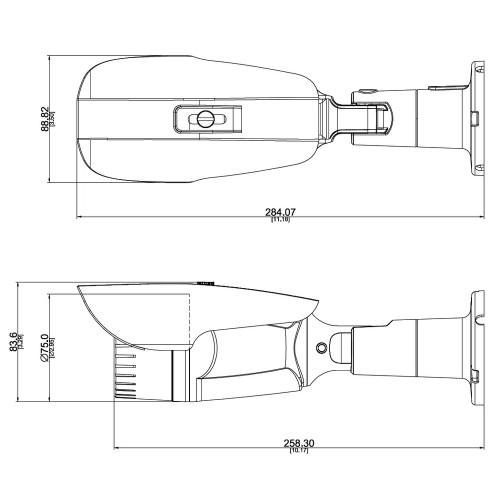
Environmental protection is identical: both cameras carry IP66, IK10 (metal casing), and NEMA 4X ratings, and both operate across -30°C to +50°C (-22°F to 122°F). Neither model has an edge on weatherproofing or vandal resistance. Pole and rack mount types are listed for both. The A49 provides a physical dimension spec of 80mm × 258.30mm (Ø × L); dimensions are not provided in the A31 spec data. The A31 weighs 771g (1.70 lb) versus 694g (1.53 lb) for the A49.
Power input is where a meaningful installation difference arises. The A31 requires PoE+ (802.3at) Class 3, meaning the switch port or injector must be 802.3at-capable. The A49 operates on standard PoE (802.3af) Class 3 at a stated 13W, making it compatible with a wider installed base of 802.3af switches without requiring an upgrade or higher-wattage injector. Both support DC 12V as an alternative power source; the A49 spec notes the adapter is not included. Network interface on the A31 is listed as a 1× RJ-45 pigtail connector without a rated Ethernet speed in that field; the A49 explicitly states 10/100 Base-T RJ-45 pigtail.
Which fits your VMS and analytics better?
ONVIF compliance differs by one profile. The A31 is listed as compliant with ONVIF Profile S, Profile T, and Profile Q. The A49 covers Profile S and Profile T only — Profile Q (used for device onboarding and zero-configuration discovery on compatible platforms) is absent from the A49 spec. For VMS platforms or management tools that rely on Profile Q for streamlined commissioning, the A31 has a broader ONVIF footprint. Both cameras support the same listed edge analytics: Video Motion Detection (VMD) and People Counting. No audio input/output capability is specified for either model in the provided data. On-board or edge storage (SD/microSD slot) is not specified for either model in the provided data.
The A49 carries an additional certification — EAC (Eurasian Conformity) — that is absent from the A31's listed approvals (CE, FCC, IP66, NEMA 4X, IK10). For deployments requiring EAC compliance, the A49 is the only option between the two. Both cameras list GPS position as manual setting, indicating no integrated GPS module; coordinates must be entered manually in both cases.
Which should you choose: the A31 or the A49?
Our take: The A49 is the stronger choice when the deployment demands flexible field-of-view adjustment, superior WDR performance, or 802.3af-only switch infrastructure. The A49's 4.3× optical zoom (2.8–12mm) eliminates the need for a fixed wide-angle frame, its 142dB Extreme WDR outperforms the A31's 120dB Advanced WDR by 22dB, and its lower minimum illumination (0.05 lux color vs. 0.1 lux on the A31) provides a measurable low-light advantage. Critically, the A49 runs on standard 802.3af PoE rather than the A31's 802.3at PoE+ requirement, reducing infrastructure cost on sites with existing 802.3af switches. The A31 holds an edge in ONVIF scope — adding Profile Q for zero-configuration discovery — and is the only option where a VMS mandates that profile. Choose the A31 for fixed wide-angle scenes on 802.3at infrastructure with Profile Q VMS requirements; choose the A49 for variable-distance coverage, higher-contrast environments, or 802.3af-constrained switch plants.
Side-by-Side Comparison
Spec-for-spec, from manufacturer data.
| Specification | ACTi A31 | ACTi A49 |
|---|---|---|
| Resolution | 3MP | 3MP |
| Image Sensor | 1/2.8 inch | 1/2.8 inch |
| Lens / Focal Length | 2.8mm fixed | 2.8–12mm varifocal (4.3× optical zoom) |
| Min Illumination (Color) | 0.1 lux @ F1.85 | 0.05 lux @ F1.4 |
| Min Illumination (B/W) | 0.01 lux @ F1.85 | 0.005 lux @ F1.4 |
| IR Range | 30m (22× 850nm LED) | 30m (Adaptive IR LED) |
| WDR | Advanced WDR 120dB | Extreme WDR 142dB |
| Max Frame Rate | 30 fps | 30 fps |
| Video Compression | H.265; H.264; MJPEG | H.265; H.264; MJPEG |
| IP Rating | IP66 / NEMA 4X | IP66 / NEMA 4X |
| IK / Impact Rating | IK10 (metal casing) | IK10 (metal casing) |
| Operating Temperature | -30°C to +50°C | -30°C to +50°C |
| Power Input / PoE Class | PoE+ 802.3at Class 3 or DC 12V | PoE 802.3af Class 3 (13W) or DC 12V |
| ONVIF Profiles | Profile S; Profile T; Profile Q | Profile S; Profile T |
| Edge Analytics | VMD; People Counting | VMD; People Counting |
| Certifications | CE; FCC; IP66; NEMA 4X; IK10 | CE; FCC; EAC; IP66; NEMA 4X; IK10 |
| Weight | 771g (1.70 lb) | 694g (1.53 lb) |
| Dimensions (Ø × L) | — | 80mm × 258.30mm (3.149" × 10.169") |
| Warranty | 3 Years | — |
Frequently Asked Questions
Which should you choose: the A31 or the A49?
The A49 is the stronger choice when the deployment demands flexible field-of-view adjustment, superior WDR performance, or 802.3af-only switch infrastructure. The A49's 4.3× optical zoom (2.8–12mm) eliminates the need for a fixed wide-angle frame, its 142dB Extreme WDR outperforms the A31's 120dB Advanced WDR by 22dB, and its lower minimum illumination (0.05 lux color vs. 0.1 lux on the A31) provides a measurable low-light advantage. Critically, the A49 runs on standard 802.3af PoE rather than the A31's 802.3at PoE+ requirement, reducing infrastructure cost on sites with existing 802.3af switches. The A31 holds an edge in ONVIF scope — adding Profile Q for zero-configuration discovery — and is the only option where a VMS mandates that profile. Choose the A31 for fixed wide-angle scenes on 802.3at infrastructure with Profile Q VMS requirements; choose the A49 for variable-distance coverage, higher-contrast environments, or 802.3af-constrained switch plants.
Is the A31 or A49 better for low-light performance?
The A49 is specified with lower minimum illumination: 0.05 lux color / 0.005 lux B/W at F1.4, compared to the A31's 0.1 lux color / 0.01 lux B/W at F1.85. The A49's wider aperture (F1.4 vs F1.85) and lower lux floor give it a measurable advantage in dimly lit outdoor scenes. Both cameras provide 30m IR range.
Can I use the A49 with my existing 802.3af PoE switch, or do I need to upgrade?
The A49 operates on standard PoE 802.3af Class 3 (13W stated), so it is compatible with existing 802.3af infrastructure. The A31, by contrast, requires PoE+ 802.3at Class 3, which means any switch port or injector must be 802.3at-rated. If your current switch plant is 802.3af-only, the A49 avoids a switch upgrade.
Does the A31 or A49 support more ONVIF profiles?
The A31 supports ONVIF Profile S, Profile T, and Profile Q. The A49 supports Profile S and Profile T only. Profile Q enables zero-configuration device discovery and onboarding on compatible VMS and management platforms. If your VMS or commissioning workflow relies on Profile Q, the A31 is the only option between these two models.
Get a Second Opinion on Your Camera Choice
Share your site layout, coverage goals, and budget. Our team will validate the camera selection, flag anything we would change, and recommend products that match the use case.