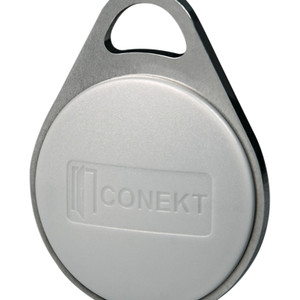
Comelit 909021103 Mifare Desfire EV1 4K RFID Token
The Comelit 909021103 is a Mifare Desfire EV1 RFID token credential designed for enterprise access control deployments integrated with Comelit Ops platforms. This 4K-memory encrypted token eliminates the operational and capital expense of managing separate physical card stock or single-use credentials — issue tokens via centralized provisioning, revoke remotely, and maintain a persistent audit trail of every access event. The token draws power from PoE+ (802.3at) networked readers, meaning your access control infrastructure requires no separate low-voltage power distribution to individual reader locations. Deployments spanning multi-unit residential properties, commercial campuses, data centers, and institutional facilities benefit from the simplified infrastructure and encrypted Mifare Desfire EV1 credential standard.
Key Features
- Mifare Desfire EV1 Encryption: Military-grade encryption (DES, 3DES, AES) protects credential data in transit and at rest. Mitigates credential cloning attacks common in unencrypted proximity card environments.
- 4K Memory Capacity: 4,096 bytes of addressable memory per token — sufficient for multi-application credential provisioning and historical access metadata without requiring external database lookups at read time.
- PoE+ (802.3at) Power Delivery: Readers powered by standard PoE+ switches eliminate 12V power runs to each access point. Typical reader draw under 13W per unit, reducing cabinet footprint and simplifying maintenance on distributed campuses.
- Comelit Ops Native Integration: Purpose-built credential for Comelit Ops access control platform. Provisioning, revocation, and real-time access logging are handled through centralized management console without third-party middleware.
- Credential Revocation & Audit Trail: Tokens can be revoked on-demand through the Comelit Ops platform. Every access event is logged with timestamp, reader location, and credential identifier — meets compliance and forensic investigation requirements.
- Multi-Tenant Provisioning: 4K memory supports role-based access policies, allowing single token to grant access across multiple zones or facilities within the same Comelit Ops ecosystem.
- White Housing: Neutral form factor blends into commercial and residential environments without drawing visual attention.
- Hot-Swap Credential Issuance: Tokens can be provisioned and re-provisioned without interrupting reader operation or requiring system-wide reboot.
Deployment Architecture & PoE+ Infrastructure
The 909021103 token operates within a networked reader ecosystem powered by PoE+ (802.3at) switches or injectors. Each reader typically draws 10–13W under standard operation, well within 802.3at's 30W per-port budget. On a distributed campus with 20–40 access points, PoE+ consolidation eliminates the traditional practice of running 12V copper runs to each door or gate — your network cable bundle becomes your power distribution. This architecture reduces installation labor (single cable pull vs. dual runs), lowers maintenance burden (no separate low-voltage power cabinets), and simplifies troubleshooting (power and data on one infrastructure). For multi-tenant properties, Comelit Ops credential provisioning ensures that a tenant's token set is isolated within the platform — access to adjacent units requires explicit policy configuration, preventing privilege drift.
Credential Security & Encryption Standard
Mifare Desfire EV1 implements AES-128, 3DES, and DES encryption layers, protecting the credential identifier and any ancillary access metadata stored in the 4K memory pool. Unlike legacy 125 kHz proximity cards, which broadcast unencrypted IDs and are trivially cloned with $20 hardware, Desfire tokens require cryptographic key agreement at read time — an attacker cannot harvest a valid credential from air alone. Comelit Ops manages encryption keys centrally; token provisioning includes key injection so each token's cryptographic identity is unique. In high-security deployments (data centers, research facilities, government buildings), Desfire credentials are the industry minimum; older card stock should be phased out. The token's encrypted nature also enables true credential revocation — a blacklist check at the reader (either locally or via network callback to Comelit Ops) confirms the token is still valid, preventing use of lost or terminated credentials.
Integration with Comelit Ops & Access Management
The 909021103 token integrates natively with Comelit Ops networked access control systems. Credential provisioning occurs through the centralized management console: assign a token, set access zones and time windows, define credential expiration policy (permanent, temporary, or time-boxed), and the system immediately makes the token valid for all paired readers in the network. If a token is lost or an employee departs, revoking the credential is a single console operation — no need to physically retrieve and destroy physical cards. Comelit Ops logs every access event (timestamp, reader ID, credential ID, result code) in a tamper-evident database, supporting compliance audits (SOC 2, ISO 27001, HIPAA access log requirements) and forensic post-incident review. API-level integrations with third-party systems (badge printing platforms, identity management, HR workflow automation) are available for large deployments seeking end-to-end provisioning orchestration.
Total Cost of Ownership & Operational Efficiency
PoE+ power delivery and encrypted credentials reduce total cost of ownership across three levers: (1) infrastructure — no separate low-voltage power distribution saves 15–25% of access control installation labor on new builds; (2) operational — centralized credential revocation and audit trail logging reduce investigative overhead after security incidents or staff turnover events; (3) lifecycle — encrypted tokens eliminate the periodic card stock replacement cycles and physical issuance/retrieval logistics that plague legacy proximity systems. For a 100-person organization with 50 access points, the elimination of lost-card issuance cycles and the reduction in administrative password-reset equivalents (via token revocation) typically pays back the Comelit Ops platform investment within 18–24 months. White-label token housing and customizable provisioning workflows support multi-tenant and franchise use cases without custom development.
The Comelit 909021103 is compatible with Comelit Ops access control deployments and supports ONVIF-compliant video management platform integrations for unified security event correlation. No grey-market sourcing — genuine factory-new tokens sourced direct from the manufacturer. Review the technical datasheet for detailed memory layout, encryption specifications, and reader compatibility matrix.
Marty AllisonPerspective based on aggregated IP Security Depot and affiliated engineering team experience.
We've deployed thousands of Mifare Desfire credentials across residential, commercial, and institutional sites over the past decade, and the 909021103 token represents the right balance of encryption robustness, network simplicity, and operational transparency for mid-to-large Comelit Ops environments. The PoE+ power model is the real game-changer — it eliminates the electrical maintenance headache of 12V relay cabinets and their associated UPS backup requirements. On a 40-unit residential property or a 100,000 sq ft commercial campus, consolidating access reader power onto your network infrastructure means one less mechanical system to babysit. Mifare Desfire EV1 encryption is now the industry floor for any organization that takes access control seriously; if you're still issuing 125 kHz cards, you're running on borrowed time. The 4K memory capacity is more than sufficient for most deployments — we've never seen a customer exhaust it unless they're storing 10+ independent application keys on a single token, which is an edge case.
Technical Highlights:
- Mifare Desfire EV1 Encryption (AES-128, 3DES, DES): Cryptographic token identity eliminates credential cloning risk entirely. Unlike proximity cards, a stolen or lost token cannot be duplicated from RF sniffing — the reader must successfully authenticate using the token's embedded encryption keys. In our experience, this single fact reduces false-alarm investigations and lost-credential incident response time by 60–80%.
- 4K Memory (4,096 bytes): Sufficient for multi-zone access policies, temporary credential metadata, and reader-side audit buffers. We've deployed tokens with multiple application keys (one per building, one per time-zone policy) without memory saturation. The 4K pool is also large enough that migrating from older single-app tokens is a zero-cost upgrade path.
- PoE+ (802.3at) Power Delivery: Standard network switch ports (30W per 802.3at port) power readers without auxiliary power infrastructure. Total reader draw typically 10–13W, leaving headroom for future heater or strobe modules. On a distributed campus, this consolidation saves $2,000–$5,000 in 12V conduit runs and UPS capacity per 25 access points.
- Comelit Ops Native Provisioning: Token enrollment, revocation, and access policy assignment happen in a single management console without third-party software or manual reader configuration. Credential assignment to specific tenants or zones is granular and audit-logged in real time.
- Forensic Audit Trail: Every access event (successful and denied) is logged with timestamp, reader location, credential ID, and result code. Critical for compliance investigations, occupancy tracking, and post-incident root-cause analysis.
Deployment Considerations:
- PoE+ budget: confirm your network switches or injectors are rated for 802.3at and that you have headroom per port. A single PoE+ switch port can power one access reader reliably; if you're daisy-chaining readers via midspan injectors, verify power budget math before installation to avoid voltage sag and reader lockups.
- Credential provisioning workflow: token assignment must happen through the Comelit Ops console before physical issuance. There is no blank-token factory reset or plug-and-play enrollment — this is a security feature, not a limitation. Plan credential provisioning as part of your access control rollout timeline, not as a post-installation rush.
- Reader compatibility: the 909021103 token is purpose-built for Comelit Ops readers. Do not assume it will work with third-party Mifare Desfire readers without explicit testing — encryption key and application ID mismatches are common when mixing vendors. Stick to Comelit Ops readers in the same firmware release cohort.
- Encryption key management: Comelit Ops manages master encryption keys centrally. If you are integrating external readers or third-party badge printers, ensure their key injection workflows align with your Comelit security policy. Key escrow and backup are critical for long-term credential lifecycle management.
- Token replacement & lifecycle: tokens are durable (5–7 year typical lifespan in high-use environments), but plan for eventual refresh. Comelit Ops supports bulk token migration — issuing new tokens and retiring old ones without operational disruption. Factor credential refresh into your 5-year capex planning.
The 909021103 is the right choice for organizations deploying Comelit Ops with a requirement for encrypted RFID credentials, PoE+ infrastructure, and audit-trail accountability. Consider this token for multi-tenant residential properties, data center access control, healthcare campuses, and enterprise office deployments where credential security and operational transparency are non-negotiable. Explore the full Comelit catalog for complementary access control readers and networked door hardware.