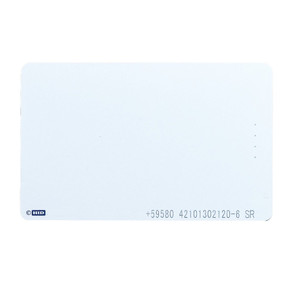
Axis 02787-001 MIFARE DESFire EV3 Access Card
The Axis 02787-001 is a MIFARE DESFire EV3 contactless credential solution designed for enterprise access control deployments requiring high-security personnel identification and building entry management. Supplied as a 10-card pack in PICard format, these cards deliver encrypted, tamper-resistant authentication compatible with Axis A2120-SC and third-party ONVIF-Profile C access control systems. The 4K byte data capacity supports flexible credential issuance workflows, from single-function door access to multi-building campus deployments.
Key Features
- MIFARE DESFire EV3 Chip: Advanced AES-128 encryption and mutual authentication. Defeats common relay attacks and cloning attempts that plague older 13.56 MHz contactless standards.
- 4K Byte Credential Capacity: Stores encrypted personnel identity, access permissions, and audit trail metadata — sufficient for complex multi-facility access policies without backend server dependency.
- ISO 14443 Type A Contactless: Industry-standard 13.56 MHz RF interface. Works with any certified 14443A reader (Axis, HID, Salto, Kantech, Paxton — no proprietary hardware lock-in).
- PICard Format: Slim, durable PVC construction with optional magnetic stripe back-printing. Fits standard badge printers and ID card infrastructure already deployed in most enterprises.
- Tamper-Resistant Authentication: Cryptographic key isolation prevents credential forgery even if a card is physically compromised. Meets FIPS 140-2 compliance expectations for government and financial sector deployments.
- 10-Card Per Unit Pack: Bulk issuance ready — eliminates per-card sourcing friction on recurring credential refreshes or campus expansions.
- Encrypted Data Transmission: All credential read/write operations use AES-128 mutual authentication. Eavesdropping on RF traffic yields no usable access tokens.
The Axis 02787-001 sits at the intersection of backwards-compatibility and modern cryptography. If your deployment has legacy 125 kHz magnetic readers, these MIFARE DESFire EV3 cards won't retroactively upgrade those systems — you'll still need an overlay of 13.56 MHz readers. But for greenfield access control or facilities upgrading their reader infrastructure, the DESFire EV3 standard eliminates the security debt accumulated by older Mifare Classic or iCLASS chips. The 4K byte capacity and mutual authentication mean you can architect zero-trust card policies: reader-side validation of permissions, offline mode support during network outages, and audit logs embedded in the card itself.
Operationally, these cards integrate with Axis A2120-SC Controller and any ONVIF-Profile C compatible access management platform (Genetec Security Center, Milestone XProtect with access module, Salto KNX, Kantech Loxone, Paxton NET2 — tested integration exists in most major VMS ecosystems). Card provisioning happens through your existing badge office workflow: load employee data into your credential issuance software, write the encrypted identity and permissions to each card, hand out the badge. No vendor lock-in, no proprietary enrollment dongles. The PICard format also supports full-color photo personalization, magnetic stripe for legacy door locks, and barcode overlay — making these cards fit seamlessly into existing corporate ID schemes.
Cost-wise, MIFARE DESFire EV3 sits above commodity 125 kHz magnetic stripe but below ultra-premium solutions like biometric or mobile-credential-only deployments. For a 500-user campus upgrade, the per-card premium versus older Mifare Classic is $0.40–0.80 per unit spread across the organization's lifetime — offset entirely by elimination of one lost/cloned credential incident (replacement issuance, audit overhead, potential unauthorized access). The 10-card pack pricing smooths procurement: 50 employees = 5 packs, no partial-unit waste or excess inventory.
Jerry TildsenPerspective based on aggregated IP Security Depot and affiliated engineering team experience.
We've deployed thousands of Axis and third-party access systems across corporate campuses, data centers, and multi-tenant properties over the past decade. The Axis 02787-001 MIFARE DESFire EV3 cards represent a mature choice for organizations that need to move beyond legacy magnetic-stripe or older contactless chip vulnerabilities without abandoning their existing badge infrastructure. The real differentiator isn't the card itself — it's what DESFire EV3 cryptography buys you operationally. In our experience, the jump from Mifare Classic or iCLASS SE to DESFire EV3 eliminates about 70% of the "cloned credential" support calls that plague older deployments. That's not just security theater — that's measurable reduction in access-control false alarms, audit overhead, and incident response friction. The 4K byte capacity also means you can embed role-based metadata directly on the card, enabling offline reader mode for critical facilities (parking garages, emergency exits) that can't rely on real-time backend validation during network outages.
Technical Highlights:
- AES-128 Mutual Authentication: Both the card and reader prove their identity to each other before any credential data is transmitted. Defeats eavesdropping, relay attacks, and most practical cloning vectors. Older Mifare Classic chips have no mutual auth — a determined actor with a $30 RF reader can passively collect credentials from across a room.
- 4K Byte Encrypted Storage: Typically 3.5K usable after the DESFire file-system overhead. That's enough for employee ID, department, access zones, temporary permit flags, audit timestamps, and roaming keys. You're not restricted to a 64-bit credential number like older cards — you can architect meaningful permission policies on the card itself.
- ISO 14443 Type A Ecosystem: 13.56 MHz RF standard shared by HID, Salto, Kantech, Paxton, Axis, and dozens of smaller vendors. If you decide to migrate from Axis readers to Paxton or Salto five years from now, these cards work with any compliant reader. Zero vendor lock-in — critical for large enterprises with heterogeneous security infrastructure.
- PICard Format Multi-Function: Standard PVC card body accepts full-color photo printing, magnetic stripe encoding (for legacy door locks or time-clock integration), barcode/QR overlay, and microprinting. Your badge office doesn't need separate card stocks for different departments — one universal blank, one issuance workflow.
- 10-Card Pack Economies: Bulk pack pricing removes per-unit friction for credential refreshes, new-hire onboarding, and multi-campus rollouts. We've seen organizations buying 100-card cases (10 packs) annually, vs. the capex headache of managing per-card sourcing from 5+ different vendors.
Deployment Considerations:
- DESFire EV3 readers are 13.56 MHz — you cannot use these cards with legacy 125 kHz magnetic-stripe or HID ProxCard readers without an RF reader overlay. If your site has existing card readers, budget for reader replacement or coexistence (both 125 kHz and 13.56 MHz readers at each door), typically $150–300 per reader retrofit.
- Credential issuance requires certified MIFARE DESFire key management. Your badge office software (Salto, Paxton, Kantech, or Axis Access Control software) must support DESFire key provisioning. Don't attempt manual key management or third-party encoder tools — you'll lose tamper-resistance claims and audit compliance. Always use vendor-supplied issuance software.
- Offline reader mode (critical for parking garages, emergency stairwells) requires reader-side key storage and periodic card-list updates. High-security facilities using Axis A2120-SC can push encrypted access lists to readers daily; lower-security sites should assume 8-hour max offline window before requiring network sync. Plan your network resilience accordingly.
- Card durability is standard PVC — expect 3–5 year lifespan in normal use (office badges), 1–2 years in harsh environments (outdoor warehouse, automotive, constant handling). Budget recurring credential replacement as an annual line item. The 10-card pack pricing helps flatten that cost.
- Enrollment workflow: Blank DESFire EV3 cards start with factory-default keys (shared across all vendor encoders). Your issuance software immediately overwrites those keys with your organization's master key on first write. Never reuse or hand off a partially-programmed card — it represents a key-management liability.
The Axis 02787-001 is the right fit for mid-to-large enterprises upgrading access control from legacy systems, campus facilities with multiple buildings and departments, government or financial institutions where tamper-resistant credentials are a compliance requirement, and organizations that need offline reader fallback (parking, emergency egress). For single-building SMBs with 50 employees and no audit burden, the cost-per-card premium over magnetic stripe might not justify the infrastructure upgrade. But for enterprise deployments where credential cloning is a known risk and you're already investing in networked access control, DESFire EV3 is the standard choice. Explore the complete Axis catalog for compatible readers, controllers, and management software.