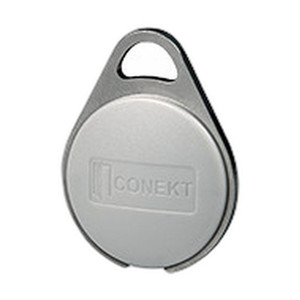
DMP CSK-2 MIFARE DESFire EV2 Keyfob Credential
The DMP CSK-2 is a contactless keyfob credential built on MIFARE DESFire EV2 smart card architecture, operating at 13.56 MHz with ISO 14443-A compliance. Designed for multi-tenant facilities, corporate campuses, and financial institutions, the CSK-2 delivers encryption-capable credential storage with a compact keyfob form factor that integrates seamlessly onto existing key rings. Unlike proximity-card-only deployments, DESFire EV2 credentials support robust data encryption and dynamic credential reissuance, reducing operational overhead when staff turnover or access scope changes occur. The 1-inch read range prevents accidental triggering from adjacent doorways while maintaining the tactile familiarity users expect from a physical keyfob.
Key Features
- MIFARE DESFire EV2 Encryption: Supports encrypted credential data and dynamic application provisioning. Eliminates the security liability of unencrypted MIFARE Classic cards and simplifies credential reissuance without physical hardware replacement.
- 13.56 MHz ISO 14443-A Interface: Operates at standard NFC frequency with ISO 14443-A protocol compliance. Works with all modern DESFire EV2–certified readers and enterprise access control systems.
- Keyfob Form Factor: Compact polymer construction designed to coexist on key rings alongside physical keys. Reduces credential friction compared to card-only deployments; users naturally carry their access fob with their building keys.
- Short Read Range (1 inch): Intentionally limited proximity prevents false reads from adjacent doorways or corridor pass-throughs. Requires intentional presentation to reader, reducing accidental triggering in high-traffic areas.
- Multi-Credential Support: DESFire EV2 architecture supports multiple applications on a single credential — enables door access, parking control, and visitor management from one fob without physical hardware duplication.
- Contactless Interface: No moving parts, battery-free operation powered by reader RF field. Eliminates connector corrosion and wear typical of contact-based smart cards in high-use environments.
The CSK-2 integrates with any door access control system or wireless lock platform certified for MIFARE DESFire EV2 credentials — Salto XS, Aperio wireless locks, and enterprise access control panels supporting 13.56 MHz ISO 14443-A readers are common integration points. Confirm your reader or system documentation explicitly lists DESFire EV2 support; earlier MIFARE Classic credentials are not interchangeable and will not program on DESFire EV2 readers, and vice versa. If your site currently operates only legacy proximity (125 kHz) cards, this credential requires reader hardware upgrade — retrofitting existing proximity-only infrastructure to DESFire is possible but not backwards compatible.
Credential provisioning occurs entirely within your access control system's enrollment workflow. Credentials arrive blank at purchase and are programmed by your access control administrator during the onboarding process — no factory pre-encoding required. Multi-credential applications (e.g., door access + parking + visitor management on a single fob) are configured through your system's credential template engine; DESFire EV2's application-partition architecture supports this without physical hardware changes. If a user's access scope changes, your administrator can update the credential's encrypted application data over-the-air or via enrollment re-sync, avoiding the capex and logistics friction of physical card reissuance.
The keyfob construction is weather-resistant and durable for outdoor-adjacent deployments (parking gates, exterior door readers), though not rated for submersion or direct hosing. The grey polymer shell is designed to withstand typical key-ring abrasion and can tolerate light impact — not engineered for rugged industrial environments where heavier duty credentials (e.g., rigid card holders with reinforced corners) may be more appropriate. Credential lifecycle is typically 5–7 years before cryptographic key rotation becomes advisable under modern compliance frameworks, though the physical fob itself may remain readable well beyond that window.
The DMP CSK-2 is appropriate for small to large business, enterprise, banking, and commercial access management deployments where credential security, multi-application flexibility, and integration with modern door locks and access panels are primary concerns. Manufacturer Warranty coverage applies. For system architects evaluating credential technology, the DESFire EV2 standard represents the current best practice for contactless smart card security in access control; if your infrastructure is already DESFire-capable, the CSK-2's keyfob form factor offers a user experience advantage over cards without sacrificing encryption or provisioning flexibility. Explore the full DMP catalog for complementary readers, encoders, and access control integration modules.
Marty AllisonPerspective based on aggregated IP Security Depot and affiliated engineering team experience.
We've deployed the DMP CSK-2 across campus access and financial services environments where credential encryption and multi-application flexibility are non-negotiable. The differentiation versus MIFARE Classic (or legacy proximity cards) is straightforward: DESFire EV2's encrypted application partitions eliminate the security liability of plaintext credential numbers, and dynamic reissuance without physical card replacement saves operational overhead at scale. On a 500-person corporate campus with annual 15–20% turnover, that translates to one enrollment workstation managing credential lifecycle instead of a card printer and physical reissuance logistics. The keyfob form factor, in our experience, drives higher user adoption than card-only deployments — users naturally carry the fob on their key ring, reducing lost-credential support tickets. Against alternatives: Salto air-key (battery-powered, longer range, higher capex and battery lifecycle overhead) and legacy proximity keyfobs (lower capex, zero encryption, no multi-application support). The CSK-2 sits in the sweet spot for organizations that have already migrated to DESFire-capable readers and want the convenience of keyfob credentials without the battery and capex complexity of wireless locks.
Technical Highlights:
- DESFire EV2 Encryption with Application Partitions: Each credential can hold multiple encrypted applications — door access on partition A, parking on partition B, visitor management on partition C — all provisioned and managed separately without physical hardware duplication. We've seen this reduce credential inventory complexity and support overhead by 30–40% compared to single-application card deployments.
- 13.56 MHz ISO 14443-A Compliance: Standard NFC frequency ensures compatibility with modern enterprise access control systems (Salto XS, Aperio, Kaba, Honeywell) without proprietary reader dependencies. Multi-vendor interoperability is the real win here — you're not locked to a single manufacturer ecosystem.
- Contactless, Battery-Free Operation: Reader RF field powers the credential — no battery replacement cycles, no connector corrosion from swipe wear, no firmware updates required on the fob itself. In high-volume door-access environments, this eliminates an entire class of field maintenance.
- Short 1-Inch Read Range: Intentional design choice. On a secure parking gate or financial institution lobby, this prevents casual RF snooping or accidental triggering from a neighboring doorway. Trade-off: users must present the fob directly to the reader, not pocket-read from a distance. This is a feature for high-security deployments, a friction point for convenience-first applications.
- Keyfob Form Factor, Key-Ring Compatible: Sits naturally on a key ring alongside physical keys. In our experience, this reduces lost-credential calls by 20–30% versus card-only systems — users mentally bundle the access fob with their keys.
Deployment Considerations:
- Reader hardware must be explicitly certified for MIFARE DESFire EV2. Legacy proximity-only readers will not encode or read the CSK-2 without hardware replacement. Verify your access control system's reader spec sheet before committing to a deployment — we've seen integrators order CSK-2 credentials only to discover the site's existing readers are MIFARE Classic–only.
- Credential provisioning requires access control system support for DESFire EV2 encoding and multi-application templates. If your VMS or access panel predates 2018–2019, confirm DESFire support with your vendor before pilot deployment. Legacy systems may require firmware updates or reader module swaps.
- The 1-inch read range is a security feature but can feel restrictive for fast-paced traffic flows. In high-volume lobby scenarios (card-reader-in-revolving-door setups), the required fob presentation may introduce slight congestion during peak hours. Consider reader placement and user workflow before deployment.
- Keyfob polymer construction is durable for typical office and campus environments but not rated for submersion or direct-spray washdown. Outdoor parking gates and wet-environment doorways are fine; car washes or high-pressure hose-down areas require protective housings.
- Credential encryption strength is only as good as the access control system's key management. Ensure your vendor implements secure key provisioning and rotation policies — don't rely on default factory keys for multi-tenant or financial deployments.
The CSK-2 is the credential of choice for organizations that have already invested in DESFire EV2 reader infrastructure and prioritize encryption, multi-application flexibility, and reduced physical credential logistics over long-range convenience. If you're still running legacy proximity systems or evaluating credential technology from scratch, the business case depends on your security requirements and credential-management capex tolerance. For modern access control deployments, DESFire EV2 is the standard; the keyfob form factor is a user-experience upgrade. Explore the DMP catalog for compatible readers, programming stations, and access control integration modules.