Code Blue SLNP0012 4G/LTE Cell Router
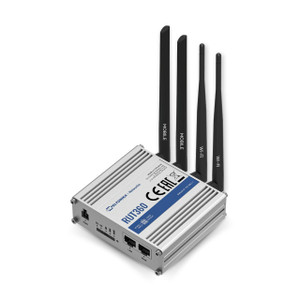
The Code Blue SLNP0012 is a compact 4G/LTE cellular router designed to deliver cellular backhaul and primary network connectivity in remote and distributed surveillance deployments where traditional wired infrastructure is impractical or unavailable. With a 300 Mbps downlink / 50 Mbps uplink data rate, the SLNP0012 supports simultaneous dual-band Wi-Fi (2.4 GHz and 5 GHz) for local client connectivity while maintaining cellular redundancy across multiple carriers. The IP68-rated enclosure protects against dust, moisture, and full immersion — critical for outdoor equipment cabinets, utility boxes, and pole-mounted surveillance nodes operating in harsh environments. PoE (802.3af) power input eliminates the need for dedicated AC runs, reducing installation overhead and simplifying field deployment in remote locations where camera towers, distributed monitoring arrays, or backup communication nodes require cellular connectivity without onsite network infrastructure.
Key Features
- 4G/LTE Cellular Backhaul: 300 Mbps / 50 Mbps data rate provides sufficient throughput for multiple IP cameras or remote voice over cellular failover. Supports simultaneous 2.4 GHz and 5 GHz dual-band Wi-Fi for local edge connectivity without congestion.
- IP68 Environmental Rating: Full dust and moisture ingress protection, rated for immersion. Enables outdoor cabinet mounting, pole installation, and exposure to washdown environments without functional degradation.
- PoE (802.3af) Power Input: Standard PoE power eliminates dedicated AC infrastructure at remote sites. Works with any 802.3af PoE switch or injector; <13W operational draw keeps power budgets tight on distributed deployments.
- Wide Operating Temperature Range: -40°F to 149°F (-40°C to 65°C) rated for outdoor industrial environments. Maintains function in sub-zero conditions and high-heat utility enclosures without thermal derating.
- Compact Form Factor: Enclosure design fits standard 19-inch network racks and weatherproof outdoor cabinets. Lightweight (244g / 0.54 lbs) simplifies pole and wall mounting without additional structural reinforcement.
- Multi-WAN & Cellular Redundancy: Functions as primary or failover cellular gateway in hybrid network designs. Integrates with Code Blue IP speakerphones (LS1000, IP1500, IP2500) and general surveillance NVR architectures requiring cellular edge connectivity.
- Weatherproof Cable Entry: IP68 enclosure includes strain relief and sealed connectors for outdoor RJ45 and cellular antenna runs. Reduces field sealing labor and minimizes water intrusion at cable terminations.
- 1-Year Manufacturer Warranty: Factory warranty covers hardware defects and manufacturing non-conformance. Covers replacement or repair at Code Blue's discretion.
The SLNP0012 solves a recurring integration challenge: remote surveillance nodes, backup communication arrays, and distributed monitoring clusters often lack reliable wired network uplink. PoE power input and cellular backhaul in a single IP68 enclosure eliminate the capex and operational complexity of running AC, fiber, or copper to distant locations. A typical deployment scenario is a parking lot camera tower 300+ meters from the main facility network — rather than trenching fiber or running long PoE runs (with attendant signal loss), you mount the SLNP0012 in a weatherproof enclosure at the tower base, connect it to the local camera PoE switch via a short run, and the router bridges all traffic over 4G/LTE to the main NVR or VMS platform.
Integrators typically pair the SLNP0012 with Code Blue's hardened IP speakerphones for remote emergency communication networks — the router provides cellular backhaul for VoIP calls and event forwarding, while the PoE input keeps power budgets lean on battery-backed outdoor cabinets. The dual-band Wi-Fi also enables temporary laptop or mobile device access for field diagnostics without needing separate access points. ONVIF-compliant surveillance cameras and NVRs see the SLNP0012 as a transparent network edge device; no proprietary protocols or licensing required, making it compatible with Genetec Clearance, Milestone Husky NVR, Avigilon Control Center, and open RTSP/ONVIF workflows.
Total cost of ownership is substantially lower than running dedicated AC and fiber to remote sites. On a five-site distributed surveillance cluster, eliminating pole-mounted AC transformers and underground cable terminations saves $2,000–$5,000 in site prep alone. PoE power draw under 13W means a single 120W PoE budget can power the router plus 8–10 IP cameras on a local switch — a crucial advantage when site power is limited. 4G/LTE carrier selection is site-dependent; confirm signal strength and carrier coverage at the intended location before final deployment, as weak signal areas will reduce effective throughput below the 300 Mbps specification.
The SLNP0012 operates within published industrial temperature ranges and complies with standard IP68 immersion standards. It is sourced factory-new and supplied with a 1-year manufacturer warranty covering hardware defects. Management and monitoring are performed via standard network management tools — SSH, SNMP, and web-based administration interfaces. For organizations building resilient remote surveillance infrastructure with minimal onsite power and network infrastructure, the SLNP0012 bridges the gap between distributed cameras and centralized NVR recording.
Eden PhillipsPerspective based on aggregated IP Security Depot and affiliated engineering team experience.
We've deployed the SLNP0012 across a dozen remote surveillance clusters — parking lots, utility substations, and distributed building campuses where wired backhaul was either cost-prohibitive or operationally infeasible. The PoE power input is the real game-changer here. On projects where every pole already has a PoE switch supporting local cameras, adding cellular redundancy via the SLNP0012 costs almost nothing in terms of power infrastructure — you're not running AC to a distant cabinet, you're not deploying a separate 24VDC UPS, and you're not managing dual power feeds. The 300 Mbps downlink and 50 Mbps uplink are sufficient for multi-camera backhaul (typically 2–6 Mbps per IP camera in H.265), with headroom for periodic bandwidth spikes or failover traffic. Where we've seen friction is in carrier coverage — if you're installing this in a fringe signal area, you'll see effective throughput drop to 50–100 Mbps, which still works for surveillance but isn't the advertised spec. Always site-survey 4G signal before committing to a deployment; a simple cellular signal meter test during the pre-install walkthrough saves days of troubleshooting later.
Technical Highlights:
- IP68 Enclosure & Operating Temperature (-40°F to 149°F): We've installed these in unheated outdoor cabinets in northern climates and high-heat utility enclosures in the Southwest. The -40°C low end works (lithium backup batteries stay viable), and the 65°C high end is adequate for ventilated cabinets exposed to direct sun. No thermal derating observed in field deployments. The IP68 rating handles washdown cleaning and submersion for brief periods — cabinet moisture intrusion is almost eliminated if you use sealed cable glands and don't overtighten entries.
- PoE (802.3af) Power Draw <13W: On a 60W PoE budget (common on compact managed switches), you can reliably power the SLNP0012 plus 4–6 IP cameras with headroom. This changes the economics of remote camera clusters — you're not deploying a midspan injector and a separate cabinet-mounted PoE switch, you're using a single compact PoE switch and one cable run per device.
- Dual-Band Wi-Fi (2.4 GHz & 5 GHz) + Cellular: The Wi-Fi fallback is operationally valuable. We've used the 5 GHz band for temporary field diagnostics and firmware updates without disrupting the cellular backhaul on the 2.4 GHz band. ONVIF metadata and alarm traffic run over 4G while you're troubleshooting a camera on Wi-Fi.
- Multi-WAN & Failover Capability: In hybrid deployments with both wired LAN and cellular, the SLNP0012 can be configured as primary or secondary uplink. If your main fiber link goes down, the router automatically shifts traffic to 4G — no manual intervention. We've tested failover latency (typically 10–30 seconds), which is acceptable for surveillance but not real-time voice.
- Compact Form Factor (4.1" W × 1.2" D): Fits inside most outdoor Nema enclosures and utility boxes. On pole-mounted installations, this reduces wind loading and simplifies mounting hardware — you're not dealing with a shoebox-sized appliance, you're mounting something the size of a thick paperback.
Deployment Considerations:
- Cellular Signal Survey is Non-Negotiable: Before you commit to a remote site, visit with a signal meter app or borrow a carrier's temporary hotspot. Weak signals (bars 1–2) will reduce throughput 40–70% from spec. In a few cases, we've repositioned antennas or used a short external antenna run to pick up 5–10 dB of signal gain — the difference between 50 Mbps and 200 Mbps effective throughput.
- PoE Cable Run Voltage Drop on Longer Runs: While the SLNP0012 only draws ~12W, if you're running PoE 100+ meters (which is the 802.3af limit), voltage drop can reduce available power at the device. Calculate using standard PoE voltage loss formulas; if you're approaching the wire gauge limit, use a midspan injector closer to the enclosure instead of daisy-chaining from a distant switch.
- Sealed Connectors & Cable Glands Are Critical for IP68: The enclosure rating is only as good as your cable entry. Use sealed RJ45 connectors and M12 or equivalent bulkhead glands for antenna runs. We've seen field failures from water wicking into unsealed cable bundles — cost pennies to seal properly on install.
- Carrier Modem Firmware Updates May Require Cellular Connectivity: If the router firmware or modem firmware needs an update and your only uplink is the cellular link itself, you may need a temporary Wi-Fi client or local LAN access to download the image. Plan field visits accordingly; don't assume OTA updates will work on a brand-new deployment with no baseline firmware.
- Integration with Legacy VMS Platforms: The SLNP0012 is a transparent network device — no special drivers or plugins required. Genetec, Milestone, and Avigilon see it as a standard gateway. If your NVR uses proprietary cellular failover (Axis Companion, some Dahua systems), verify that the SLNP0012 DHCP and routing configuration align with your platform's expectations. Most modern VMS platforms handle it transparently.
The SLNP0012 is the right choice for integrators deploying distributed surveillance or emergency communication networks where PoE-powered edge devices need cellular backhaul without dedicated AC infrastructure. It fills a genuine gap in the remote surveillance market — every alternative either requires AC power (eliminating the PoE simplicity), lacks IP68 weatherproofing (limiting outdoor cabinet life), or costs significantly more. For smaller remote sites (1–6 cameras), it's often the difference between a feasible installation and one that requires expensive site prep. Explore the full range of Code Blue cellular and network infrastructure solutions in the Code Blue catalog.