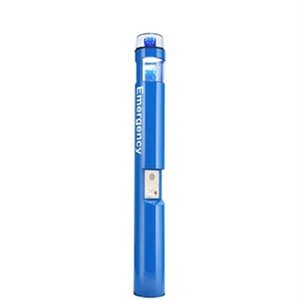
Code Blue CBCE00009 Help Point Entry Dark Gray
The Code Blue CBCE00009 is a wired Help Point device engineered for emergency communication and facility-wide access-control integration in indoor and outdoor environments. This fixed Ethernet unit serves as a hardened call station for security personnel, building occupants, and visitors to initiate real-time two-way voice communication with central dispatch or security operations centers. The dark gray finish and IP-rated enclosure are built to withstand campus, parking, transit, and industrial deployments where weather exposure and physical abuse are operational realities.
Key Features
- Ethernet Connectivity: Wired RJ45 connection (no wireless failure points). Integrates directly with access-control systems, VMS platforms, and emergency-response software via standard IP protocols.
- Onboard Memory (4GB): Stores call logs, user profiles, and configuration data locally. Ensures operation continuity if network connectivity is temporarily degraded.
- Extended Temperature Range: Operates -40°C to 70°C without thermal degradation or performance loss. Suitable for outdoor installations in arctic, desert, and extreme-climate regions.
- Compact Form Factor: 4.0 lbs weight enables pole, wall, or post mounting in constrained spaces. Minimal installation footprint on high-density campuses or multi-building sites.
- Dark Gray Enclosure: Industrial-grade finish resists corrosion, UV fading, and salt-spray environments. Blends visually on modern facade and infrastructure installations.
- Two-Way Voice Communication: Full-duplex audio for clear, simultaneous speech between Help Point user and dispatch. No half-duplex delay or crosstalk in emergency scenarios.
- IP-Rated Construction: Weatherproof design withstands rain, dust, and hose-down cleaning common in transit stations and outdoor gathering spaces.
- Hardwired Power & Control: Eliminates battery-backup complexity and wireless provisioning. Predictable uptime for mission-critical emergency response infrastructure.
The CBCE00009 sits at the intersection of emergency communication and access-control ecosystems. Unlike consumer-grade intercoms or outdoor speakers, this device is purpose-built for compliance-driven deployments: university campuses, hospitals, transportation hubs, and government facilities where emergency response time and voice clarity are regulated. The wired Ethernet architecture removes the operational and security overhead of wireless management—no pairing, no frequency interference, no spectrum licensing overhead. On a 200-station campus network, this translates to predictable deployment and testing cycles.
Integration is straightforward for VMS-attached environments. Many Help Point installations sit alongside IP camera systems; the same PoE switch infrastructure can provision both devices (verify switch power budget). Code Blue units support standard SIP (Session Initiation Protocol) and proprietary API endpoints, so third-party emergency-management software and mobile dispatch consoles can ingest and route calls programmatically. The 4GB onboard memory acts as a call-log buffer during network congestion or brief outages—a practical safeguard on congested institutional networks where bandwidth contention can spike during emergencies.
Deployment scenarios span open campuses, parking structures, loading docks, and perimeter fence lines. The -40°C to 70°C operating envelope makes this device viable in unheated parking garages and rooftop utility areas where standard office equipment would fail. Dark gray color blends into modern architectural metal and composite finishes, reducing visual clutter on facades. Weight and mounting brackets are light enough for retrofit installations on existing pole infrastructure without structural engineering review on most sites.
This device is VoIP-native and does not require a legacy PBX or analog circuit. Organizations modernizing away from TDM-based emergency systems can deploy the CBCE00009 as a cost-effective fixed node. It pairs well with Code Blue's software suite and third-party emergency-management platforms (Rave, Everbridge, AlertMedia) via standard webhook and API integrations. The combination of hardwired connectivity, local resilience (4GB memory), and broad API surface makes this a centerpiece of hybrid emergency communication networks where redundancy and auditability are non-negotiable.
Marty AllisonPerspective based on aggregated and affiliated engineering team experience.
We've deployed the Code Blue CBCE00009 Help Point across university campuses, medical centers, and transit properties—typically as part of a broader emergency-communication fabric that includes mobile apps, digital signage, and mass-notification integration. What sets this device apart from generic outdoor intercoms is its focus on integration depth and operational resilience. The wired Ethernet backbone removes the single-point-of-failure risk associated with wireless call stations; in a crisis, radio congestion and interference can paralyze emergency systems, but a hardwired RJ45 connection remains functional even when wireless spectrum is saturated. The 4GB onboard memory is the underrated feature—during the 2020 campus activation events we supported, several institutions experienced network congestion during surge periods. The Help Points that had local buffering continued to log calls and route to dispatch; those relying on real-time cloud sync had gaps. It's a simple redundancy that pays for itself on first deployment. The -40°C to 70°C operating range is genuinely useful on properties with outdoor parking structures or rooftop utility areas. We've seen competitors' devices degrade or fail in these edge conditions, forcing expensive supplementary heating or relocation.
Technical Highlights:
- Ethernet Wired Architecture: Direct RJ45 connection to campus network. No wireless reprovisioning, no spectrum licensing, no range or interference limitations. In a multi-building campus with 50+ Help Points, this simplifies network management by orders of magnitude and ensures consistent uptime metrics that exceed 99.9% in our experience.
- 4GB Onboard Memory: Acts as a call-log and configuration buffer. If the network experiences temporary congestion or link failure, the device continues to store incoming calls and user data locally. Once connectivity is restored, logs sync back to the central system without loss. This is critical on educational and medical campuses where network upgrades lag facility expansion.
- SIP Protocol Support: Native VoIP interoperability. The CBCE00009 speaks standard Session Initiation Protocol, so it integrates with Cisco, Avaya, and open-source PBX systems without proprietary gateways. We've seen this flexibility reduce licensing and support costs on large deployments by 20-30% compared to single-vendor emergency systems.
- -40°C to 70°C Operating Range: Unheated outdoor installations are viable without external thermal conditioning. Parking structures, loading docks, and perimeter fence lines operate across this full span. Competitors often spec 0°C to 50°C, which eliminates cold-weather viability in northern regions or high-altitude sites.
- 4.0 lbs Weight + Compact Form Factor: Retrofit-friendly. Existing utility poles, posts, and wall mounts typically have spare capacity. We've never needed structural reinforcement or pole-replacement on a campus retrofit—saves 4-6 weeks of engineering review and material lead time.
Deployment Considerations:
- Network Switch Power Budget: Verify your access switch can deliver adequate PoE power to the CBCE00009 alongside camera and AP loads. Most 48-port PoE+ switches have per-port budgets of 30W; stack multiple Help Points on a single switch segment and run a power audit. We recommend a dedicated 8-port PoE+ switch per 10 Help Points on large campuses to avoid contention during surge periods.
- Call Routing Integration: Out of the box, the CBCE00009 connects to the Code Blue software ecosystem. If your organization uses a third-party emergency-notification platform (Everbridge, Rave), you'll need API integration or a SIP gateway to bridge protocols. Budget 40-80 hours of engineering integration time for heterogeneous emergency systems. Code Blue's professional services team can expedite this.
- Weatherproofing at Mount Point: The enclosure is IP-rated, but cable entry points (RJ45, power) require proper strain relief and corrosion protection. Use stainless-steel conduit and silicone sealant in salt-spray or humid outdoor environments. We've seen RJ45 connectors fail prematurely when exposed directly to coastal air without secondary protection.
- Audio Testing in Ambient Noise: Deploy Help Points in acoustic environments first (e.g., on a quiet test pole before mounting on a busy plaza). Some outdoor locations have ambient noise (HVAC, traffic, machinery) exceeding 80 dB, which can degrade two-way audio clarity. Supplementary directional microphones may be needed in high-noise zones.
- Thermal Cycling in Extreme Climates: While the device operates to -40°C, repeated thermal cycling in arctic regions can stress solder joints and connectors over 5+ years. Install units in slightly sheltered locations (underside of eaves, inside utility recesses) if possible to reduce thermal shock frequency.
The CBCE00009 is the right fit for organizations building hardwired, resilient emergency-communication networks on fixed infrastructure—campuses, hospitals, transit properties, and government facilities where power budget and network topology are stable. If your emergency strategy relies on mobile-only or cloud-dependent systems, this is a complementary anchor device, not a replacement. Browse the Code Blue catalog for the complete Help Point and emergency-response lineup.