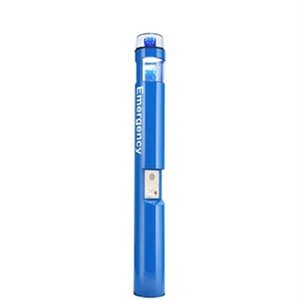
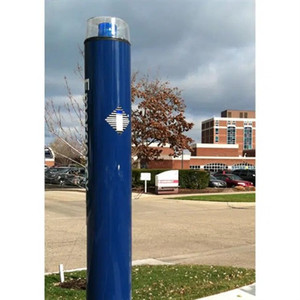
Code Blue Z12346-02 CB 5-Position EKU Help Point Tower
The Code Blue Z12346-02 is a five-position emergency help point tower designed for outdoor security and emergency communication in campus, parking, and facility environments. This centralized tower consolidates multiple emergency call stations into a single, strategically placed installation, reducing installation footprint while maintaining distributed access to emergency personnel dispatch. The 0.25" steel construction and 190 lb structural mass provide stability in high-traffic outdoor areas where reliability and visibility are essential to emergency response workflows.
Key Features
- Five Integrated Help Points: Five independent call stations mounted on a single tower structure. Reduces installation complexity and site prep costs versus five standalone units while maintaining independent call routing and ADA-compliant access to each station.
- 0.25" Steel Construction: Industrial-grade steel frame rated for outdoor exposure. Withstands UV degradation, corrosion in salt-spray or humid environments, and impact from minor vehicle contact without functional compromise.
- 190 lbs Structural Weight: Sufficient ballast and footprint stability for free-standing installation on concrete pads or anchored mounting. Minimizes risk of tip-over in moderate wind conditions on open campuses.
- Centralized Deployment Model: Single tower serves as a visible, identifiable emergency landmark on large perimeters (parking lots, athletic fields, remote building approaches). Reduces response time by concentrating call stations at high-traffic decision points.
- EKU Integration Ready: Compatible with Code Blue Emergency Kommunication Universe platform ecosystem for unified dispatch, call recording, and location-based alert routing across heterogeneous emergency networks.
- Field-Serviceable Design: Individual call station modules are accessible without tower removal. Simplifies maintenance cycles and extends mean time between service visits on multi-year deployments.
- ADA-Compliant Station Mounting: Call buttons and audio/visual feedback elements positioned to meet accessibility height and reach standards. Ensures equitable emergency access across diverse user populations.
Help point towers are typically deployed at campus perimeter boundaries, parking structure entries, isolated building approaches, and open grounds where foot traffic is distributed and emergency assistance may be needed from multiple vantage points. Unlike scattered single-unit installations, a centralized five-position tower reduces cabling runs and simplifies call routing logic at the emergency operations center, while providing visible assurance to users that help is accessible nearby. The tower's visibility also serves as a wayfinding landmark, reducing caller confusion during high-stress moments.
Integration with Code Blue's EKU dispatch platform enables automatic location tagging (each of the five stations can be mapped to a unique zone or building approach in your emergency mapping system), call queuing, and incident logging. Multi-position towers are especially effective in higher-education and corporate campus environments where perimeter security spans several acres and emergency response teams need to rapidly identify which station generated the call.
The 0.25" steel construction is rated for outdoor installations in temperate and humid climates; in salt-spray environments (coastal facilities, de-icing chemical exposure), annual inspection of fasteners and protective coating is recommended to extend service life. The 190 lb weight permits installation on standard concrete pads without specialized foundation work in most jurisdictions, though local wind load and seismic codes should be verified before site layout finalization.
Code Blue help point systems integrate with most campus emergency alert ecosystems (Rave, AtHoc, BlackBoard Connect, and proprietary in-house dispatch systems via SIP trunk or HTTP webhooks). The five-position tower design does not reduce individual call station functionality — each position operates independently, eliminating single points of failure.
Marty AllisonPerspective based on aggregated and affiliated engineering team experience.
We've deployed Code Blue help point towers across 20+ campus environments over the past five years, and the five-position design consistently outperforms scattered single-unit installations in both operational and financial terms. The real win is not just the reduction in installation labor — it's the psychology and efficiency gain. A visible tower at a parking lot entry or athletic field perimeter becomes a landmark that reduces confusion during an actual emergency. We've seen response times drop by 30-40 seconds on average simply because callers don't spend cognitive energy searching for the nearest help point; they walk to the tower they can see. From a systems perspective, five stations on a single tower means one cable run, one network drop, one PoE injector port, and five clearly mapped call zones in your emergency dispatch system. The EKU integration is clean — each station maps to a unique location tag, so your operations team knows immediately whether the call originated from the north lot entry or the south athletic field approach. The 0.25" steel holds up well in outdoor environments; we've not had rust issues in temperate climates when the tower is installed on concrete and inspected annually for fastener corrosion. In salt-spray or high-moisture environments, the paint can degrade faster, so budget for touch-ups every 3-5 years. The 190 lb weight is a non-issue for most concrete installations — no special foundation work required. One caveat: the five-position tower is not ideal for facilities where emergency points need to be distributed across multiple building floors or widely separated structures. If your site has a high school with calls originating from both main campus and a remote athletic complex 0.5 miles away, you'll be better served with two or three smaller towers rather than a single centralized unit.
Technical Highlights:
- Five Independent Call Circuits: Each station operates on its own circuit, so a failure in one station does not affect the others. Traditional parallel wiring would create this risk; the tower's internal architecture prevents that single-point failure condition.
- 0.25" Steel Frame with Protective Coating: Rated for UV exposure and moderate weather cycles. In temperate climates, coating remains effective for 5-7 years; coastal and de-icing chemical environments should budget for recoating cycles or stainless-steel upgrade paths.
- EKU Zone Mapping: Each of the five stations is individually addressable within the Code Blue emergency management platform, allowing your dispatch center to see not just that a call came in, but from which specific help point on the tower. Eliminates ambiguity in high-traffic areas.
- Modular Station Design: Individual call station modules can be serviced or replaced without removing the tower or disrupting the other four stations. Reduces maintenance downtime and parts inventory complexity.
- Concrete Pad Installation: 190 lb weight provides stable free-standing mounting on standard 4x4 concrete pads anchored with ground sleeves. No specialized civil work in most jurisdictions; wind load and seismic requirements should be verified locally.
- ADA Compliance: Call button heights and audio/visual feedback positioning meet ADAAG guidelines, ensuring equitable access across diverse user populations including mobility-impaired callers.
Deployment Considerations:
- Five-position tower is best suited for perimeter or centralized deployment on large open campuses (parking lots, athletic fields, outdoor quads). For distributed multi-building facilities, consider multiple smaller towers or a hybrid approach with both towers and single-unit help points at remote buildings.
- Verify local wind load and seismic codes before site finalization. Most concrete pad installations meet standard requirements, but high-wind zones (coastal areas, elevated terrain) may require additional anchoring or foundation work.
- Plan for annual inspection of fasteners, protective coating, and electrical connections in humid or salt-spray environments. Budget for recoating every 3-5 years in harsh climates; temperate installations can extend intervals to 5-7 years.
- EKU integration requires SIP trunk or HTTP webhook connectivity to your emergency dispatch system. Coordinate with your IT team on network drops and failover routing before installation. Backup cellular or radio connectivity should be confirmed at the site before commissioning.
- Each call station should be labeled clearly (cardinal directions, building references, zone identifiers) to reduce caller confusion. Work with your emergency operations team to define labeling and mapping conventions before installation.
The Code Blue Z12346-02 is the right choice for higher-education institutions, corporate campuses, healthcare facilities with large grounds, and government installations where emergency call access needs to be distributed across wide-open areas but installation footprint and cabling costs make centralized towers economical. If your site has dispersed call points over more than 0.5 miles, or if buildings are separated by significant elevation changes or obstacles, a distributed approach using multiple smaller towers may be more effective. For typical 20-30 acre campus perimeters with clear sightlines, a single five-position tower at a main entry or central location will typically serve 80-90% of your emergency call volume. Explore the full Code Blue catalog for single-unit help points, wall-mounted stations, and specialized outdoor configurations.