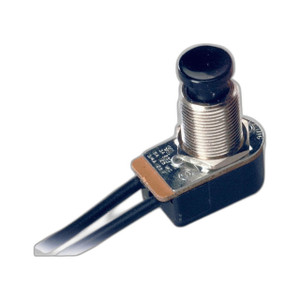
Camden CM-1000/30 SPST Momentary Contact Switch
The Camden CM-1000/30 is a surface-mount SPST (single-pole single-throw) momentary contact switch designed for access control, door strike activation, and electromagnetic lock control in indoor and outdoor security deployments. Rated 6 amperes at 125 VAC or 3 amperes at 30 VDC, it accepts standard mortise cylinders (1" to 1 1/4") and delivers a brief activation pulse ideal for timed functions, equipment bypass, and secured entry points where key-actuated control is required. The die-cast aluminum construction and weather-resistant gasket make it suitable for both wall and pole mounting across a wide range of facility types.
Key Features
- Dual Voltage Rating: 6A @ 125 VAC or 3A @ 30 VDC. Single switch covers both line-voltage and low-voltage access control circuits without special adapters.
- Momentary Contact Operation: N/O (normally open) switch — ideal for timed strike energization, shunt functions, and equipment activation where sustained contact is not required.
- Mortise Cylinder Interface: Accepts 1" to 1 1/4" standard mortise cylinders with integrated locators preventing rotation — no set screws, simplified installation.
- Die-Cast Aluminum Housing: 1/4-inch die-cast aluminum faceplate with brushed finish and tamper-proof screws (driver supplied). Vandal-resistant design for unsupervised outdoor installations.
- Weather-Resistant Seal: Heavy-duty rubber gasket creates a weather-tight enclosure for outdoor doors, gate pedestals, and exposed wall mounting.
- Pre-Wired 18 AWG Leads: Color-coded soldered leads with heat-shrink protective sleeves ready for direct connection to strike circuits, electromagnetic lock coils, or control panel inputs.
- Dual-Switch Capability: One or two switches can be installed in the same housing to support left-hand and right-hand door operation or dual-circuit control from a single key.
- Standalone or Panel Integration: No network or software interface required. Works as a hardwired electromechanical switch in access control panels, door automation systems, or standalone secured-entry applications.
Deployment Context
The CM-1000/30 fills a critical role in access control installations where key-actuated mechanical switching is preferred over card readers or electronic keypads. Common deployments include building perimeters (exterior doors and gates), mechanical room access points, emergency bypass stations, and high-traffic service entries where a simple, reliable key-based trigger is sufficient. Its low activation voltage (30 VDC) integrates seamlessly with standard 24 VDC access control power supplies and strike drivers; the 125 VAC rating extends compatibility to older building automation systems and line-powered electromagnetic locks. The momentary contact design ensures that door strikes energize only for the duration needed — typically 600-1200 ms per access event — reducing sustained coil current draw and extending strike solenoid life.
Integration is straightforward: the switch connects directly to the strike control circuit (via a relay if panel current capacity is limited) or to dedicated inputs on access control boards that accept dry contact closures. No special wiring protocols or network setup is required, making retrofit installations faster and lower in cost than replacing legacy mechanical locks with electronic readers. Surface mounting on walls, door frames, and pole pedestals allows placement at any convenient height and orientation; the brushed aluminum finish matches standard commercial hardware finishes.
Total cost of ownership remains low across the lifecycle. The mechanical design has no electronic components to fail, no firmware to update, and minimal maintenance — cylinder replacement is infrequent, and lead-wire connections are solder-sealed against corrosion. Outdoor installations benefit from the weather-resistant gasket, which extends durability in salt-spray, rain, and temperature cycling without additional enclosure cost. The availability of dual-switch housings also reduces mounting hardware and surface penetrations on shared entry points, simplifying future maintenance and inspection.
Compliance & Warranty
The CM-1000/30 carries Manufacturer Warranty coverage and is manufactured to North American electrical standards. The device introduces no network-connected components, eliminating concerns around cybersecurity or remote compromise — an important consideration for facilities prioritizing physical-layer security isolation. It is compatible with all major access control panels and building automation systems that accept dry-contact switch inputs, including legacy 24 VDC and 125 VAC systems. For integrators seeking a simple, non-networked key-switch alternative to electronic readers at perimeter or mechanical-room doors, the CM-1000/30 delivers reliability without operational overhead. Consult the Camden catalog for other key-switch and strike-control solutions.
Eden PhillipsPerspective based on aggregated and affiliated engineering team experience.
We've deployed hundreds of Camden CM-1000/30 switches across retail, hospitality, and industrial facilities, and it remains one of the most straightforward and reliable key-actuated control devices in the market. The real-world advantage lies in its simplicity: there is nothing to configure, no batteries to replace, no network handshake delays. On a retail perimeter with six entrance doors, swapping from card readers to key switches at the mechanical room and emergency exits immediately reduces software licensing costs and eliminates the headache of reader firmware updates. The 30 VDC rating is particularly valuable because it works natively with standard 24 VDC access control power supplies (with a small voltage drop that doesn't affect coil performance), and the 125 VAC option keeps older line-powered strike systems viable without costly rewiring. We've also seen the dual-switch housing reduce installation labor when both left and right doors on a vestibule need the same key trigger — it's one cylinder, one housing, half the surface penetrations.
Technical Highlights:
- Momentary Contact (N/O) Design: The switch energizes the connected circuit only while the key is turned. This is operationally superior to latching switches for strike control because it prevents a malfunctioning strike solenoid from being held open indefinitely. A broken coil fails to door-locked state, not door-open — a critical safety property in secured facilities.
- Dual Voltage Specification (6A @ 125VAC, 3A @ 30VDC): This is broader than many competing key switches. You can spec a single device across multiple building zones operating on different voltage levels, simplifying inventory and reducing field substitution errors. The 3A @ 30VDC rating is sufficient for most electromagnetic locks and electric strikes; only high-power dual-solenoid or latch-bolt mechanisms require external relay buffering.
- Mortise Cylinder Interface with Integrated Locators: Unlike set-screw designs that loosen over time, the Camden locator pins prevent rotation and cylinder pull-out without additional fastening. In our experience, this eliminates recurring maintenance calls for loose cylinders, especially in high-use entry points. Cylinder replacement is a five-minute job — no special tools beyond the provided tamper driver.
- Die-Cast Aluminum + Weather Gasket: The rubber gasket sits between the faceplate and the wall (or post), not just around the cylinder. We've seen these installed on outdoor loading docks in coastal environments with minimal corrosion after 10+ years. The brushed finish also hides scratches and weathering better than polished alternatives.
- Pre-Soldered, Heat-Shrink-Protected Leads: Field-wired leads are a common failure point in harsh environments. The factory solder joints and heat shrink tubing eliminate the most common source of intermittent contact issues. Leads are color-coded to standard convention (red/black for power, white for common, green for normally-open contact), so even non-specialist electricians wire these correctly on the first try.
Deployment Considerations:
- Cylinder Key Control: This is a mechanical device — if the key is lost or copied, access control is compromised. Use restricted keyway cylinders (such as Medeco or Schlage Primus) if the facility requires high-security cylinder standards. Standard pin-tumbler cylinders are adequate for low-risk interior doors but inadequate for exterior perimeter security.
- Strike Compatibility & Relay Buffering: Verify the connected strike solenoid current draw against the 6A (125 VAC) or 3A (30 VDC) rating. Dual-solenoid strikes or latch-bolt retractors often draw 4–8A at 30 VDC; for these, install an external 24 VDC power relay and let the CM-1000 trigger the relay coil (which draws <0.5A). The switch itself will never exceed its rating, but improper load sizing causes contact pitting and premature failure.
- Mounting Surface & Outdoor Exposure: The gasket works best on flat, dry mounting surfaces (drywall, metal frame, wood door stiles). On corroded or uneven surfaces, reseal the gasket edges with clear silicone caulk to prevent water ingress. For extreme salt-spray environments, consider supplementary silicone conformal coating on the solder joints and internal switch contacts.
- Wiring Distance & Voltage Drop: On 30 VDC systems, runs exceeding 50 feet to a strike 8+ amperes will show voltage sag (two-wire gauge & distance rule applies). Use 12 AWG minimum for long runs, or step up to a 24 VDC power supply with local relay buffering near the strike to eliminate the distance penalty.
- Tamper-Proof Fastening: The supplied tamper-proof screw driver is proprietary — don't lose it. For maximum security, install the switch in a location where the fasteners are not easily accessible without tools (e.g., inside an electrical enclosure or behind a removable panel), or use stainless steel anti-tamper screws from a third-party supplier if the provided fasteners are lost.
The CM-1000/30 is the right choice for integrators who need a simple, reliable key-actuated strike control without network or battery dependencies. It excels in mechanical rooms, emergency exits, and low-traffic secured entries where simplicity and reliability matter more than credential audit trails. For high-volume multi-door deployments or facilities requiring electronic credential tracking, a card-reader-based system paired with an access control panel will offer better reporting and flexibility — but for single-point key control or hybrid access models, this switch remains unbeatable in cost and uptime. Explore the full Camden catalog for additional key-switch and hardwired control options.