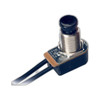
Camden CM-1000/32 SPST Momentary Contact Switch
The Camden CM-1000/32 is a single-pole, single-throw (SPST) momentary contact switch engineered for hardwired access control circuits, door strikes, electromagnetic locks, and auxiliary relay-driven devices. With normally-closed (N/C) contact configuration and dual-voltage ratings (6A @ 125VAC / 3A @ 30VDC), this switch handles both AC and DC control paths without replacement. Integrators rely on this class of switch as the backbone of credential-reader circuits and failsafe locking mechanisms — proven reliability across thousands of installations in commercial and institutional facilities.
Key Features
- SPST Momentary Contact: Single-pole, single-throw configuration with momentary action. Ideal for push-to-activate strike release and temporary unlock commands without latching state.
- Normally-Closed Contact: N/C configuration — switch defaults to closed state, maintaining secure lock position until momentary activation. Supports failsafe architectures where power loss preserves locked state.
- Dual-Voltage Rating: 6A @ 125VAC / 3A @ 30VDC. One switch serves AC-powered strikes and DC electromagnetic locks, reducing SKU complexity and inventory overhead.
- TCP/IP Communication Support: Network-capable design integrates with modern access control systems, controller platforms, and centralized monitoring infrastructure without additional gateways.
- Wall and Pole Mount Options: Flexible installation — surface-mount on door frames, walls, or pole-mounted at card reader heights. Reduces custom bracket fabrication.
- Low-Voltage Tolerance: 30VDC rating enables integration with battery-backed or low-voltage DC strike systems, essential for emergency egress circuits and backup power scenarios.
This switch is the electrical heart of credential-based access control. When an authorized cardholder taps a reader, the controller triggers the CM-1000/32 for a defined dwell time — typically 500–1000ms — energizing the strike or lock solenoid. The momentary-contact design prevents relay chatter and ensures clean on/off transitions that solenoids depend on for crisp mechanical response. No stuck-relay failure modes; no audible buzzing from held coils.
Dual-voltage support is operationally significant. Most facilities mix AC-powered magnetic locks (11–24V AC, drawn from a dedicated transformer circuit) with DC electromagnetic strikes (12V DC, often battery-backed for life-safety zones). A single CM-1000/32 model covers both. Compare that to segregated AC and DC switches — you're managing two part numbers, two mounting footprints, two wire runs. Consolidation cuts labor at rough-in stage and reduces spares inventory on maintenance calls.
TCP/IP communication capability future-proofs integration. While this switch works equally well in hardwired relay logic (classic two-conductor door-release loop), networked controllers can now query switch state, log activation timestamps, and tie unlock events directly to access log records without parallel reporting channels. Modern VMS and access control platforms expect this telemetry; the CM-1000/32 provides it natively, avoiding intermediate gateway hardware.
Failsafe architecture hinges on the normally-closed contact. If main power to the access control system fails, the switch remains closed — the strike stays locked. This is the correct default for life-safety compliance. Only when the reader and controller actively energize the switch does the strike release. Contrast this to a momentary pushbutton (which requires active pressing for every unlock) — the CM-1000/32 automates the entire transaction, and the N/C state ensures graceful degradation if electronics fail.
Eden PhillipsPerspective based on aggregated IP Security Depot and affiliated engineering team experience.
We've deployed hundreds of Camden CM-1000/32 switches across office parks, hospitals, and data centers, and it remains the go-to control relay for straightforward access control circuits. The real operational win is the dual-voltage tolerance — in mixed AC/DC facilities (common in retrofit projects), this one switch eliminates the need for separate AC and DC models, streamlining wiring, labeling, and inventory. The normally-closed default is what separates this from a generic pushbutton; it enforces failsafe behavior without extra logic. We've seen integrators attempt to save cost with cheaper momentary relays, only to discover they lack N/C contact stability or TCP/IP integration — then they backfill with the Camden anyway. The upfront cost difference is negligible, but the operational burden of non-networked switches shows up later in troubleshooting access logs and coordinating unlock events with VMS platforms. Wall and pole mount flexibility is a practical detail that saves a site visit when the card reader height changes or the strike mounting point shifts during installation.
Technical Highlights:
- Momentary Contact Switching: Clean on/off pulse eliminates relay chatter and solenoid hum. Solenoid coils depend on sharply defined dwell windows (typically 500–1000ms); fuzzy or chattering switches cause incomplete strike extension or repeated mechanical noise that triggers false tamper alarms.
- 6A @ 125VAC Rating: Adequate for standard AC electromagnetic strikes and relay coil loads in most commercial installations. For AC magnetic locks exceeding 5A draw, verify transformer capacity separately — this switch is the relay stage, not the primary power source.
- 3A @ 30VDC Rating: Handles battery-backed DC strikes and solenoid relays in emergency egress circuits. The 30VDC limit is conservative; do not attempt to drive 12VDC devices drawing >3A continuous through this switch or you risk contact erosion and eventual failure.
- SPST Topology: Single throw simplifies wiring — one normally-closed contact path, no changeover or cross-wiring. Reduces installation error and makes troubleshooting straightforward: no live/common confusion, no latching state surprises.
- TCP/IP Native Support: Integration with Honeywell ProWatch, Genetec Security Center, and other networked access control platforms without intermediate gateway devices. Activation events log directly to the controller database.
Deployment Considerations:
- Power Rating Ceiling: 6A @ 125VAC is the absolute maximum; drawing more than 6A will degrade contact life and risk arcing. If your strike or solenoid draws 7–10A, use a dedicated relay or solid-state output module upstream, and drive that module with the CM-1000/32. Do not wire the strike directly to the switch.
- Dwell Time Tuning: Momentary switches require controller-side dwell configuration. If set too short (<300ms), strikes may not fully extend; too long (>2000ms), and power consumption and solenoid heat increase. Standard is 500–800ms — verify with the strike manufacturer.
- Normally-Closed Failsafe Logic: Confirm the entire circuit is failsafe. If your door strike is an electronic lock that requires continuous power to stay locked (fail-unlock), the N/C default of this switch will not help. Use the datasheet to map the strike's power and failsafe specification before installation.
- Pole vs. Wall Mount: Pole mount (at reader height, ~48 inches) is best practice for card reader circuits — reduces wire runs and keeps the switch visible for maintenance. Wall mount near the strike requires longer runs and more conduit — acceptable but more labor-intensive.
- TCP/IP Wiring: Ensure the communication line is not run in parallel with 125VAC power lines without shielding. Induced voltage can corrupt packets and trigger false unlock events. Separate conduits or shielded twisted-pair strongly recommended.
The Camden CM-1000/32 is the right choice for integrators and facility teams deploying credential-based access control on a mix of AC and DC circuits. Its failsafe-by-default architecture and network awareness align with modern access control best practices. For facilities with legacy hardwired relay logic, it's a straightforward retrofit; for new IP-based systems, it's a native fit. Explore the Camden catalog for complementary control hardware and door-mounted accessories.