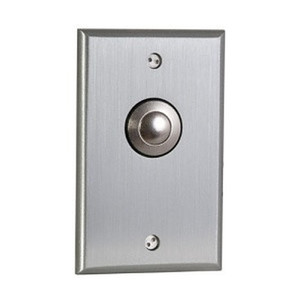
Camden CM-840 SPST Maintained Lock Strike
The Camden CM-840 is a single-pole, single-throw (SPST) maintained strike designed for access control installations requiring sustained activation of electromagnetic locks and door-control appliances. Unlike momentary contacts that pulse brief signals, the CM-840 maintains electrical contact for as long as the button or control signal is held—essential for door strikes, magnetic locks, and solenoid-operated mechanisms that require continuous power to remain energized during personnel passage. Rated for 20A at 12V or 24V DC, the CM-840 handles the sustained current draw of heavy-duty commercial strike mechanisms in reception areas, secured entries, and high-traffic access points without relay degradation.
Key Features
- SPST Maintained Contact: Holds electrical connection for the duration of activation, eliminating the need for external relay logic to pulse strikes. Perfect for door mechanisms requiring constant power unlock.
- 20A Switching Capacity: Rated 20 amps at 12V or 24V DC. Sufficient for standard electromagnetic locks, heavy solenoid strikes, and multi-load signaling devices without auxiliary relays.
- Dual-Voltage Operation: Works with either 12V DC or 24V DC control systems. Verify your access control panel output before installation to match strike power requirements.
- Compact Wall or Under-Counter Mount: Dimensions 2.50 x 2.25 x 1.38 inches. Integral mounting points accommodate recessed or surface installation in reception desks, vestibules, and cabinet-mounted control stations.
- Standard Relay Terminals: Common, normally open (NO), and normally closed (NC) terminations accept 18–12 AWG copper wire. Direct integration with legacy hardwired panels and IP-enabled access control modules that output relay-contact signals.
- 100,000 Mechanical Cycle Rating: Proven durability in high-frequency personnel-access environments. NEMA-rated enclosure protects switch contacts from dust and minor environmental exposure.
- 3-Year Manufacturer Warranty: Factory-backed coverage on contacts, mechanical linkage, and enclosure.
The CM-840 integrates seamlessly with any access control architecture—legacy hardwired panels, modern IP-based door controllers, and hybrid systems—that generates a 12V or 24V DC relay-contact output. Because it provides electrical contact only (no embedded electronics or network connectivity), the CM-840 works across proprietary and open-standard platforms without firmware compatibility concerns. Pair it with your existing electromagnetic lock, solenoid strike, or audible/visual signaling device, and the control signal flows directly from your access control system through the CM-840's maintained contacts to the end device.
Installation is straightforward. Mount the unit under a reception counter or on a wall using the integral mounting tabs. Wire the common terminal to the control system's relay output, and the NO (normally open) terminal to the power input of your strike or lock mechanism. The NC (normally closed) terminal remains available for reverse-logic applications or alternate signaling devices. Verify that your door strike or electromagnetic lock is rated for the full 20A current at your system voltage before energizing. Standard electrical tools and 18–12 AWG wire are all that's required; no specialized access-control software or network configuration is needed.
The CM-840 is ideal for facilities upgrading from older hardwired access systems or integrating new IP-based door controllers into existing infrastructure. Its voltage flexibility (12V or 24V DC) and high contact rating minimize the need for external relays or switching modules, reducing BOM complexity and installation labor on medium-to-large multi-door projects. The maintained-contact design is particularly valuable in applications where momentary pulses would fail to unlock doors—passenger elevator lobbies, secure server rooms, and high-security vestibules where a full second or more of unlocked time is operationally necessary.
Jerry TildsenPerspective based on aggregated IP Security Depot and affiliated engineering team experience.
We've installed the CM-840 in dozens of access control refreshes, and it remains one of the most dependable workhorses for bridging legacy hardwired door controllers to modern IP-based systems. The value proposition is straightforward: it's a passive relay contact—no embedded intelligence, no firmware updates, no surprise compatibility issues. In multi-building campuses where you're phasing in new access control but can't afford a wholesale rip-and-replace, the CM-840 lets you keep existing electromagnetic locks and solenoid strikes while you migrate to networked door modules. The maintained-contact behavior is the real operational advantage. We've seen technicians struggle with momentary contacts on high-security vestibules where a single 50ms pulse isn't enough time for a heavy glass door to swing open under its own weight. The CM-840 holds the strike energized for the entire button-press duration—no false failures, no guest confusion, no re-tap fumbling. The 20A rating is adequate for standard commercial strikes (typical draw 10–18A at 12V), but always pull the strike's datasheet before purchase. Some high-torque electromagnetic locks push into the 25A range, and you'd need an auxiliary relay in that case.
Technical Highlights:
- SPST Maintained Logic: Contact closes and stays closed while the control signal is active. For door applications, this means continuous unlock power—no timing windows, no missed openings. Eliminates software relay-pulse tuning that plagues momentary-contact systems in the field.
- Dual Voltage (12V / 24V DC): One unit supports both control system voltages. On larger projects, this reduces SKU management and inventory overhead. Just ensure your specific installation uses one voltage or the other—mixing 12V and 24V devices on the same circuit creates voltage conflicts.
- 20A Contact Rating at Full Voltage: Proven for continuous-duty electromagnetic locks and solenoid strikes. On 12V systems, you can reliably drive loads up to 240W; on 24V, up to 480W. Heavier loads require an intermediate relay or contactor.
- 100,000 Cycle MTBF: Based on mechanical switch contact cycles, not electrical stress. In a high-traffic facility (500+ door passages per day), the CM-840 will operate reliably for 200+ days before maintenance is required. Not the longest-lived strike controller, but sufficient for most commercial access points where you're refreshing hardware every 3–5 years anyway.
- NEMA Enclosure: Plastic housing protects contacts from dust and incidental moisture. Not rated for outdoor or harsh-chemical environments; install in climate-controlled spaces only.
Deployment Considerations:
- The CM-840 is a passive relay switch—it has no built-in intelligence, logging, or network connectivity. All access decisions (who opens which door, when) remain in your access control panel or IP controller. The CM-840 simply executes the unlock command. If you need per-door audit trails, that requirement stays in your main system.
- Verify your door strike's power consumption and voltage before purchase. An electromagnetic lock drawing 25A at 12V will exceed the CM-840's 20A rating; in that case, specify an auxiliary relay or a higher-capacity strike controller. Check the lock manufacturer's datasheet—don't estimate from part numbers.
- Installation in high-noise environments (parking garages, manufacturing floors) may expose the mechanical switch contacts to RF interference. If you see false unlocks or chatter, add 1–2 feet of shielded cable between the control panel and the CM-840 common terminal, and ground the shield at the panel only (not at both ends—ground loops cause their own noise problems).
- The maintained-contact design means the strike stays powered as long as the access control system holds the relay closed. On power loss to the control panel, the strike de-energizes immediately. If your installation requires fail-secure or fail-open magnetic locks with battery backup, those are controlled by the lock itself, not the CM-840—verify that your lock module includes its own battery circuit.
- Mount the CM-840 close to the door strike or lock mechanism (within 10 feet of wiring run). Long cable runs (50+ feet) increase capacitive coupling and potential for false contact chatter, especially on 12V systems where you're working with higher current relative to voltage.
The CM-840 is the right choice for integrators and facility managers building access control systems where passive relay contacts are the design standard—which is most commercial door-control installations. It's especially valuable when you're unifying hardware from different eras or vendors and need a voltage-agnostic relay interface. Explore more options in the Camden catalog.