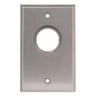
Camden CM-2010 Key Switch SPST Maintained 30VDC
The Camden CM-2010 is a single-pole single-throw (SPST) maintained key switch designed for hardwired access control circuits operating at 30VDC. Cast from 1/4-inch aluminum in a one-piece die-cast assembly, it provides reliable mechanical switching for electric strikes, electromagnetic locks, and access control shunting functions. Maintained action holds the switch state until the key is manually returned to the off position — a critical feature for door hold-open circuits, emergency egress override, and sustained lock activation without repeated input. The mortise cylinder design fits 1-inch, 1 1/8-inch, and 1 1/4-inch bore diameters, and the tamper-resistant construction makes it suitable for high-traffic outdoor and semi-outdoor entrances where mechanical durability and weather resistance are non-negotiable.
Key Features
- SPST Maintained Switching: 30VDC rated. Holds state until manually returned; eliminates need for repeated actuation on sustained control functions like door prop-open circuits.
- Cast Aluminum Construction: 1/4-inch die-cast body. Resists corrosion, tampering, and casual vandalism in outdoor and semi-outdoor door frames.
- Mortise Cylinder Compatibility: Accepts standard mortise cylinders in 1", 1 1/8", or 1 1/4" bore diameters. Cylinders sourced separately; allows keying to match building master-key system.
- Direct Strike/Lock Integration: Hardwired 30VDC output — no relay, no network dependency. Works with electric strikes, magnetic locks, and access control solenoids rated for 30VDC.
- Tamper-Proof Assembly: Includes brass cylinder lock ring and security-bit fasteners (socket-head and slotted-head screws with tamper-proof drivers). Discourages unauthorized disassembly.
- Single-Gang Mounting: Fits 1 3/4"-wide openings. Retrofit into existing door frames or mount in new construction without extensive modification.
- No Environmental Restrictions: Operable in rain, dust, and temperature extremes. IP rating depends on the downstream strike or lock device, not the switch itself.
- Manual Override Capability: Key-operated access means authorized staff have mechanical control independent of power failure, network outage, or access control system compromise.
The CM-2010 bridges mechanical and electrical control domains. Unlike push-button or proximity switches, the key-operated mortise design enforces a deliberate human action sequence — insertion, rotation, return — making it ideal for sensitive functions like emergency egress override, facility lockdown, or service-access doors where audit-trail accountability matters. The maintained switching action is essential for any application requiring sustained lock energization: prop-open during loading operations, extended access for contractor work, or manual hold of an electromagnetic lock during fire-alarm situations.
Integration is straightforward: run 30VDC control wire from your access control power supply, through the switch contacts, to the solenoid of your electric strike or magnetic lock. No additional relay logic required. The switch itself draws no power — it simply makes or breaks the 30VDC circuit. Total copper resistance is negligible; wire gauge and run length are constrained only by voltage drop on the 30VDC line supplying the downstream device.
Deployment contexts range from warehouse loading docks (driver-operated prop-open for pallet unload) to hospital staff areas (mechanical override during power-saver scheduling) to data-center secure zones (keyed access to emergency door release). In environments where key redundancy or geographic distribution of access points is required, the CM-2010 eliminates dependency on networked readers or cloud-based access control — a significant operational advantage in remote facilities or sites with unreliable internet connectivity.
The CM-2010 is covered under manufacturer warranty. It carries no NDAA concerns and integrates seamlessly with any 30VDC access control system architecture — legacy hardwired panels, modern IP-based controllers, or hybrid deployments mixing wired and wireless credential readers.
Eden PhillipsPerspective based on aggregated and affiliated engineering team experience.
We've deployed the CM-2010 in dozens of mixed-use facilities where mechanical switching and key-based control remain non-negotiable. The maintained action is the critical distinction here: it's not a momentary switch, and that matters operationally. On a loading dock where a driver needs to hold a door strike open for 10+ minutes, or a cafeteria where staff prop a service door during service hours, the CM-2010 eliminates the need for a person to stand holding a button or waiting for a timer to expire. You insert the key, turn, and walk away — the lock stays energized until someone physically returns the key to the off position. That's mechanical accountability built into the hardware itself. Against modern IP-based smart locks, the CM-2010 has zero dependency on network connectivity, power redundancy, or credential provisioning systems — a genuine operational advantage in facilities where network outages happen or where you need immediate, deterministic access without software arbitration.
Technical Highlights:
- 30VDC Direct Control: Hardwired output means no relay intermediary, no additional power conditioning, no latency. Strike energizes immediately on key turn. Total circuit resistance is negligible — critical on long wire runs where voltage drop could weaken magnet pull on a 30VDC strike.
- SPST Maintained Topology: Unlike momentary switches (which require continuous button press), maintained switches hold state and are ideal for door-prop, sustained solenoid operation, or emergency override circuits where hands-free holding is essential.
- Cast Aluminum Die-Cast Body: 1/4-inch thickness provides structural rigidity and corrosion resistance without the weight and cost of stainless steel. Withstands rain, freeze-thaw cycles, and salt-air exposure typical in coastal or harsh-weather regions.
- Mortise Cylinder Standard: Accepts any standard mortise cylinder — 1", 1 1/8", or 1 1/4" bore. Allows building-wide master-key integration; keying is managed offline, not through software provisioning.
- Security-Grade Fasteners: Includes tamper-proof driver bits. Deters casual vandalism and discourages unauthorized disassembly without specialized tools. Pair with security screws (sold separately) for maximum resistance.
Deployment Considerations:
- Maintained action means the switch remains in the activated state until manually reset — if the key is lost or left in the on position, the door strike stays energized indefinitely. Implement key-retrieval procedures and train staff on positional awareness; consider a key-retention sleeve or tether on high-traffic doors.
- Mortise cylinder sourcing is separate; ensure bore diameter matches your door frame and that the cylinder you select is compatible with your master-key system. Non-standard cylinders can delay installation by weeks.
- The 30VDC requirement means you need a dedicated power supply (typically a 24–30VDC access control transformer or UPS-backed panel). If your facility uses 12VDC infrastructure, the CM-2010 is not a drop-in swap — you'll need circuit redesign or a separate power branch.
- Install the switch in a sheltered location whenever possible — external exposure to heavy rain or direct spray will eventually degrade the mortise cylinder barrel and key action, even though the aluminum body is corrosion-resistant. Overhang or weather shield is worth the installation labor.
- Wiring capacity depends on the downstream strike or lock load. A typical electromagnetic strike draws 0.5–1A at 30VDC; ensure your power supply and cable gauge support the inrush current and sustained draw without excessive voltage drop. Runs over 150 feet may require voltage compensation or larger wire.
The CM-2010 is the right choice for facilities that need mechanical, key-based access control without network or software dependency. Load-dock operators, building engineers, security staff, and facility managers value the simplicity and reliability of this switch. For door-prop applications, emergency override circuits, or geographically distributed access points where internet connectivity is unreliable, the CM-2010 delivers deterministic control at a fraction of the total cost of ownership of networked smart locks. Explore the full range of control switches and access hardware in the Camden catalog.