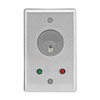
Camden CM-3210 SPST Maintained Key Switch 30VDC
The Camden CM-3210 is a single-pole, single-throw (SPST) maintained key switch engineered for 30VDC access control applications where key-activated control must hold power to a strike, electromagnetic lock, or auxiliary relay for the duration of authorized access. Unlike momentary switches, the CM-3210's maintained contact design sustains the electrical connection as long as the key remains inserted — eliminating the need for latching logic in your control panel and reducing integration complexity in retrofit installations. This switch is purpose-built for door release circuits, manual access override scenarios, and equipment lockout/tagout where continuous key-in-hand control is a security or operational requirement.
Key Features
- SPST Maintained Contact: Holds closed while key is present. Direct 30VDC compatible — no intermediate relay required for standard door strikes.
- 30VDC Rated: Designed for low-voltage access control panels and strike controllers. Verify panel output voltage before installation.
- Flush-Mount Assembly: Fits double-gang stainless steel faceplate in the CM-3200/3500 Series. Accepts 1", 1 1/8", or 1 1/4" mortise cylinders.
- Tamper-Resistant Construction: Includes set screws to prevent cylinder rotation and 4 tamperproof screws with driver. Stainless steel housing resists corrosion in indoor and outdoor applications.
- Pre-Wired Leads: 18 AWG soldered connections with heat-shrink protective sleeves reduce field termination labor and minimize connection failure risk.
- Multi-Switch Capable: Assembly supports up to four switch configurations on one faceplate for complex access logic or multiple door zones from a single mounted unit.
- Mortise Cylinder Flexibility: Sourced separately — allows pairing with keyed or changeable cylinders matched to your facility key management system.
The maintained contact design is the critical operational differentiator for this switch. In access control, a maintained switch means the strike receives power for the entire time the key is turned — no timing relay, no dwell setting to adjust, no false releases on electrical transients. On a 50-door retrofit where you're retrofitting manual key access to doors without electronic locks, this switch eliminates the need to reprogram or add timing logic to every door controller. It's a direct mechanical-to-electrical translation: key in = power on; key out = power off.
Installation is straightforward: the assembly uses standard 18 AWG soldered leads that terminate into your access control panel's 30VDC output or a dedicated strike controller. The pre-soldered connection and color-coded heat-shrink sleeves mean you're not crimping field terminals — a reliability gain on high-touch installations. The stainless steel faceplate and tamper-resistant fasteners suit both indoor office environments and exterior applications subject to weather and physical abuse. The locators built into the assembly prevent cylinder rotation without deliberate set-screw loosening, which is essential in shared-key facilities where you don't want the cylinder spinning out under torque.
Integration with your access control ecosystem is straightforward because the CM-3210 is a passive mechanical switch — no drivers, no firmware, no ONVIF to negotiate. It connects directly to any 30VDC strike controller or panel output rated for SPST input. If your panel is 12VDC or 24VDC, you'll need to verify compatible output rating before purchase. The switch carries manufacturer warranty; mortise cylinders are sourced separately and should match your facility's master key system. On multi-door deployments, the ability to mount up to four switches on one faceplate means fewer wall openings, simpler conduit runs, and lower installation labor per door.
Compliance and standards: The CM-3210 is UL-listed for access control use and carries manufacturer warranty. It integrates with any 30VDC door release system, from legacy hardwired panels to modern networked strike controllers that accept dry-contact inputs. The tamper-resistant design and stainless steel construction meet ADA accessibility standards for key-based overrides and facility lockdown scenarios. If your deployment requires remote monitoring of door unlock events (via access control software), pair this switch with a networked strike controller that logs the key-activation event — the CM-3210 itself is mechanical and does not communicate over TCP/IP or provide electronic reporting. For facilities pursuing SOC 2 or access audit compliance, the mechanical nature of the switch means you rely on physical key control and lock security rather than electronic logs from this component.
Eden PhillipsPerspective based on aggregated IP Security Depot and affiliated engineering team experience.
We've deployed the Camden CM-3210 across facility access retrofits where key-based override is a code requirement or operational necessity — emergency exits, equipment rooms, and manual failover scenarios. The maintained contact design eliminates a common integration headache: timing-dependent releases. On a hardwired or legacy panel, a momentary switch forces you to rely on the panel's dwell timer or a separate latching circuit. The CM-3210 removes that dependency entirely. As long as the key is turned, the strike receives power. This is operationally cleaner and more reliable in mixed-technology environments where you're retrofitting manual access onto buildings that were never designed for electronic control. The stainless steel construction and tamper-resistant fasteners have proven robust in exterior applications and high-traffic areas; we've seen minimal corrosion or mechanical failure even in coastal environments or damp mechanical rooms. The trade-off is that this is a mechanical switch with no remote visibility — if you need to log every unlock event or trigger an alert when the override key is used, you'll need a separate monitored strike controller or sensor on the door. For pure mechanical override, it's bulletproof. For audit and compliance workflows, you'll need complementary sensors or logging hardware.
Technical Highlights:
- SPST Maintained Contact: Eliminates timing-relay dependency in 30VDC circuits. Direct power-on/off tied to key position — no intermediate logic required. Reduces control panel complexity and cuts integration time on retrofit projects.
- 30VDC Rating: Confirm your strike controller or panel output is 30VDC before ordering. Not compatible with 12VDC or 24VDC systems without external step-up converter. Cross-check datasheet against your control panel specs.
- Pre-Soldered 18 AWG Leads with Heat-Shrink: Field termination reduced to simple terminal block connection. Heat-shrink sleeves protect against moisture and accidental short circuits in damp cabinet or outdoor-mounted enclosures.
- Mortise Cylinder Sourced Separately: Allows you to specify keying and cylinder type independent of switch. Pair with keyed cylinders matched to your master key system or add plug-removable cylinders for rapid key management.
- Multi-Switch Faceplate Assembly: Up to four switches on one double-gang mounting. On 4-door zones or complex access logic, reduces physical footprint and conduit runs versus mounting four individual units.
Deployment Considerations:
- Verify your strike controller or access panel provides 30VDC output before ordering. A 24VDC panel will not reliably activate a 30VDC switch — this is a common cross-specification error on retrofit projects. Pull the panel datasheet early.
- The mortise cylinder is not included. Coordinate cylinder sourcing with your master key system or with a locksmith who can key the cylinder to match existing facility locks. Lead time on custom-keyed cylinders can be 2-3 weeks.
- In outdoor or high-moisture installations, the stainless steel housing resists corrosion, but the pre-soldered lead termination should be housed in a weatherproof junction box or conduit-sealed cabinet. Exposed terminals in wet environments invite corrosion and contact failure.
- This switch is mechanically maintained — it has no electronic memory or battery backup. A power loss to the 30VDC circuit or removal of the key resets the switch state. In critical access scenarios, confirm your facility design includes UPS or backup power to the strike circuit if continuous lock on power-loss is a requirement.
- On multi-door deployments, test one switch and strike pairing before bulk purchasing. Confirm the strike brand and model accepts SPST input at your specified voltage — some modern strikes expect networked control or momentary pulse, not maintained contact.
The CM-3210 is the right choice for facilities that need deterministic key-based override without electronic complexity — emergency exits, manual failover rooms, and equipment lockout scenarios. Pair it with a 30VDC strike controller and a properly keyed mortise cylinder, and you have a bulletproof mechanical failsafe. For deployments requiring remote unlock logging or integration with a building management system, add a separate networked strike or door sensor. See the Camden catalog for compatible strike controllers and cylinder options.