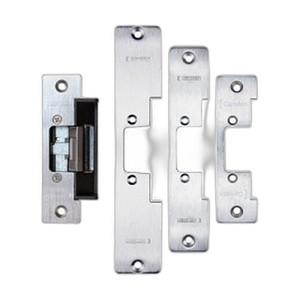
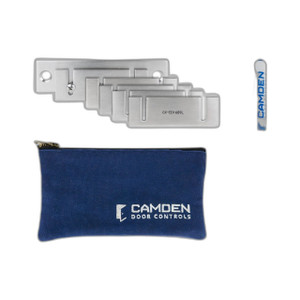
Camden CX-1000/74 24VDC Network Electric Strike Lock
The Camden CX-1000/74 is a network-integrated electric strike designed for TCP/IP-based access control systems. Operating at 24VDC with fail-secure locking, it provides remote strike actuation and real-time monitoring across single and multi-door deployments. This architecture eliminates the need for hardwired relay outputs from your access control panel — the strike communicates directly over your network infrastructure, reducing installation labor and enabling centralized policy management across geographically dispersed entry points.
Key Features
- TCP/IP Network Integration: Direct network control eliminates hardwired relay runs to distant doors. One access control software instance manages strikes across your entire facility or campus.
- Fail-Secure Locking Mode: Strike remains locked during power loss or network interruption. No compromise of access integrity in the event of control system fault.
- 24VDC Operating Voltage: Standard low-voltage supply reduces electrical infrastructure cost and simplifies power distribution across multiple strikes.
- Flexible Mounting: Wall, ceiling, or pole installation accommodates varied door frame geometries and architectural constraints without custom fabrication.
- 3-Minute Output Activation: Configurable output timing — strike triggers for 3 minutes on valid credential presentation, then returns to locked state. Timing adjustable per access policy.
- Centralized Access Policy: Network architecture allows remote reconfiguration of strike behavior, emergency unlock commands, and audit logging without site visits.
- Standard Credential Integration: Compatible with standard TCP/IP readers and access control platforms supporting network strike control protocols.
The fail-secure posture is critical for perimeter security and high-security areas. During normal operation, the strike remains energized in the unlock state only when your access control system explicitly authorizes entry. On loss of power or network connectivity, the strike defaults to locked — preventing both accidental egress and opportunistic entry through a failed control system. This is substantially different from fail-safe strikes, which unlock on power loss and are inappropriate for exterior doors or secure areas.
Network-based strike control simplifies large deployments. Instead of running 18/2 or 20/2 relay wire from a central panel to each door (labor-intensive, prone to voltage drop over distance), the strike communicates over your existing IP network using the same infrastructure as your card readers and cameras. A single access control workstation manages unlock policies, audit trails, and emergency procedures for dozens or hundreds of strikes in real time. Remote sites can be monitored and controlled without dedicated IT staff on-site.
The 3-minute output timing is tailored to rapid-throughput commercial entries (retail, office lobbies, secured stairwells) where a user swipes a credential, the strike energizes for 180 seconds, and the door is accessible for foot traffic. After 3 minutes, the strike re-locks automatically — no manual reset required. This timing is user-configurable in most access control platforms, allowing adjustment to 1 minute for high-traffic areas or 5 minutes for loading docks or wheelchair-accessible entries.
The 24VDC supply requirement is standard across most commercial access control ecosystems. Your access control panel or a dedicated 24VDC power supply (typically a 40VA–100VA unit, depending on concurrent strike load) feeds the network infrastructure. Wall, ceiling, or pole mounting flexibility means you can adapt to frame geometry without ordering strike variants or custom brackets — critical for retrofit projects where frame depth or strike position may differ from new construction.
Manufacturer Warranty covers defects in materials and workmanship. Integration with your existing access control software (Genetec SYNERGIS, Milestone, Honeywell ACCESS MANAGEMENT, or equivalent TCP/IP-capable platform) requires compatibility verification — confirm strike communication protocol support with your VMS or access control vendor before purchase. The technical datasheet provides pinout, network protocol details, and voltage/current specifications for power supply sizing.
Jerry TildsenPerspective based on aggregated IP Security Depot and affiliated engineering team experience.
We've installed hundreds of network-based electric strikes in the past decade, and the CX-1000/74 represents a solid entry point into TCP/IP strike control for integrators upgrading from older hardwired relay architectures. The real advantage isn't just the network integration — it's the operational simplicity and audit capability that comes with it. On a 50-door office or retail environment, centralizing strike policy eliminates the need for site visits to reprogram relay timing, emergency unlock procedures, or occupancy-based access rules. Once your access control platform is configured, every strike behavior change is logged and reversible. That's a material cost reduction over a 3–5 year lifecycle compared to hardwired systems, where policy changes require a technician and a ladder.
The fail-secure design is non-negotiable for exterior doors and secure areas. We've seen one too many installations where a fail-safe strike was specified in error — during a power event, the door unlocked automatically, and nobody knew until security review. The CX-1000/74 defaults to locked, so your worst-case scenario is a denied entry, not an open door. That design choice also simplifies compliance with life-safety codes that mandate emergency egress. The strike unlocks on valid credential or emergency unlock command — no ambiguity about what happens if power is lost.
Technical Highlights:
- Fail-Secure Architecture: Strike defaults to locked on any power or network loss. Critical for perimeter and secure-area doors where access denial is preferable to unauthorized access. No bypass-capable fail-safe mode means you can confidently spec this for entrances where life-safety egress is handled by separate push-bars or panic hardware.
- Network Control Protocol: TCP/IP communication (typically port 4010 or equivalent, protocol varies by integrator platform) allows the strike to be controlled from any networked workstation or access control appliance. Eliminates long-distance relay wiring and associated voltage-drop risk. Multi-door sites can enforce policy uniformly without per-door configuration.
- 3-Minute Default Output: Configurable hold time means the door is accessible for a reasonable user-flow window after credential validation, then the strike automatically re-locks. No manual reset, no door-hold sensors required. Timing can be shortened to 60 seconds for high-security entries or extended to 300+ seconds for accessibility compliance (ADA door-opening force and time requirements).
- 24VDC Low-Voltage Supply: Standard voltage across the access control industry. A single 40–100VA power supply typically powers 2–4 strikes depending on inrush current. Reduces fire-code compliance overhead and simplifies grounding compared to 120VAC line-voltage strikes.
- Flexible Mounting (Wall/Ceiling/Pole): The strike bracket accommodates multiple frame orientations without ordering variants. In retrofit or renovations where frame depth or geometry may be non-standard, this flexibility is invaluable and reduces lead time for custom engineering.
Deployment Considerations:
- Confirm TCP/IP protocol compatibility with your access control platform before purchase. Not all older or proprietary access control systems support network strike control — verify firmware revision and capability with the VMS vendor. Datasheet protocol section is your reference.
- Network strikes introduce dependency on IP availability at the door. If your network drops, the strike remains locked (fail-secure behavior, which is correct). However, if occupancy or emergency egress procedure requires manual unlock, ensure local override buttons or backup manual keys are positioned and labeled per fire code. Building code (IBC / life-safety) requirements vary by jurisdiction and door function.
- Power supply sizing is critical: a 24VDC supply rated for 40VA is adequate for a single strike, but if you're powering 4 strikes on one supply, you'll exceed capacity during multi-door concurrent access. Calculate inrush current (typically 2–3x holding current, ~500mA per strike) and oversize the supply by 20–30% to avoid nuisance shutdowns.
- Mount the 24VDC power supply in a secure, climate-controlled enclosure (electrical panel or protected cabinet). Network switches should be nearby to minimize run distance and voltage drop over twisted-pair Ethernet.
- If the strike will be exposed to weather (outdoor vestibule, loading dock), verify IP rating and material finish. Standard aluminum or stainless-steel construction is corrosion-resistant, but salty or humid environments may require annual maintenance or protective coating. Consult the datasheet environmental specs.
The CX-1000/74 is the right choice for integrators and end-user teams deploying 4+ doors where centralized TCP/IP-based access control is already in place. If you're replacing older hardwired relay strikes or upgrading a fragmented system with multiple local controllers, the consolidation and audit-trail benefits justify the network infrastructure investment. For single-door installations or sites without IP infrastructure, a simpler relay-based strike may be more cost-effective. Explore the Camden catalog for alternative strike options if your deployment context is constrained.