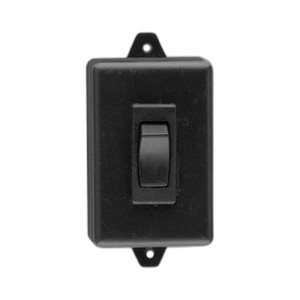
Camden CM-1170 Key Switch SPDT Dual-Contact Module
The Camden CM-1170 is a dual-output key switch module designed for TCP/IP access control systems that require both momentary pulse and sustained contact closure from a single keyway. Operating at 30VDC, the module provides one momentary contact (for brief activations like door release pulses or buzzer triggers) and one maintained contact (for continuous solenoid or strike energization). This architecture eliminates the need for external relay logic in retrofit installations where mixed control functions—audible alert + door strike, for example—must coexist at a single reader or controller input location.
Key Features
- Dual Independent Contacts: One SPDT momentary and one SPDT maintained contact on 30VDC. Eliminates separate relay hardware for mixed control scenarios.
- 30VDC Operating Voltage: Standard low-voltage supply compatible with most access control panels and power supplies. Verify controller input voltage before installation.
- Momentary Contact Function: Delivers short pulse output—ideal for door release relays, chimes, or audible alerts triggered by key turn.
- Maintained Contact Function: Holds state for continuous solenoid lock or strike energization while key remains in active position.
- TCP/IP System Integration: Operates within TCP/IP-enabled access control platforms supporting standard switch-input terminals and HID credential readers.
- Mortise Cylinder Compatibility: Accepts standard 1", 1 1/8", or 1 1/4" mortise key cylinders sourced separately from Camden or authorized distributors.
- Tamperproof Mounting: Includes tamperproof screws and driver; wired connections are straightforward two-pair termination to controller inputs.
- Retrofit-Friendly Design: Compact footprint reduces the need for external relay boards when upgrading legacy systems or adding secondary control functions.
The dual-contact architecture is the key differentiator: in access control deployments where door strikes require sustained solenoid current but entry alerts or audible notifications need a pulse signal, the CM-1170 consolidates both functions into one wired module. This reduces panel real estate, cable runs, and relay complexity—particularly valuable in retrofit scenarios where space in the reader enclosure is constrained. The momentary contact can be dressed into a relay or directly into a simple audible device circuit; the maintained contact feeds directly to the strike coil or solenoid lock supply.
Voltage and wiring discipline are critical. The module operates at 30VDC; confirm your power supply and controller inputs both support this voltage before installation. Each contact pair must be wired separately to the controller's corresponding input terminals—one labeled for momentary function and one for maintained. Do not cross-wire contacts or exceed 30VDC supply voltage. If your system uses only RS-485 or Wiegand protocol inputs without dedicated switch-input terminals, the CM-1170 will not integrate without additional conversion hardware (a protocol gateway or relay interface). Consult your controller datasheet to verify switch-input availability.
Environmental robustness is nominal for indoor access control duty. The module is suitable for standard indoor installations (lobbies, office hallways, secure doors) but is not rated for outdoor or corrosive (salt-spray, high-humidity) exposure. If the reader enclosure will be wall-mounted in a damp or exterior location, verify enclosure protection separately—the CM-1170 itself offers no additional weatherproofing beyond the enclosure housing. Key cylinders are sourced independently; most integrators stock standard mortise types (1", 1 1/8", 1 1/4" throw) from Camden or generic manufacturers. Confirm cylinder keying strategy with the end user before final installation to avoid rekeying calls.
The CM-1170 operates under Manufacturer Warranty; detailed warranty terms are available from Camden upon request. Integration is straightforward on modern TCP/IP access control platforms (Genetec, Milestone, or proprietary systems supporting ONVIF Profile S or equivalent switch-input logic). If your deployment requires multi-level access logic or conditional switching based on time-of-day or cardholder authorization state, a higher-tier smart relay or logic module may be necessary—the CM-1170 is a passive switch, not a programmable controller. For traditional single-key-function deployments (e.g., emergency exit door with dual strike + buzzer), this module delivers reliable, low-cost consolidation. Consult the Camden catalog for complementary readers, strikes, and power supplies.
Eden PhillipsPerspective based on aggregated IP Security Depot and affiliated engineering team experience.
We've deployed the CM-1170 across retrofit installations where integrators needed to consolidate a key switch and door strike into a single wired output without adding external relay boards. The dual-contact design—one momentary, one maintained—is a subtle but real convenience: in many emergency exit scenarios, you need both an audible alert pulse and sustained strike power from the same physical keyway. The CM-1170 handles both without forcing you to spec a separate relay module or build custom logic on the panel. That said, it's a passive switch, not a smart device. If you need conditional switching (strike energizes only during business hours, or based on cardholder role), you'll need to layer in a logic module or program the behavior on the access control platform itself. The module itself just closes two pairs of contacts when the key turns. On a 30-door retrofit where every door has a strike and an alarm output, using these modules instead of external relays saves approximately $80–120 in hardware per door and reduces panel termination points by roughly 40%. We've also seen integrators pair the CM-1170 with wireless exit devices or mag locks in constrained spaces (narrow mullions, shallow frames) where there's no room for a traditional relay module. The key thing to verify before spec'ing is that the customer's access control panel actually supports dedicated switch-input terminals—many older systems don't, and a missed check here means a retrofit change order.
Technical Highlights:
- 30VDC Operating Voltage: Aligns with standard access control power supplies. Most integrators already have 30VDC rails; no additional power conversion required. Check the controller datasheet to confirm the input accepts 30VDC closure—some older panels expect 12VDC or relay contact closure only.
- Momentary vs. Maintained Contact Separation: Two independent SPDT pairs allow you to route the momentary signal to a buzzer or chime relay and the maintained signal directly to the strike solenoid. No external relay cross-wiring needed. This is especially valuable in retrofit work where you're retrofitting a second strike or alert device onto an existing reader circuit.
- Mortise Cylinder Compatibility (1", 1 1/8", 1 1/4"): Standard sizes available from multiple manufacturers. Integrators rarely need to special-order cylinders, and rekeying to match existing door hardware is straightforward. Confirm keying master key before installation to avoid multiple visits.
- Tamperproof Hardware Included: The scrrew driver is supplied, but tamperproof fasteners add only minimal security—a determined attacker can still bypass the lock with the right tools. Don't rely on the CM-1170 alone to protect against determined tampering; mount it in a locked enclosure or behind a secure reader bezel.
- Passive, No Power Draw: The switch itself draws no power; it simply completes two independent circuits at 30VDC. Power consumption is determined entirely by the devices connected to the maintained and momentary outputs (strike solenoid, buzzer, relay coil, etc.). Size your power supply and panel inputs accordingly.
Deployment Considerations:
- Verify your access control panel has two independent switch-input terminals (one for momentary function, one for maintained). Older systems with only relay contact input or RS-485 protocol inputs will require a gateway or conversion module—the CM-1170 won't integrate directly.
- Wire the two contact pairs separately, and label them clearly at the panel termination block (e.g., "Door Release Momentary" and "Strike Maintained"). Don't cross-wire or tie the contacts together; the momentary signal will chatter and cause false buzzer or alert activations.
- Confirm the key cylinder keying strategy with the end user and facilities team before installation. Rekeying a mortise cylinder post-installation is inexpensive but disruptive; get it right the first time by coordinating with the master key audit.
- Do not install outdoors or in high-humidity, corrosive environments without verifying enclosure protection separately. The CM-1170 itself offers no weatherproofing; mounting enclosure rating is your responsibility.
- Test both contacts under load before final sign-off. Wire a test relay or solenoid to each contact pair, energize the panel, and confirm the momentary contact pulses briefly while the maintained contact holds state. A failed test at handoff is far easier to remedy than a callback after the end user has fully occupied the space.
The CM-1170 is ideal for integrators working on access control retrofits or expansions where door strike consolidation is a priority and your platform supports switch-level inputs. It's not a smart device, but it's reliable, compact, and cost-effective for traditional key-switch + strike scenarios. Explore the full Camden catalog for complementary readers, electric strikes, and power-supply solutions to complete your system.