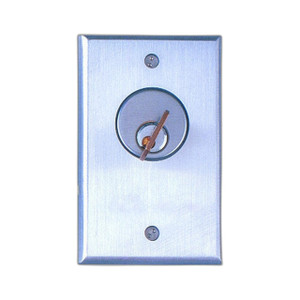
Camden CM-2030 Key Switch SPDT Maintained
The Camden CM-2030 is a hardwired key-switch relay designed to provide manual override control of electric strikes, electromagnetic locks, and door activation devices in access control installations. Rated for 30VDC operation with maintained-contact switching, the CM-2030 holds its relay closed as long as the key remains in the turned position—eliminating the fail-secure reset problem that catches installers off guard. Built from cast aluminum into a one-piece die-cast housing, it tolerates high-frequency cycling and resists tampering and environmental stress in commercial and industrial door control deployments where a network-independent override is non-negotiable.
Key Features
- SPDT Maintained Contact: Relay stays energized while key is turned; resets only when key is returned to neutral position. Critical for manual override scenarios where you cannot rely on power-loss-default behavior.
- 30VDC Rated: Operates on standard commercial lock power supplies and door control circuits. Direct wiring to electric strike, EM lock, or auxiliary relay—no intermediate network layer required.
- Mortise Cylinder Design: Accepts standard 1", 1 1/8", or 1 1/4" mortise cylinders. Countersunk opening eliminates extra drilling; swap cylinder brand or keying without modifying housing.
- One-Piece Cast Aluminum Body: Die-cast construction resists vandalism, impact, and weather exposure. Footprint 1 3/4" wide fits single-gang or narrow doorframe openings.
- Hardwired Relay—No Network: Zero software dependencies, zero credential lookup, zero cloud connectivity. Operates identically with or without an access control panel; integrates as a standalone manual bypass or augments panel-controlled circuits.
- Tamperproof Hardware: Supplied with brass cylinder lock ring, countersunk mounting screws, and tamperproof driver screws to prevent unauthorized disassembly in high-traffic areas.
The CM-2030 operates on a simple hardwired relay principle: apply 30VDC across the two terminals, route your strike or lock load through the switch contacts, and turn the key to energize. No credentials, no IP address, no integration overhead. This straightforward design makes it ideal for retrofit applications where adding network-connected readers would require extensive rewiring or VMS integration work. Facilities with legacy standalone strikes, older panel systems, or zones where physical-key override is the stated requirement find immediate value in the CM-2030's isolation from network failures, firmware updates, or credential revocation delays.
Installation footprint is compact: mount the housing in a single-gang box or directly to a narrow doorframe (confirm surface flatness and structural soundness before fastening). The mortise cylinder opening is pre-countersunk; insert your selected cylinder, secure the lock ring, and anchor the housing with the supplied screws. Wiring is two-conductor: bring your 30VDC source and strike/lock load to the switch terminals, observe polarity (check the datasheet silkscreen), and validate operation with a multimeter before closing the door. No special tools, no configuration software, no commissioning delays—within minutes of turning the key, you'll see the strike energize or lock disengage.
The CM-2030 occupies a specific niche: facilities that mandate hardwired manual override as a safety or operational requirement, retrofit projects where network wiring is impractical, and hybrid deployments where certain critical doors keep a key-switch backup alongside an access control reader. Because it holds its contact only while the key is actively turned, it's inherently audit-friendly—unauthorized or extended strikes leave a clear visual record (key must be present and rotated). Pair it with a request-to-exit (RTE) motion sensor or push button on the egress side to round out the manual control strategy; the CM-2030 becomes the ingress override, RTE becomes the exit unlock.
Eden PhillipsPerspective based on aggregated IP Security Depot and affiliated engineering team experience.
We've deployed the CM-2030 across retrofit and hybrid access control projects where network-independent manual override is either a compliance mandate or an operational safety requirement. The maintained-contact design is the critical differentiator—when you turn that key, the strike or lock energizes and stays energized until you turn it back. This behavioral guarantee means the CM-2030 doesn't suffer from the false-release problem we've seen with fail-secure readers that reset on power loss or network dropout. In a healthcare environment with electronically locked medication rooms, a maintained key switch is often the stated backup requirement: if the access control system goes down, facility staff can manually unlock the cabinet without waiting for IT or having to drill it open. The hardwired relay also insulates the function from credential database delays—there's no reader lookup, no SSL handshake, no VPN reconnect pause. Key turns; strike energizes. Period. That reliability is worth the trade-off of losing audit logging integration with the main panel, because in the scenarios where CM-2030 gets deployed, physical key possession and visual confirmation of key position usually constitute the audit trail.
Technical Highlights:
- SPDT Maintained Contact (not momentary): The relay closes and latches while the key is rotated. This differs fundamentally from momentary switches, which pulse the relay and rely on panel logic to hold the strike. Maintained contact means the strike is energized directly by key position—no panel intermediary needed, and no failure mode where a panel reset clears your unlock. Critical for emergency egress scenarios and backup-system thinking.
- 30VDC Specification: Matches the standard 24VDC or 30VDC power rails deployed in most commercial door control circuits. The rating provides headroom for wire-run voltage drop on long runs (200+ feet of 18 AWG copper can sag ~6VDC). Confirm your lock power supply voltage before wiring; field-swapping to a 12VDC supply will fail.
- Mortise Cylinder Compatibility: Accepts industry-standard mortise cylinders (1", 1 1/8", 1 1/4" diameter). This modularity is underestimated—you can rekey the cylinder without replacing the entire switch, and you can pair it with any mortise brand (Schlage, Mul-T-Lock, ASSA ABLOY). Compare this to integrated key readers, where rekeying often requires a full unit swap.
- One-Piece Die-Cast Body: Cast aluminum housing is far less vandal-prone than stamped steel alternatives. In high-traffic areas (healthcare, hospitality, detention), the solid construction withstands repeated impact and tampering attempts. The seamless design also eliminates the micro-gaps where dirt and moisture accumulate, improving longevity in dusty or humid environments.
- No Network Dependency: This is both a feature and a constraint. The CM-2030 functions identically whether or not an access control panel is present. This makes it ideal for standalone door overrides and for augmenting legacy systems that lack network-door-control capability. However, you forfeit real-time audit logging to a centralized VMS—every activation is a local event only.
Deployment Considerations:
- Confirm your 30VDC lock power supply can sustain the strike or EM lock draw (typically 500mA to 2A for a standard strike). The CM-2030 relay itself draws minimal current, but the load on the terminals may exceed the panel's internal 24V rail. Use an external 30VDC power supply and route the CM-2030 as a distributed control point, not as a daisy-chain off the panel.
- Mortise cylinder diameter must be verified before installation. A 1" cylinder housing the CM-2030 cannot accept a 1 1/4" cylinder body—measure your existing door boltwork or confirm the replacement specification with the lock manufacturer. Ordering the wrong size forces a field retrofit.
- Maintained-contact operation means unauthorized or extended key-turning will energize the strike for as long as the key remains rotated. This is intentional (manual override), but it also means you must trust key custody and visibility. Pair the CM-2030 with mechanical key control or RFID-enabled key cabinets if audit sensitivity is high.
- Polarity matters: 30VDC is DC-specific, not AC. Reverse polarity on the terminals will not energize the relay. Use a multimeter to confirm correct wiring before testing the strike. Some 30VDC power supplies have both + and − rails; swapping them is a common field mistake.
- The one-piece casting footprint is 1 3/4" wide; ensure your target mounting surface (doorframe, door hardware mounting plate, or adjacent electrical box) has adequate clearance. Narrow framing or overlapping hardware can force you to mount the switch on an auxiliary plate, adding labor.
- Because the CM-2030 is hardwired and non-networked, it does not report activation status to a VMS or access panel. If centralized event logging for every manual override is a compliance requirement, you'll need to supplement this switch with a separate hardwired sensor (dry-contact door position monitor) or add a networked reader for audit purposes. That adds cost and complexity, so confirm the requirement early.
The CM-2030 is the right choice for facilities that need a network-independent, fail-safe manual override for critical doors, retrofit projects where adding network readers is prohibitively expensive, and deployments where key custody and visual activation are the stated audit mechanism. Integrators who work frequently with healthcare, government, or industrial facilities with high security awareness consistently spec the CM-2030 as a backup layer to their primary access control reader. See the Camden catalog for complementary strike controllers and mortise hardware.