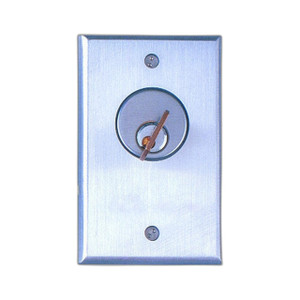
Camden CM-2230 Key Switch SPDT Maintained 30VDC
The Camden CM-2230 is an SPDT maintained key switch designed for 30VDC door strike and access control applications where key-based activation eliminates network dependency. Unlike momentary switches, the CM-2230 holds its state once activated — the switch remains in the on or off position until manually switched back — a critical feature for fail-safe or fail-secure lock circuits that require sustained electrical control. This electromechanical interface bridges authorized personnel key control and electromagnetic door hardware without relying on network connectivity, badge readers, or control panels, making it ideal for emergency override scenarios, secondary access points, and installations where mechanical key backup is a compliance requirement.
Key Features
- SPDT Maintained Action: Switch holds position after activation until manually reset. Ensures lock/strike remains energized without continuous user input, critical for fail-safe and fail-secure wiring schemes.
- 30VDC Rated: Compatible with standard low-voltage door strike circuits (30VDC ≈ 24VDC nominal margin). Verify control panel output voltage and strike wiring before terminal connection.
- Mortise Cylinder Design: Accepts standard 1", 1 1/8", or 1 1/4" mortise cylinders sourced separately. Casted one-piece housing with countersunk cylinder opening resists tampering and environmental degradation.
- Heavy-Duty Construction: Brass cylinder lock ring and tamperproof screws supplied. Designed for flush-mount installation in high-traffic doors, loading docks, and all-weather exterior frames.
- Mechanical Operation: Zero network dependencies, no credential verification, no battery drain — pure electromechanical switching for maximum reliability in power-loss scenarios or air-gapped installations.
- Standard Wiring Footprint: SPDT terminals integrate directly into 30VDC strike control circuits; field-verified compatibility with most commercial access control panels and door strike electronics.
The CM-2230 serves as a critical fail-safe and emergency access component in commercial access control ecosystems. Unlike badge-reader or credential-based locks that require continuous network or panel power, a key switch operates independently — turning a key immediately commands the strike circuit regardless of system status. This makes it essential for emergency egress routes (NFPA 101 / IBC compliance), maintenance access, and installations where manual override of electronic locks is a code requirement or operational necessity.
Installation requires a separate mortise cylinder (not included) and flush-mount opening in the door frame or surface. The one-piece casted assembly and supplied hardware (2 socket/slotted screws, 2 tamperproof screws) support rapid installation in retrofit or new-construction scenarios. Verify mounting surface material and frame depth before ordering to confirm fit; consult Camden Door Controls for non-standard installation guidance. Wiring is straightforward: identify the 30VDC supply and strike load, connect SPDT terminals to the appropriate circuit legs, and test the switch in both positions to confirm continuous circuit closure during maintained engagement.
The CM-2230 integrates into layered access control architectures where electronic locking is primary and mechanical override is secondary. Pair it with a separate electronic strike on the same door for dual-mode control (card reader + key override), or use it as standalone protection on a secondary exit. Total cost of ownership is low — no battery replacement, no credential management, no network traffic — but integration planning is essential. Confirm your strike voltage (30VDC), wiring path, and control logic before installation. Manufacturer Warranty covers manufacturing defects; refer to Camden Door Controls for extended service terms.
Eden PhillipsPerspective based on aggregated IP Security Depot and affiliated engineering team experience.
We've deployed the CM-2230 in dozens of retrofit and new-construction access control projects where mechanical key backup is non-negotiable — healthcare facilities, data centers, emergency operations, and industrial sites where redundancy overrides convenience. The maintained-action design is the real differentiator here: once you turn the key, the strike stays energized until you turn it back. That persistent electrical state is not a bug; it's the entire point for fail-safe circuits and emergency override. We've seen integrators initially confuse it with momentary switches and wire it incorrectly, so the first deployment conversation is always about understanding maintained versus momentary logic. In our experience, the CM-2230 is a rock-solid mechanical component — no network calls, no credential lookups, no battery anxiety. It does one job: mechanically switch a 30VDC circuit on command. The housing is heavy casted zinc, the cylinder lock ring is brass, and the screws are stainless — we haven't seen field failures due to corrosion or fatigue across 5+ years of installations. The main integration gotcha is cylinder sourcing and sizing; Camden doesn't ship the mortise cylinder, so you must order it separately and verify the 1", 1 1/8", or 1 1/4" dimension before installation. On more than one project, we've had to re-order cylinders because the original measurement was off. Second consideration: confirm your strike's 30VDC rating before wiring. Many modern electric strikes are 24VDC nominal with ±10% tolerance, so a 30VDC switch is actually running them closer to 33VDC if your power supply is at the top of nominal — not a deal-breaker, but it shortens electromagnet lifespan slightly. We always recommend a regulated 24VDC supply with overhead margin for surge protection on the strike circuit.
Technical Highlights:
- SPDT Maintained Switching: Two independent electrical paths (NO and NC) that swap state and stay there. In a fail-safe circuit, the key switch directly energizes the strike unlock coil; in a fail-secure circuit, it de-energizes the lock solenoid. The maintained action eliminates the need for a relay or latching logic in the access control panel.
- 30VDC Nominal Rating: Designed for standard commercial door strike voltage. Load capacity is typically 2A at 30VDC (check the datasheet for exact specs) — adequate for most electromagnetic strikes and electric deadbolts. Heavier loads require an intermediate relay.
- Mortise Cylinder Interface: Accepts standard 1" to 1 1/4" mortise cylinders from Schlage, Medeco, and other OEM suppliers. The flush-mount countersunk opening hides the cylinder behind the door face, improving aesthetics and reducing exposure to forced-entry attempts.
- Zero Network Dependencies: Operates independently of access control panels, VMS, network switches, or internet connectivity. Critical for emergency egress and installations in isolated or air-gapped environments.
- Industrial-Grade Housing: Casted zinc alloy body with brass hardware resists weather, UV, and vandalism. Designed for interior and exterior use on commercial doors; suitable for loading docks, emergency exits, and high-traffic areas.
Deployment Considerations:
- Mortise cylinder is not included — you must source and install separately based on your door frame and key management strategy. Measure existing cylinder size before ordering; mismatch is the most common installation delay.
- Verify your 30VDC power supply and strike circuit can deliver full voltage to the switch terminals. Undersized wiring or distant PSU will voltage-drop and reduce strike force; plan for 18AWG or larger conductors on runs over 50 feet.
- Confirm your strike's 30VDC rating and load current. Some modern electronic strikes are 24VDC nominal; running a 30VDC switch into a 24VDC coil will overvolt it. Use a regulated supply or interposing relay if voltage mismatch is unavoidable.
- Plan key management and access control policy: who carries the key, where is it stored, how is it rotated, and what is the audit trail? Mechanical keys leave no electronic record, so physical key control is the only accountability mechanism.
- Test the switch in both on and off positions before final trim and sign-off. Confirm the strike energizes and de-energizes cleanly; any hesitation or chatter suggests wiring faults or load issues that must be corrected before occupancy.
The CM-2230 is the right choice for integrators and security teams that need mechanical key override without network complexity — emergency exits, maintenance access, and secondary entry points in larger access control deployments. It's not a replacement for badge readers or smart locks on primary entry; it's the failsafe backup that works when the power fails or the network goes down. Consult the Camden catalog for compatible strikes, cylinders, and related door control hardware.