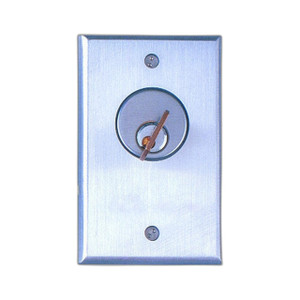
Camden CM-1260 Key Switch SPDT Maintained
The Camden CM-1260 is a 30VDC SPDT maintained-contact key switch designed for hardwired access control circuits and door strike activation in hybrid and standalone security systems. The maintained contact holds its electrical state as long as the key remains in the ON position, eliminating the need for continuous panel signaling to keep a strike or lock energized. This flush-mount switch accepts standard 1", 1 1/8", and 1 1/4" mortise cylinders, making it a drop-in replacement for existing door frame preparations across retrofit and new-construction deployments.
Key Features
- SPDT Maintained Contact: Switch holds energized state with key inserted. Simplifies wiring logic for door strikes, electromagnetic locks, and solenoid latches—no continuous control signal required.
- 30VDC Operating Voltage: Rated for standard 30VDC access control power supplies. Low voltage minimizes shock hazard and simplifies integration with relay-switched strike circuits and panel-mounted control modules.
- Mortise Cylinder Compatibility: Accepts 1", 1 1/8", and 1 1/4" cylinders. Works with keyed or keypad cylinders and serves as a physical backup credential in multi-factor access scenarios.
- Flush-Mount Design: Single-gang opening footprint (2 3/4" width standard housing, 1 3/4" narrow housing). Conceals wiring and reduces visual footprint on glass or metal door frames.
- Hardwired Integration: Two-terminal backplate connects directly to strike circuit wiring. No network dependency—operates as a standalone electromechanical device on any 30VDC power source.
- Tamper-Proof Hardware: Supplied with security fasteners and driver. Resists unauthorized removal and cylinder substitution in high-traffic or outdoor-exposed installations.
The CM-1260 integrates into hybrid access control architectures where manual key-based override and local strike control reduce dependency on networked control panels. It pairs with electromagnetic locks, electric strikes, solenoid-driven latches, and relay-switched circuits common in warehouse, industrial, and retrofit environments. Because the maintained contact eliminates panel latching logic, wiring complexity drops significantly—critical for integrators working with legacy panels or space-constrained electrical enclosures.
Installation mounts flush in a single-gang opening with the counter-sunk cylinder opening accepting mortise locks directly. The package includes brass cylinder lock ring, socket/slotted mounting screws, and tamper-proof fasteners with driver. Wiring connects via two terminals inside the backplate; a third-party installer references the access control panel strike circuit diagram to source 30VDC through the switch contacts to the strike or lock. Rated for high-frequency use and all-weather outdoor mounting when installed in a weatherproof enclosure or stainless-steel backplate housing (sold separately).
The maintained-contact design also simplifies failsafe/failsecure logic: a normally-open (NO) strike remains de-energized and locked unless the key is turned ON, while a normally-closed (NC) strike remains energized and unlocked until key OFF stops current flow. This dual-mode capability makes the CM-1260 a versatile retrofit choice for facilities transitioning from fully mechanical locks to hybrid electromechanical control. Compliance with local fire code egress requirements is the integrator's responsibility; confirm strike rating and release mechanism against ADA and life-safety standards before deployment.
Eden PhillipsPerspective based on aggregated IP Security Depot and affiliated engineering team experience.
We've specified the CM-1260 in dozens of hybrid access deployments over the past five years, and it remains one of the most straightforward maintained-switch solutions for facilities that need local key override without panel dependency. The maintained-contact behavior is its core strength: once the key is turned, the strike stays energized until manually switched OFF. This eliminates a class of wiring-logic bugs that plague integrators new to access control—no need to program or troubleshoot latching relays, and no risk of a momentary control signal failing to energize the strike long enough for the door to open. In our experience, that simplicity cuts first-call troubleshooting time significantly compared to momentary switches paired with panel-resident latching logic. The 30VDC rating pairs well with standard power supplies and relay modules found in legacy and modern panels alike. Drawback: the CM-1260 is a hardwired device—it has no network smarts, no audit trail of who turned the key, and no remote monitoring. If your spec calls for networked access logging and remote unlock capability, you'll need an IP-based smart lock or a gateway relay module. But for a warehouse, mechanical room, or parking-gate application where the key serves as manual override and the site has one dedicated access operator, this switch is faster to install and more reliable to maintain than a networked alternative.
Technical Highlights:
- SPDT Maintained Contacts: The switch maintains contact state as long as the key is ON—no panel signal required to hold the strike energized. Reduces wiring complexity and eliminates latching-relay failures. Pair with either NO or NC strikes depending on failsafe/failsecure requirement.
- 30VDC Rating: Standard low voltage for access control power supplies. No special PSU configuration needed; works with commodity Honeywell, Altronix, or generic 30VDC supplies rated for the strike amperage load (confirm strike current draw and PSU capacity before final selection).
- Mortise Cylinder Interchangeability: Accepts 1", 1 1/8", 1 1/4" cylinders—covers 90% of retrofit door frames. Key blanks and cylinders are widely available through locksmith channels, reducing long-lead-time risk.
- Two-Terminal Wiring: Backplate has only two screw terminals. Strike circuit wire in on one terminal, strike load out on the other. No polarity reversal, no bridge jumpers—integrator error rate is low.
Deployment Considerations:
- No Audit Trail — The CM-1260 is electromechanical; there is no log of who opened the door or when. If your spec requires access records and chain-of-custody, a networked smart lock or access panel with hardwired input monitoring is mandatory. Manual key switches are best used as backup/override in facilities with separate video surveillance and entry logging upstream.
- Strike Current Draw — Confirm the electromagnetic strike or lock amperage rating and ensure your 30VDC power supply has headroom. A typical electric strike draws 0.5–1.5A; undersized PSU will shut down on key ON. Always add 20% margin in PSU capacity for thermal and inrush headroom.
- Failsafe vs. Failsecure Logic — Decide early whether the strike should de-energize (failsafe, door locks if power is lost) or stay energized (failsecure, door remains locked). The CM-1260 switch itself is polarity-agnostic, but your strike choice locks in the behavior. Document this in the wiring diagram and site-acceptance test.
- Weather and Outdoor Mounting — The CM-1260 backplate is standard steel; for outdoor or corrosive environments, Camden offers a stainless-steel housing. Verify material selection at spec time, as retrofit housing replacement is labor-intensive.
- Key Management — A mortise cylinder key is a physical credential. Implement key control procedures (logged issuance, inventory audits, prompt return/replacement on employee exit). Lost keys are a common vulnerability vector in hybrid systems.
The CM-1260 is the right choice for integrators and facility teams who prioritize installation simplicity, low maintenance overhead, and hardwired reliability over networked logging and remote monitoring. For facilities with a dedicated access operator, backup key override on high-traffic doors, or mechanical/industrial zones where network infrastructure is limited, this switch delivers faster time-to-deployment and fewer failure modes than networked alternatives. For a full range of Camden door control and key switch solutions, see the Camden catalog.