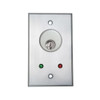
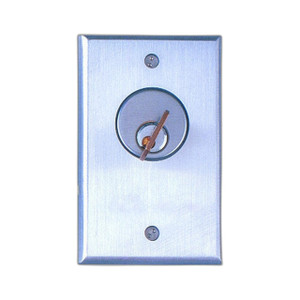
Camden CM-1160 Key Switch 2 SPDT Maintained
The Camden CM-1160 is a maintained key switch engineered to control 30VDC electric strikes, electromagnetic locks, and solenoid-driven access hardware in commercial and institutional door control applications. Unlike momentary contacts that pulse voltage, the two SPDT (single-pole, double-throw) contacts in the CM-1160 hold their energized state for as long as the key remains in the turned position — releasing power only when the key is rotated back. This maintained contact behavior is critical for latching strikes that require sustained power to remain locked or unlocked, eliminating the need for external relay logic to latch control power. The die-cast aluminum housing provides vandal and tamper resistance, and the assembly fits standard 1", 1 1/8", or 1 1/4" mortise cylinders, making it a drop-in retrofit for legacy door hardware.
Key Features
- SPDT Maintained Contacts: Two independent single-pole, double-throw contacts hold voltage state continuously while key is activated. Eliminates relay logic for strikes requiring sustained power, simplifying wiring and reducing control circuit complexity.
- 30VDC Rated Operation: Engineered for direct 30VDC strike control — the standard voltage for electromagnetic locks and latching solenoid hardware in access control systems. Supports standard 24VDC circuits with appropriate power supply de-rating.
- Dual Contact Flexibility: Two independent SPDT contacts allow single-strike control with contact redundancy, or parallel wiring of two separate door zones from one key switch activation.
- Die-Cast Aluminum Housing: Tamper and vandal-resistant construction withstands physical attack and environmental stress. Suitable for high-traffic entry points, loading dock doors, and unsecured wall-mount installations.
- Standard Mortise Cylinder Compatibility: Accepts 1", 1 1/8", or 1 1/4" mortise cylinders sourced independently. Enables integration with existing keying schemes and allows cylinder replacement without replacing the entire switch body.
- Manual Override Capability: Provides key-based access activation independent of card readers or electronic credential systems — essential for emergency egress, power-loss scenarios, and scheduled after-hours manual access.
- Direct-Wired Control: No relay, timer module, or intermediate control board required for basic latching strike operation. Two SPDT contacts wire directly to 30VDC strike power supply, reducing bill of materials and installation labor.
- Tamperproof Mounting Hardware: Supplied with security screws and driver. Prevents casual disassembly and removes evidence of tampering, supporting institutional compliance requirements.
The CM-1160 integrates into access control architectures that rely on key-based manual override combined with electronic strike management. In warehouse and loading-dock scenarios, facility managers often pair this switch with card readers on the same door — the key switch provides a manual failsafe when the card system is down, or allows scheduled key-only access during off-hours. The maintained contact design is non-negotiable for strikes that must hold power continuously; momentary-contact switches force the use of external relay modules to latch power, adding cost and troubleshooting complexity. A single key switch wired to two separate strike circuits gives you zone-level flexibility without adding hardware to the wall or frame.
Installation mounts the CM-1160 in a standard 1" mortise opening at 2 3/4" width. The die-cast body is rugged enough for retrofit into existing wooden or metal frames without reinforcement. Sourcing the mortise cylinder separately allows you to match existing facility keying — a critical detail for institutions managing multiple buildings or access zones. Two SPDT contacts wire directly to 30VDC; verify your power supply provides adequate current for the connected strike (typical draw is under 5A for single latching solenoid). Tamperproof screws secure the assembly and deter non-technical bypass attempts.
The CM-1160 carries a Manufacturer Warranty covering defects in materials and workmanship. The die-cast aluminum and brass components resist corrosion in indoor and lightly exposed (covered) outdoor environments; do not install in direct rain or salt-spray zones without additional NEMA enclosure protection. For applications requiring momentary pulse control instead of maintained contact, Camden offers alternative switch models — consult the product datasheet or system architect before final specification to confirm contact-type alignment with your strike hardware.
Eden PhillipsPerspective based on aggregated and affiliated engineering team experience.
We've deployed the Camden CM-1160 across warehouse entry points, institutional cafeteria serving areas, and secure document rooms where key-based override is mandated by facility policy. The maintained contact behavior is the selling point — it eliminates the relay-module tax that momentary switches impose. On a typical 30-door warehouse retrofit, removing relay logic from each strike circuit saves roughly 20% on control-panel real estate, simplifies troubleshooting when a strike fails to latch, and reduces voltage drop issues on longer wire runs. The die-cast aluminum body holds up well in light industrial environments; we've seen minimal vandalism on wall-mounted installations because the assembly looks intentionally industrial rather than like soft target. The two independent SPDT contacts are genuinely useful — on multi-door zones, you can wire one contact to the primary strike and the second to a solenoid-driven bolt-release on an adjacent security gate, all from a single key activation. That kind of wiring flexibility is rare in key switches at this price tier.
Technical Highlights:
- Maintained Contact Design: The two SPDT contacts hold their state continuously as long as the key remains activated. This eliminates the need for external relay modules to latch strike power — critical for solenoid-latching hardware that cannot respond to momentary pulses. Wiring is direct: key switch to 30VDC supply to strike. Fewer components = fewer failure points.
- 30VDC Direct Control: Rated for 30VDC operation with standard DC strike hardware. Supports 24VDC circuits by current de-rating; do not exceed rated voltage or contact loading specifications without consulting Camden technical support.
- Die-Cast Aluminum Housing: Tamper-resistant body resists physical attack and casual disassembly. The mortise cylinder accepts industry-standard cylinders — you source the cylinder separately, matching your facility keying scheme.
- Dual SPDT Flexibility: Two independent single-pole, double-throw contacts allow single-strike redundancy, zone splitting, or parallel wiring to manage multiple solenoids from one key switch. No additional logic required.
- Mortise Cylinder Compatibility: Fits 1", 1 1/8", or 1 1/4" mortise cylinders. Cylinder sourcing is separate; verify your keying plan aligns with facility master key system before ordering.
Deployment Considerations:
- Maintain a strict key control policy — the CM-1160 provides unmediated access to any strike it controls. In institutional settings, designate a responsible key custodian and audit key assignments regularly. Loss of the key compromises the strike's access control.
- Verify strike current draw before installation. Standard 30VDC latching solenoids draw 1–3A; high-powered dual solenoids or EM locks can exceed 5A. Confirm your power supply and wiring gauge support peak inrush current without voltage sag.
- The maintained contact closes and holds indefinitely while the key is turned. There is no automatic timeout — if someone leaves the key in the switch, the strike remains energized until the key is physically removed and rotated back. Install the switch in a secure or monitored location, or pair it with a supervisory device that alerts on prolonged key activation.
- Do not install the CM-1160 in direct rain, salt spray, or condensing environments without a NEMA 4X stainless enclosure. Die-cast aluminum corrodes in wet coastal or freeze-thaw climates. Indoor installation under covered loading docks is acceptable; outdoor perimeter doors require secondary environmental protection.
- The mortise cylinder is user-sourced — lead time and keying customization may add 2–3 weeks to procurement. Confirm cylinder source and master-key alignment early in the project. Camden technical support can recommend compatible cylinder vendors.
The CM-1160 is the right choice for warehouse managers, institutional facilities, and security architects who need tamper-resistant key-based strike control without relay logic overhead. If your application requires momentary pulse control, electronic credential integration, or automatic timeout, consider a multi-technology reader or an access control panel with integrated key-switch relay logic. For straightforward key-to-strike wiring in institutional and light-industrial settings, the CM-1160 is cost-effective and operationally transparent. Explore additional Camden access control hardware in the Camden catalog.