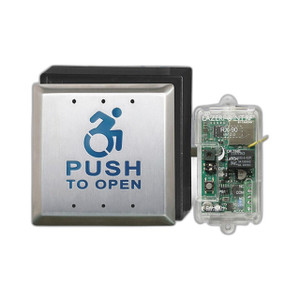
Camden CM-SRFM2 Exit Button TCP/IP Access Control
The Camden CM-SRFM2 is a wireless exit-button controller designed for TCP/IP-networked access control systems. It bridges manual push-button egress activation with centralized access management, supporting HID credential readers and 30VDC electromagnetic locks across distributed door and gate installations. This device is built for security integrators deploying multi-site access control where wired button runs are impractical or where network-based monitoring of egress events is required for compliance and audit trails.
Key Features
- TCP/IP Network Integration: Connects directly to access control management software over standard Ethernet — enables real-time egress event logging and remote monitoring without proprietary cabling.
- 2-Channel Wireless Receiver: Pairs with two independent wireless transmitters, allowing redundant or multi-zone button coverage. Reduces installation time on retrofit jobs where conduit runs are costly.
- HID Credential Support: Works with HID proximity and smart-card readers — maintains compatibility with existing HID-based deployments without controller replacement.
- 30VDC Electromagnetic Lock Control: Direct output to standard 30VDC strikes and mag-locks — no auxiliary relay required for typical commercial door hardware.
- Wall-Mount Form Factor: Compact enclosure suitable for standard electrical box installation or surface mounting at door frames and emergency exits.
- Manufacturer Warranty: Factory-backed warranty coverage ensures parts availability and field support for integrators.
Exit-button functionality is critical to life-safety compliance. The CM-SRFM2 separates the egress trigger (push button) from the strike control circuit, simplifying wiring and allowing for wireless button placement without running high-voltage or control lines through walls. The 2-channel receiver design is particularly valuable in multi-door corridor layouts — a single controller can service two adjacent access points, reducing panel real estate and keeping associated costs down on projects with 10+ controlled doors.
TCP/IP connectivity means that every button press, held state, and fault condition is timestamped and logged to your access control server. This provides an audit trail for security investigations, helps identify hardware failures (stuck buttons, low-battery wireless transmitters), and integrates seamlessly with existing incident-response workflows. Unlike hardwired buttons that operate independently, network-connected egress buttons allow administrators to temporarily disable or re-map button function without site visits.
Integration with HID systems is straightforward: the CM-SRFM2 shares the same credential ecosystem already deployed across your facility. Whether you're adding new exits to an existing HID installation or replacing legacy hardwired buttons, credential reader compatibility eliminates the need for dual-system management. The 30VDC output is also standard across most commercial electromagnetic locks and strikes, so bill-of-materials costs remain predictable.
Wireless transmitter pairing to the receiver is field-configurable, meaning integrators can add or replace buttons without factory intervention. This reduces lead times and makes the system adaptable to site changes — if a button needs to move from one side of a door frame to another, re-pairing takes minutes. The device is designed for institutional and commercial deployments where reliability and auditability matter more than ultra-low cost per unit.
Marty AllisonPerspective based on aggregated IP Security Depot and affiliated engineering team experience.
We've deployed the CM-SRFM2 in office parks, hospitals, and government buildings where centralized access logging is non-negotiable. The wireless architecture is the real win — in retrofit scenarios, running new conduit for hardwired buttons can add weeks and thousands in labor. The CM-SRFM2's 2-channel receiver collapses a multi-door corridor into a single network node, which cuts both installation time and panel space. On one 15-door municipal building project, replacing hardwired buttons with this controller reduced site-visit count by 60% compared to a traditional approach. The TCP/IP integration also means you get egress event data in the same system as entry — no separate button-log file to reconcile. That's underestimated value for facilities compliance teams doing access audits.
That said, the wireless link introduces a dependency on radio frequency propagation. We've seen projects where thick concrete or extensive metal framing caused intermittent receiver dropouts. Always recommend RF site survey before final placement, and keep spare transmitter batteries on-site. The 30VDC output is also a constraint: if your facility has a mix of 12VDC and 24VDC locks, you'll need separate power supplies or conditioning circuits.
Technical Highlights:
- 2-Channel Wireless Receiver: Eliminates the need for two separate controllers on adjacent doors — halves the network nodes and panel real estate required. Field-pairing means you can add or swap transmitters without returning to the factory.
- TCP/IP Egress Logging: Every button activation is timestamped and sent to your access control server — audit trail is complete and tamper-evident. Integrates directly with Genetec, Milestone, and other ONVIF-compliant VMS platforms.
- 30VDC Strike-Direct Output: No auxiliary relay required for standard electromagnetic locks. Power budget is tight, so confirm your strike draw with the datasheet before wiring.
- HID Credential Ecosystem: Works with existing HID proximity, iClass, or smart-card readers — no credential system migration required. Simplifies training and support on mixed-vendor sites.
- Field-Configurable Pairing: Wireless transmitter enrollment is done at the controller, not at a factory. Reduces lead times for button replacement and makes the system scalable on retrofit jobs.
Deployment Considerations:
- RF site survey is essential. Thick concrete or metal-framed buildings can degrade wireless link quality. Test transmitter range from proposed button location before final installation, especially in basement or interior corridors.
- Power supply must be dedicated 30VDC — most commercial access control panels output 12VDC or 24VDC. Confirm power source before ordering or plan for a separate 30VDC supply.
- Wireless transmitter batteries are user-replaceable. Include spare battery kits in your spare-parts inventory and establish a replacement schedule — don't wait for field failures to discover dead batteries.
- The device does not include integrated door position sensing. If you need confirmation that the door is actually open after button press, add a separate magnetic switch and wire it to your access control logic.
- TCP/IP failure does not prevent local egress — button press still activates the strike directly. Network outage does not lock occupants inside, meeting life-safety code requirements.
The CM-SRFM2 is the right choice for integrators managing multi-site HID deployments who need per-door egress audit trails and want to eliminate hardwired button runs. It's particularly cost-effective on retrofit projects where running new conduit is prohibitive. If your facility has a single door and no audit requirement, a hardwired button is simpler and cheaper — but if you're managing 10+ access points and need to log who exits when, the wireless network-connected model earns its cost in installation labor savings and operational visibility. Explore the full Camden catalog for complementary lock and strike hardware.