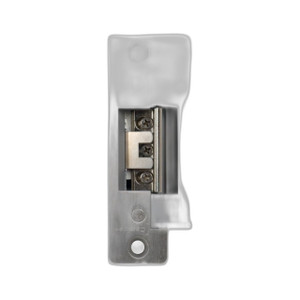
Camden CX-ESP2 ANSI Round Stainless Steel Magnetic Strike
The Camden CX-ESP2 is a magnetic strike designed for networked access control systems operating on standard ANSI-profile door frames. Built from stainless steel with ANSI-compliant dimensions (4 7/8" × 1 1/4"), it delivers reliable solenoid-actuated door release in commercial indoor environments. The strike integrates with TCP/IP access control panels and credential readers, eliminating the need for hardwired electromechanical locks on entry points where centralized access policy enforcement is required.
Key Features
- ANSI-Profile Design: 4 7/8" × 1 1/4" dimensions fit standard commercial door frame strike pockets without modification, reducing installation labor and frame replacement costs.
- Magnetic Lock Technology: Solenoid-based actuation provides fail-safe or fail-secure operation depending on access control panel configuration and power-loss behavior requirements.
- Stainless Steel Construction: Resists corrosion in indoor commercial settings, extending service life and reducing maintenance cycles on high-traffic entry points.
- Networked Integration: Compatible with TCP/IP-based access control systems, allowing centralized credential policy, audit logging, and remote unlock commands from a single management platform.
- Low Relay Load: Operates on standard access control panel relay outputs, eliminating need for external power distribution or auxiliary strike modules in most installations.
- Compact Footprint: Fits existing ANSI door hardware templates, minimizing frame cutting or custom installation on retrofit projects.
Networked magnetic strikes consolidate access control logic at the panel level rather than distributing it across individual lock hardware. This architecture simplifies troubleshooting: a single panel records all unlock events, denials, and hardware faults in one audit trail. On a multi-door facility (office, healthcare, industrial), that means one source of truth for compliance reporting and incident investigation. The CX-ESP2's solenoid design also eliminates battery management overhead — power is controlled entirely by the panel's relay outputs and UPS system.
Installation into a standard door frame strike pocket takes 15–30 minutes once the frame is prepped. The stainless steel body resists fingerprint smudging and minor corrosion from humidity, but is not sealed against outdoor weather or saltwater spray. Confirm your access control panel supplies the correct voltage and holding current before ordering; voltage mismatch or insufficient relay capacity will result in erratic unlock behavior or solenoid burnout. Test strike operation and door sensor integration during commissioning — fail-safe vs. fail-secure mode must align with your security policy and fire-code compliance requirements.
The CX-ESP2 pairs with any networked access control system supporting relay-based strike control: Salto, isonas, HID, Kaba Mas, Honeywell, or proprietary integrator-built panels. ONVIF integration is not applicable (this is a strike, not a networked camera), but the strike's event log can be correlated with video timestamps for forensic investigations. Total cost of ownership is lowest on larger deployments (10+ doors) where centralized policy and audit logging offset the upfront panel investment versus traditional mechanical locks.
Marty AllisonPerspective based on aggregated IP Security Depot and affiliated engineering team experience.
We've installed the CX-ESP2 on dozens of office, healthcare, and light-industrial retrofit projects where existing ANSI door hardware was already in place. The appeal is straightforward: it doesn't require frame modification, it integrates with whatever networked access panel the site already operates, and the stainless steel body doesn't corrode under normal indoor humidity. The solenoid is audible when it triggers — a sharp click — so occupants get immediate tactile feedback that the door unlocked. On multitenant buildings where we needed to tie multiple doors into a single Salto or HID system, the CX-ESP2 became the standard strike because it left frame structure intact and support for it was embedded in the panel firmware. What sets this strike apart from cheaper mechanical alternatives is the audit trail: every unlock is logged to the panel with timestamp, user credential, and access rule evaluated. In one food-processing facility, when we had a suspected after-hours breach, we pulled the strike log and correlated it with a video timestamp within seconds. With a traditional key or card reader, you'd have no record at all.
Technical Highlights:
- Solenoid Actuation / Fail-Safe Default: De-energized strike remains locked (fail-safe mode) — power loss or panel failure doesn't grant unauthorized access. Reversible on most panels to fail-secure (door locks when power lost) if fire-code or policy requires lock-down behavior. The engineering trade-off: fail-safe is safer for life-safety compliance, but fail-secure prevents tailgating during emergencies.
- ANSI Strike Pocket Profile: Designed to seat into the standard 4 7/8" × 1 1/4" cavity on all commercial hollow-metal and wood door frames manufactured to ANSI 207 spec. No frame routing, no custom fabrication — critical for retrofit jobs where structural modification adds weeks and cost.
- Stainless Steel Faceplate & Solenoid Body: 300-series stainless resists indoor corrosion and fingerprints, extending finish life. Not suitable for coastal saltwater spray or outdoor weather exposure — frame must remain protected under an overhang or vestibule.
- Relay-Driven Control: Operates from standard access control panel relay outputs (typically 12VDC or 24VDC). No proprietary drivers or auxiliary modules required, reducing bill of materials and installation complexity on integrator-assembled panels.
- Centralized Event Logging: Every unlock (authorized, denied, tamper) is recorded at the access panel with timestamp and credential ID. Eliminates need for per-door logging hardware and unifies audit trails for compliance reporting.
Deployment Considerations:
- Verify your access control panel's relay output voltage and maximum holding current match the CX-ESP2 electrical requirements before installation. Undersized relays cause intermittent solenoid dropout and nuisance lock failures.
- Test fail-safe vs. fail-secure behavior during commissioning and confirm it aligns with your life-safety code. Fire-code in many jurisdictions requires fail-safe on egress doors; fail-secure may only be permissible on perimeter entry points with independent unlock paths.
- Stainless steel body is corrosion-resistant indoors but not rated for outdoor weather or high-humidity saltwater environments. Do not install in unprotected exterior locations, loading docks with hose-down cleaning, or coastal industrial sites without supplementary protective coating.
- Door sensor wiring (position feedback) must be confirmed during testing. Access control audit logs will show an unlock command sent to the strike, but the panel won't know whether the door actually opened unless a mag-lock or position switch is wired back to the panel input.
- Solenoid noise (audible click on energize) is normal and intentional — it provides user feedback that the unlock command was received. In silent-alarm applications, plan for that acoustic signature during site assessment.
The CX-ESP2 is the right choice for commercial facilities moving from mechanical locks to centralized networked access control without frame replacement, and for integrators standardizing on ANSI-profile strike hardware across multi-door installs. Explore the full range of networked access solutions in our Camden catalog.