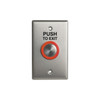
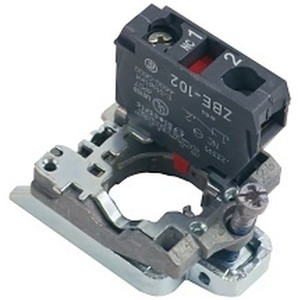
Camden CM-4000/60N Additional N/O Circuit Module
The Camden CM-4000/60N is an additional normally-open (N/O) relay output circuit designed to expand the electromagnetic lock and strike control capacity of Camden's CM-3000 through CM-8000 networked access control systems. This module adds discrete relay channels for controlling supplementary strike mechanisms, door holders, access-controlled devices, or monitoring equipment in multi-door installations where the base controller's native output count is insufficient. Deploy this accessory when your access topology requires more independently controlled outputs than the primary control unit provides natively.
Key Features
- N/O Relay Output: Normally-open circuit configuration. Supports standard electromagnetic lock and strike solenoid applications at rated coil impedance.
- 30VDC Operation: Operates at 30VDC supply voltage. Compatible with existing Camden power infrastructure and strike equipment rated for this voltage.
- Networked Integration: Connects via TCP/IP network into the same access control topology as the base CM-3000-8000 controller. Credentials (DESFire, MIFARE, HID, SEOS, 125 kHz proximity) are managed centrally across all expansion modules.
- Multi-Credential Support: Works with all credential types supported by your base controller — no additional reader hardware required at the module level.
- Modular Expansion: Plugs into available expansion slots on CM-3000, CM-4000, CM-5000, CM-7000, or CM-8000 series controllers. Allows staged capacity growth without replacing the primary control unit.
- Wall, Pole, or Recessed Mounting: Flexible installation footprint accommodates surface-mounted, pole-mounted, or recessed deployment scenarios depending on site architecture.
- Manufacturer Warranty: Backed by Camden manufacturer warranty coverage for defects and workmanship.
The CM-4000/60N solves a common integration pain point in larger access-controlled campuses: when a single door controller can manage authentication and logging across all credentials but lacks sufficient relay outputs to control every strike or auxiliary device independently. Rather than deploying a second full controller (capex and network overhead), this module extends the primary unit's I/O capacity at a fraction of the cost and network complexity.
Installation integrates directly into the base controller's expansion port. Your primary unit must have available module slots — consult your specific CM-3000 through CM-8000 technical documentation for slot count and terminal assignments. The 30VDC supply and relay contact ratings are derived from the base controller's power budget; you'll need to verify that your primary unit can source sufficient current for the additional strike(s) before final commissioning. This is a networking-layer accessory, not a standalone device — it inherits all credential logic, access rules, and audit logging from the primary controller's configuration.
Deployment scenarios include multi-tenant buildings where a core CM-7000 controller manages credential authentication for all entry points but individual tenant suites require independent strikes (the base unit controls the main lobby, this module controls suite-level doors); secure document storage facilities requiring multiple relay-controlled locks on separate cabinets; or perimeter access stations where a single controller manages badges for the guard shack, loading dock, and equipment room, each with its own strike. The N/O configuration is standard for electromagnetic locks and solenoid strikes operating at 30VDC — confirm your strike coil impedance and inrush current ratings align with the relay contact specifications before wiring.
The module operates within the same TCP/IP network backbone as your base CM-3000-8000 controller, meaning credential updates, access rule changes, and audit logs flow through a single management interface. If your base controller is managed via a central access control platform or custom API integration, the relay outputs of this module inherit the same policy engine and audit trail.
Marty AllisonPerspective based on aggregated IP Security Depot and affiliated engineering team experience.
We've deployed the CM-4000/60N in dozens of mid-to-large access control projects where the original single-controller architecture hit its relay output ceiling. The module is straightforward: it's a networked I/O expander that inherits all the policy and credential logic from the base CM-3000-8000 controller. What differentiates it from commodity relay modules is that it plugs directly into the Camden ecosystem — no secondary controller, no parallel credential database, no API glue code. The access rules you define once on the primary unit automatically apply to all strikes controlled by this module. That simplicity saves commissioning time and eliminates a whole class of sync bugs that plague multi-box deployments. The trade-off is that you're locked into the Camden control architecture — if you later decide to migrate to a Salto or HID platform, you'll need to replace this module along with the primary controller. For green-field campuses or retrofit projects where the base CM-3000-8000 is already the decision, this is the right expansion path. For brownfield integrations mixing multiple control brands, you'd want a true ONVIF or networked relay gateway instead.
Technical Highlights:
- 30VDC Relay Output: Rated for standard 30VDC electromagnetic strikes and locks. Verify inrush current (typical 2–8 amps for 24/30VDC solenoid coils) against the module's contact rating before wiring. Undersized relays will chatter or fail prematurely under solenoid inrush loads.
- N/O Configuration: Normally-open relay — strike releases when power is applied. Ensures fail-open behavior (unlocked) on power loss unless you're using a power-to-lock solenoid paired with an external holding supply. Confirm your strike type and safety requirements before installation.
- TCP/IP Networked Control: No separate relay protocol or RS-485 bus — all I/O is commanded through the same network tunnel as the base controller. Simplifies cabling on large campuses; the module doesn't add latency or bandwidth headaches if your network infrastructure is sound.
- Credential Inheritance: The module doesn't authenticate credentials itself — the base CM-3000-8000 controller validates all cards (DESFire, MIFARE, HID, SEOS, 125 kHz) and triggers relay outputs according to access rules. One credential database, one audit log, one point of policy management across all doors and expansion modules.
- Modular Slot Expansion: Most Camden controllers support 2–4 module slots. Don't assume unlimited expansion — confirm available slots on your specific base unit before specifying multiple modules in a single project.
- No Standalone Operation: This module is purely an I/O expander. It cannot function without a primary CM-3000-8000 controller on the network. If you're building a new installation, order the base controller and this module together.
Deployment Considerations:
- Power Budget: Verify that your CM-3000-8000 base controller's 30VDC supply can handle the inrush current of all strikes connected to both the primary unit and this module. A typical 30VDC 2–4 amp supply may saturate if you're driving 3+ solenoids simultaneously. Add a local regulated 30VDC supply for the module if current draw exceeds the primary unit's rating.
- Expansion Slot Availability: Before purchase, confirm your specific base controller model has an available module slot. Datasheets specify slot count (e.g., CM-7000 supports up to 4 modules). Installing a module into an unavailable slot will require hardware changes or a controller upgrade.
- Strike Coil Verification: N/O relay configuration means the strike energizes and releases when the relay closes. If your strike is a power-to-lock type or requires holding power, you'll need to supply 30VDC to the coil continuously and use the relay as a gate signal — not as the main power switch. Test this on the bench before field installation.
- Credential Sync: All credentials managed on the base controller apply to module-controlled doors automatically. If you delete or modify a cardholder's access rules, every door (base + module) updates without manual intervention. This is a feature, but it's also a single point of failure — if the primary controller fails, module relay outputs go dark.
- Cable Routing: Module expansion slots are typically on the rear or side of the controller enclosure. Plan cabling runs from the base unit to the module early in the physical design; coiled or stressed cable runs in tight enclosures can degrade contact reliability over time.
The CM-4000/60N is the right choice for integrators expanding an existing Camden CM-3000-8000 installation or for new projects where the base controller is already locked in. If you're selecting an access control platform from scratch and you know you'll need 6+ independently controlled strikes across multiple doors, evaluate whether a centralized multi-door controller with built-in I/O (e.g., CM-8000 with onboard relay count) is more cost-effective than a smaller controller plus multiple expansion modules. For retrofit and phased rollouts, this module is fast and low-risk. Explore the Camden catalog for compatible base controllers and credentials readers.