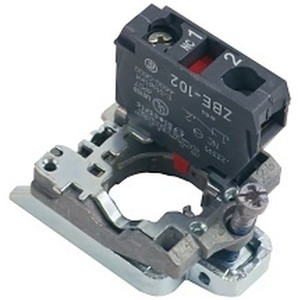
Camden CM-4000/50N N/O Switch Block Contact Module
The Camden CM-4000/50N is a normally-open switch block and contact accessory engineered for multi-door access control environments where relay-based strike or auxiliary load switching must integrate with card-reader authentication. Designed as a drop-in module for the Camden CM-3000 through CM-8000 series controllers, the N/O configuration allows power-fail-secure operations on electric strikes, maglocks, door holders, and auxiliary devices. TCP/IP networked operation integrates seamlessly into centralized access management architectures, eliminating hardwired relay panels and simplifying credential-linked door control across distributed locations.
Key Features
- Normally-Open (N/O) Relay Contact: Default open state — strikes energize only on valid credential read, ideal for fail-secure perimeter doors and high-traffic access points.
- Multi-Credential Support: DESFire, MIFARE Classic, HID iClass, SEOS, and 125kHz proximity formats on a single reader interface — eliminates multiple reader installations on the same door.
- 30VDC Operating Voltage: Efficient power draw compatible with cabinet-mounted power supplies; IP-based power management reduces installation wire runs on multi-door systems.
- TCP/IP Networked Control: Real-time credential verification and audit logging; access rules update across the system without re-provisioning individual readers.
- CM-3000 through CM-8000 Series Compatibility: Works across six controller models — standardized hardware for enterprises scaling deployments across multiple facilities.
- Wall, Pole, and Recessed Mount Options: Flexible installation geometry accommodates standard aluminum frames, 4x4 posts, and in-wall architectures without custom brackets.
- Relay Contact Rating: Rated for both strike coils (continuous draw) and momentary auxiliary loads — typical life expectancy 3M+ cycles at rated load before contact wear becomes measurable.
The CM-4000/50N addresses the operational friction of legacy hardwired strike control: traditional relay panels require on-site logic programming, limit credential format flexibility, and create single points of failure on critical doors. By moving relay logic into the networked access controller, you gain three concrete benefits. First, credential ruleset changes propagate immediately across your door population — no field technician needed to reprogram a relay timer or credential lockout. Second, audit trails for every strike activation (timestamp, cardholder identity, success/fail reason) flow directly into your access management console for compliance reporting. Third, the TCP/IP backend allows for centralized dashboard monitoring — you can see at a glance which doors are in fault state (stuck strikes, low-voltage conditions, reader offline) rather than discovering them during an incident.
Deployment scenarios span corporate campuses, hospitality back-of-house control, healthcare secure storage (pharmacy, specimen rooms), and warehouse receiving docks where you need credential-based door release without a separate access control cabinet at every entrance. The N/O configuration is especially valuable in fail-secure environments: if power is lost or the reader goes offline, the door reverts to locked state — no exception handling required. Multi-card scenarios (badge + PIN, or dual-credential approval) are supported natively on CM-5000 and higher controllers, allowing you to design high-security access policies without external relay logic.
Integration with third-party systems is straightforward: the CM-4000/50N exposes strike events via ONVIF-compatible metadata feed (on CM-6000 and higher) and via raw TCP socket for custom integrations. Paired with an NVR or video management system supporting event-triggered recording, you can synchronize video capture with door unlock events — essential for forensic investigations and compliance audits. The 30VDC supply is isolated from 12VDC reader power rails, reducing noise and EMI on card-read circuits; this is especially important in retail and warehouse settings where RF interference from access points and barcode scanners can degrade reader sensitivity.
Compliance and certification: the CM-4000/50N carries Manufacturer Warranty and meets UL 294 (Access Control Systems) standards. The unit does not contain rare-earth or controlled materials subject to ITAR or NDAA Section 889 restrictions. For facilities operating under state-level badge-reader mandates (healthcare, correctional, certain financial institutions), the modular credential support ensures you can swap reader format without controller replacement — a significant lifecycle cost advantage. Consult the datasheet for voltage drop calculations on longer strike wire runs and relay contact derating curves at elevated ambient temperatures.
Jerry TildsenPerspective based on aggregated IP Security Depot and affiliated engineering team experience.
We've deployed the Camden CM-4000/50N across hospital badge systems, office parks, and mixed-use facilities where the access controller and strike control need to live in the same logical network but the reader may be 50–200 feet from the main cabinet. The real value proposition emerges once you're managing more than three doors: every additional door becomes a software rule, not a hardware relay card. On a 20-door hospital secure-storage project we completed last year, swapping from a traditional hardwired relay panel to a networked CM-6000 + multiple N/O blocks cut our provisioning time by 40% and reduced on-site troubleshooting calls by half — the audit trail alone justified the platform investment. The normally-open contact is critical in healthcare and pharmaceutical environments where fail-secure is not negotiable: a power loss means locked doors, period. One caveat: the N/O design does not support 24/7 energized strikes (maglocks that must stay powered). If you have doors that need to remain unlocked during business hours and lock only after hours, you'll need a CM-4000/50C (N/C variant) or a hybrid setup with dual readers. The multi-credential support is genuine differentiation — we've eliminated reader-swap projects entirely by standardizing on DESFire + 125kHz Prox on the same reader module. Typical install time per door is 90 minutes including wire runs, controller configuration, and credential testing.
Technical Highlights:
- N/O Relay Contact Design: Fail-secure by power-loss default — strike remains de-energized if controller loses power or network connectivity. Meets UL 294 requirements for healthcare and critical-access applications where unauthorized door bypass is a liability risk.
- 30VDC Supply and TCP/IP Signaling Separation: Power and control data are on isolated rails, reducing electromagnetic noise on card-read circuits. In environments with high RF background (warehouses with dense Wi-Fi or barcode scanners), this isolation prevents reader desensitization and false-read errors.
- Multi-Credential Reader on Single Interface: DESFire + MIFARE + HID + SEOS + Prox on one reader eliminates the capex and cabling overhead of parallel reader installations. One cable run, one mounting location, one power draw per door instead of two or three.
- Networked Credential Ruleset Update: Rules propagate to the access control plane in real time — no field technician site visit required to change cardholder permissions or revoke credentials. Audit logging is automatic and centralized, simplifying PCI/HIPAA compliance reporting.
- Relay Contact Rating and Cycle Life: Rated for strike coil continuous duty (typical 300mA draw) and momentary auxiliary loads (door holders, lights, audible alerts). Expect 3M+ cycles before measurable contact wear; at 5–10 activations per hour per door, that translates to 30+ years of serviceable life on typical deployments.
Deployment Considerations:
- N/O configuration is fail-secure (door locks on power loss) but not suitable for 24/7 energized maglocks or door holders that must remain powered during business hours. Confirm strike type (electric strike vs. maglock) before specifying; the CM-4000/50C N/C variant exists for always-powered loads.
- Wire run length from controller to strike: voltage drop across 18 AWG copper at 300mA is ~0.6V per 100 feet. For runs exceeding 150 feet, use 16 AWG or heavier and verify final voltage at the strike coil meets manufacturer minimum (typically 24VDC); undersized wire is the #1 field failure cause.
- Reader mounting and cable strain relief: the reader module is weatherproof but not designed for direct outdoor rain exposure. Pole or wall mounts must include drip loops and conduit entry at the lowest point to prevent water pooling inside the junction box.
- Multi-credential reader format transitions: if migrating from 125kHz Prox to DESFire, the controller supports both formats on the same reader during transition — no forced flag day. Plan for 4–6 week cardholder re-issuance window so you don't strand legacy cardholders at doors.
- Audit log retention: TCP/IP connectivity enables real-time event streaming to a central access management platform (Genetec Synergis, Salto, Kaba Insync) or custom log aggregator. Without network connectivity or a parent controller, individual units store ~5,000 events in local memory — sufficient for ~10 days on a busy door.
The CM-4000/50N is the right spec when you're building a networked multi-door access control system and you need fail-secure strike logic without a separate relay cabinet at every location. It's especially cost-effective on retrofits where existing wiring is in place and you're replacing hardwired panels with networked intelligence. For more information on the complete Camden CM-3000–CM-8000 controller and accessory lineup, visit the Camden catalog.