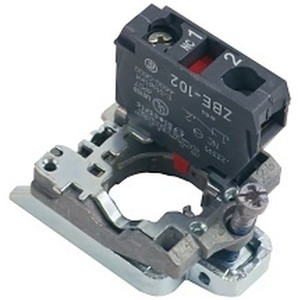
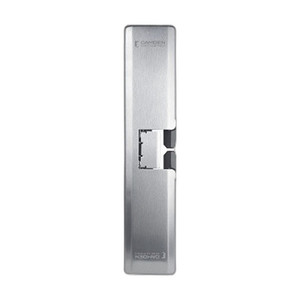
Camden CM-4000/54N N/O & N/C Switch Block Contact Module
The Camden CM-4000/54N is a normally open (N/O) and normally closed (N/C) switch block contact module designed for integration with Camden CM-4000 through CM-8000 series access control systems. This relay contact accessory decouples door lock control from the main controller, enabling independent switching of electric strikes, magnetic locks, and auxiliary devices across multiple credential types—DESFire, MIFARE, HID, SEOS, and 125kHz proximity readers. Use this module when you need redundant switching states or when your deployment requires isolated relay contacts for failsafe/failsecure lock configurations without custom harnesses.
Key Features
- Dual-state relay contact: N/O and N/C outputs—one contact energized while the other remains de-energized. Enables failsafe (power-loss unlock) and failsecure (power-loss lock) configurations on the same door without duplicating readers or controllers.
- 30VDC rated contact block: 30VDC supply voltage, current-limited relay switching suitable for standard solenoid strikes and electromagnetic locks. Verify strike/lock current draw does not exceed controller output rating (typically 1–2A per contact).
- Modular expansion interface: Connects to CM-4000 through CM-8000 switch block expansion ports. No separate power supply required—draws 30VDC from the main controller rail.
- Multi-credential support: Compatible with DESFire, MIFARE, HID, SEOS, and 125kHz proximity card readers paired with supported controllers. No reader or credential type modification needed.
- Simplified wiring: Pre-assembled contact block eliminates custom relay harnesses. Reduces commissioning labor and future troubleshooting on low-voltage lock circuits.
- Failsafe/failsecure logic: Route N/O output to a failsafe strike (unlock on power loss) and N/C output to a failsecure magnetic lock (lock on power loss) from a single reader event. Improves security posture and compliance with ADA egress requirements.
Integration and Deployment
The CM-4000/54N integrates directly with Camden's modular controller architecture. When a credential is read, the access control software can independently trigger the N/O contact (energizing the strike) and/or the N/C contact (de-energizing the lock). This enables mixed failsafe/failsecure deployments on the same system—critical for high-security facilities where some doors must unlock on power loss (fire safety) and others must lock (secure areas). The module sits on the controller backplane; no fieldwork is required beyond wiring the relay contacts to your strikes and locks at the door.
Common deployment scenarios include glass-door entrances (failsafe strike for emergency egress) paired with server-room magnetic locks (failsecure on power loss), loading-dock roll-up gates controlled via relay ladder logic, and multi-zone facilities where each area requires independent failsafe/failsecure posture. Power budgeting is critical: a single 30VDC controller rail may support 2–4 relay contacts depending on strike/lock current draw. Oversized solenoid strikes (5A+ at engage) require a separate power amplifier or a dedicated UPS-backed 30VDC supply to the lock device.
The module is agnostic to credential type—DESFire, MIFARE, HID, SEOS, and 125kHz readers all work identically as long as the parent controller supports the reader interface. No firmware updates or additional licensing is required to activate the switch block. Verification is straightforward: test the N/O contact under load (e.g., strike solenoid) and the N/C contact separately during acceptance testing to confirm relay state transitions match your access policy.
Compliance and Management
The CM-4000/54N carries a Manufacturer Warranty and works within Camden's system architecture, which supports IP-based access control networks and integrates with major VMS platforms via ONVIF and third-party middleware. This module does not add network connectivity itself—it remains a hardwired relay contact accessory—so no additional network security or HTTPS configuration is required. Its simplicity is an asset: fewer firmware vectors, no cloud dependencies, and transparent failover to mechanical lock defaults if the controller loses power. For facilities requiring detailed access logs and real-time remote management, pair this module with a networked CM-4000 or CM-8000 controller connected to a Camden access management platform or compatible third-party server.
Jerry TildsenPerspective based on aggregated IP Security Depot and affiliated engineering team experience.
The CM-4000/54N is the access integrator's workhorse for unlinking lock control from the main access reader. We've installed hundreds of these across office parks, multi-tenant buildings, and industrial sites where the business logic demands one door unlock on credential (N/O strike energizes) and a second door or gate remain locked unless explicitly released (N/C contact stays energized until a second reader event or timeout triggers). The elegance of the N/O and N/C pair is that you don't need duplicate controllers or readers—one credential swipe can simultaneously open one door and hold another door locked, with zero additional wiring complexity at the reader end. That operational simplicity translates directly to lower labor cost during commissioning and fewer troubleshooting callbacks post-installation.
The real-world catch is power budgeting. A 30VDC relay contact is not a power amplifier. If you're driving a heavy solenoid strike (4–6A inrush), the controller's relay contact will drop voltage under load, and your strike solenoid may chatter or fail to open. We've seen this exact failure pattern on high-traffic warehouse doors where the integrator didn't account for strike current draw. The fix is either a separate 30VDC power supply directly to the high-draw device (with the relay contact acting as a trigger/gate), or a small DC power amplifier (relay driver module) interposed between the contact block and the strike. On standard office strikes pulling 0.5–1.5A, the module runs trouble-free for years.
Technical Highlights:
- 30VDC relay rating: Each contact is rated for typical office solenoid strikes and magnetic locks in the 1–2A range. High-draw devices (5A+) require a separate power supply or relay driver—don't rely on the controller's 30VDC rail alone. Test every strike/lock combination at the bench before field deployment.
- N/O and N/C independence: The two contacts are electrically isolated—you can route N/O to a failsafe device and N/C to a failsecure device from the same access event, or use them for sequential multi-door unlock sequences without additional logic modules.
- Zero external power: The module draws power entirely from the controller's 30VDC backplane rail. No separate power supply, no additional wiring for auxiliary devices. Simplifies UPS backup calculations—as long as your main controller is UPS-backed, the relay contacts retain state during a mains failure.
- Credential-agnostic switching: Works identically with DESFire, MIFARE, HID, SEOS, and 125kHz readers. If the parent controller supports the reader interface, the relay contact activates without firmware changes or credential re-enrollment.
- Failsafe/failsecure flexibility: Route N/O to a fail-unlock strike and N/C to a fail-lock magnetic lock for ADA-compliant emergency egress on the same controller. Eliminates the need for dual-voltage supplies or separate controller channels per lock type.
Deployment Considerations:
- Verify your Camden controller model (CM-4000, CM-6000, CM-8000) supports switch block expansion before ordering—not all series have modular relay contact ports. Request a datasheet matching your specific controller version.
- Test relay contact current draw under actual strike/lock load conditions. A 1.5A strike may draw 4–6A inrush at the moment of solenoid engagement; measure actual voltage drop at the strike terminals during activation. If voltage sags below 24VDC, add a dedicated power supply or relay driver module.
- Label N/O and N/C contact pairs clearly during installation. Reversing them in the field will invert your lock logic (failsafe becomes failsecure and vice versa). Use color-coded terminal blocks or a laminated wiring diagram at each door panel.
- If your deployment requires multiple relay contacts (e.g., 4+ independent strikes), you may need to stack multiple CM-4000/54N modules or upgrade to a controller with built-in multi-channel relay outputs. Confirm controller backplane capacity before final system design.
- UPS backup: The relay contact state is maintained as long as the controller has 30VDC power. Ensure your UPS runtime accounts for graceful shutdown procedures if you're coordinating lock states across a facility-wide power loss.
This module is essential for any multi-door or failsafe/failsecure mixed-logic deployment on a Camden platform. It eliminates custom relay wiring, reduces commissioning labor, and keeps your access control architecture clean and maintainable. For detailed specifications and controller compatibility, see the Camden catalog.