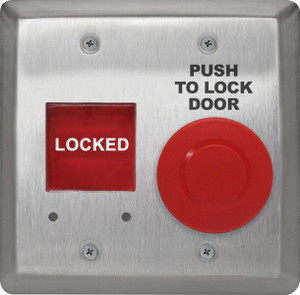
Camden CM-420RPTE Single Gang Red Push Button Switch
The Camden CM-420RPTE is a hardwired push-button switch designed for door activation and access control manual release. It provides dual relay contacts—normally open (N/O) and normally closed (N/C)—allowing independent wiring paths to electric strikes, solenoids, and control panel inputs. The molded ABS housing and single-gang form factor fit standard US electrical boxes, making it suitable for new construction and retrofit installations where tactile, immediate door release is required without credential readers or biometric authentication.
Key Features
- Dual Contact Outputs (N/O and N/C): Independent normally open and normally closed relay pairs. Enables simultaneous strike activation and alarm circuit supervision without additional relays.
- 12V or 24V DC Operation: Compatible with standard access control power supplies. Works with most electric strike solenoids and panel relay inputs across voltage ranges.
- Molded ABS Housing: Flame and impact-resistant polymer construction. Withstands high-traffic environments and repeated button presses without cracking or deformation.
- Single-Gang Wall Mount: Standard electrical box footprint. Direct retrofit into existing conduit runs; no special adapters or larger cavity requirements.
- Hardwired Relay Contacts: Passive mechanical switching—no batteries, wireless modules, or active electronics. Zero network dependencies; contacts close/open on physical press.
- Red Button Identification: Visual coding for emergency or secondary release. Distinguishes manual override from credential readers on the same door frame.
- Stainless Steel Fasteners: Included mounting hardware resists corrosion in indoor and light outdoor environments.
- No Power Draw on Standby: Mechanical relay operation—zero parasitic current when idle, lowering panel power budget on multi-door installations.
The N/O contact is typically wired to the strike release circuit (12V or 24V solenoid), while the N/C contact can supervise door status or trigger an alarm input. Confirm your access control panel's contact rating and voltage before terminal connection—most standard 12/24V relays handle the switch current without issue. Integrators often wire the N/O for momentary activation (press to de-energize the strike), allowing the door latch to fall into locked position when the button is released. The N/C path enables dual-state logic: if the button is pressed and held, the N/C contact remains open, signaling to the control panel that manual release is active.
Installation is straightforward: mount the single-gang plate into a standard electrical box, run the N/O and N/C terminal wires to your strike circuit or panel input terminals, and secure the button module to the wall. No power supply connection, batteries, or programming is required—the CM-420RPTE is entirely passive. Strain relief and proper wire gauging (typically 14/2 or 16/2 for low-current relay circuits) prevent fatigue at terminal points over years of high-use doors. Test both contact paths before final commissioning: verify that pressing the button closes the N/O contacts and opens the N/C contacts, and that release restores both to rest state.
Common deployment scenarios include emergency exits (red button override on double doors), visitor/tenant access points (secondary release next to card reader), loading docks (manual activation for after-hours access), and secured vestibules (tailgate prevention via dual-contact logic). In multi-door access control systems, the CM-420RPTE's lack of network or wireless dependencies means it remains functional even if the central panel loses connectivity—a critical safety feature for life-safety doors.
The Camden CM-420RPTE carries a manufacturer warranty and is sourced direct from the manufacturer through authorized US distributors. Its proven mechanical simplicity and standard electrical footprint make it a reliable choice for integrators specifying manual release on any 12V or 24V access control circuit. For deployments requiring additional features such as weathering (IP65 rating), LED status indication, or networked status reporting, explore Camden's extended push-button and switch lineup in the Camden catalog.
Marty AllisonPerspective based on aggregated IP Security Depot and affiliated engineering team experience.
We've specified the Camden CM-420RPTE on dozens of access control retrofits and new builds, and it remains one of the most bulletproof manual release options available. What sets it apart is the absence of active electronics—there's no circuit board to fail, no firmware to update, and no network dependency. On a mid-size office complex or warehouse with 20+ doors, that simplicity translates directly into lower maintenance headcount and zero worry about an emergency override button becoming unreachable due to a panel reboot. The dual-contact design is particularly valuable for life-safety applications: one integrator we worked with in healthcare used the N/O for strike release and the N/C for a door-position alarm that triggered whenever the button was held—allowing nursing staff to verify that the door was actually unlocking, rather than pressing blindly and hoping. Compared to wireless panic buttons or networked push-to-exit readers, the CM-420RPTE sacrifices convenience (no remote status, no audit log) for absolute reliability and zero latency.
Technical Highlights:
- Dual Relay Contacts (N/O and N/C): Both paths energize on the same button press, enabling simultaneous strike control and supervisory logic without a separate relay module. If your panel has limited input capacity, this cuts your wiring footprint in half versus two separate buttons.
- Passive Mechanical Operation: No power supply connection, no batteries, no standby current draw. On a large campus installation with 40+ doors, the elimination of wireless battery maintenance across all override points is a real operational win. The button works identically whether the access control panel is on or offline.
- 12V/24V DC Compatibility: Works across the two dominant access control power standards. Verify your solenoid draw against the relay contact rating (typically 1-2A for N/O, same for N/C), but most standard electric strikes fall comfortably within spec.
- Single-Gang Conduit Footprint: Direct fit into any standard US electrical box—no custom mounting brackets, no oversized cavities. On retrofit jobs where you're installing a button next to an existing credential reader, the compact form factor prevents a second wall box and keeps the aesthetic clean.
- Molded ABS + Stainless Hardware: The plastic housing withstands repeated presses, thermal cycling, and minor impact without delaminating. We've pulled units from 10-year-old installations that still click crisply. Not suitable for harsh outdoor environments (unheated loading docks in winter, direct UV), but standard indoor or covered vestibule deployments show no degradation.
Deployment Considerations:
- Verify your access control panel's relay input voltage and contact rating before wiring. Most panels accept 12V/24V dry contacts up to 2A; the CM-420RPTE handles that easily. If you're driving a high-current solenoid (>2A draw), add an intermediate relay to avoid contact arcing.
- Hardwired relay means you must run new conduit or reuse existing cable paths. If your infrastructure is entirely wireless or network-based, the CM-420RPTE requires a parallel hardwired circuit—a cost adder on some retrofits. Weigh that against the reliability gain on life-safety doors.
- N/O contact typically energizes the strike solenoid on press. Confirm with your door hardware spec sheet that the strike de-energizes and latches when voltage is removed—some electric strikes behave differently depending on wiring polarity and circuit topology.
- Test both contact paths (N/O and N/C) before final panel commissioning. A stuck relay or intermittent contact will prevent either path from functioning. A simple continuity check with a multimeter takes 30 seconds and avoids call-backs.
- Red color coding is standard for emergency/override buttons, but verify it aligns with your facility's color-coding policy (some hospitals or government sites have specific override button requirements). For non-emergency manual release (vestibule push-to-exit), consider whether gray or black housing would reduce confusion with true emergency buttons.
The CM-420RPTE is the right choice for integrators prioritizing bulletproof reliability and low operational overhead on access control manual release. If you need audit logging, remote status, or wireless convenience, you'll outgrow this button—but for life-safety, backup release, and retrofit simplicity, it's hard to beat. Explore the full Camden catalog for wireless and networked alternatives.