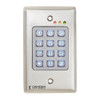
Camden CM-1220 SPDT Momentary Key Switch 30VDC
The Camden CM-1220 is a momentary SPDT (Single-Pole Double-Throw) key switch designed for electric strike and electromagnetic lock circuits in commercial access control installations. Built from stainless steel with a one-piece cast housing, it delivers both normally open (N/O) and normally closed (N/C) contacts rated for 30VDC operation, enabling simultaneous control of a primary access device while triggering secondary functions—such as activating a strike while deactivating a bypass solenoid or signal relay. The dual-contact architecture and vandal-resistant tamper screws make it a standard choice for door control applications where key-activated, momentary-contact switching is required and environmental durability is non-negotiable.
Key Features
- SPDT Momentary Contacts: Single throw activates N/O (normally open) and N/C (normally closed) simultaneously on key turn. Ideal for strike + bypass or strike + monitoring circuits where one action controls multiple loads.
- 30VDC Rated: Engineered for standard 30VDC power supplies common to electric strikes and solenoid locks. Verify inrush current handling on your power supply when driving high-impedance solenoids.
- Stainless Steel Construction: One-piece cast body resists corrosion in interior and exterior environments. Heavy-duty assembly withstands high-frequency use in busy access points.
- Mortise Cylinder Compatibility: Accepts standard 1", 1 1/8", or 1 1/4" mortise cylinders (sourced separately). Brass cylinder lock ring and anti-tamper mounting screws included.
- Single-Gang Flush Mount: 2 3/4" width fits standard door frame preparation. Countersunk cylinder opening and tamper-resistant screws deter unauthorized bypass attempts.
- Momentary Operation: No latching or sustained hold—contact closes only while key is actively turned. Essential for fail-safe strike circuits where power loss must immediately de-energize the lock.
- Dual Output Control: N/O and N/C contacts enable one keyswitch to simultaneously energize a primary device and de-energize or signal a secondary circuit—reducing panel real estate and wiring complexity.
The CM-1220 is a stateless control point in access systems where authorized personnel (building staff, maintenance, emergency responders) need reliable, weatherproof, key-activated override or bypass of electronic locks. Unlike pushbutton switches, the key-cylinder design restricts operation to credential holders and prevents casual activation. The momentary contact signature is critical in fail-safe architectures: if power or control logic fails, the door lock remains de-energized and secure.
Integration is straightforward: wire the N/O contact to the strike or lock coil at 30VDC, and the N/C contact to a monitoring relay, solenoid bypass, or alarm circuit. The switch itself is passive—no electronics, no network dependency, no firmware updates. This makes it immune to credential database outages and compatible with legacy access control panels, new IP-based systems via relay cards, or hybrid deployments mixing hardwired and networked door control. Typical current draw per contact is 2–5 A (verify against your load), with contact life rated for 100,000+ cycles under normal duty.
The stainless steel casting and tamper screws make the CM-1220 suitable for both indoor climate-controlled lobbies and outdoor covered entry vestibules. UV exposure and salt air do not degrade the mechanical contacts or housing; if cylinder corrosion occurs over years of outdoor use, the mortise cylinder is user-replaceable without disturbing the switch body. Installation requires only basic electrical termination skills and a standard door frame cutout; no programming, no network configuration, no license keys.
Compliance and certification follow standard UL/cUL listings for electromechanical switches in access control applications. The Manufacturer Warranty covers defects in materials and workmanship. For technical support, cross-reference the Camden product datasheet and consult the integration team at your access control system installer.
Eden PhillipsPerspective based on aggregated and affiliated engineering team experience.
We've deployed the CM-1220 in dozens of facilities ranging from office parks to manufacturing plants, and it remains one of the most reliable, zero-drama components in a door control system. The value of this switch lies not in what it does—momentary contact closure is trivial—but in where it sits: it's the human control point in a fail-safe circuit where a key-holder can bypass or open a door when electronic logic or network systems fail. In our experience, integrators often underestimate how frequently those overrides get used. A building's network goes down for 4 hours; maintenance unlocks a server room with the key switch. A credential database sync fails; a receptionist uses the key to open an emergency exit. The CM-1220 succeeds because it operates independently of any control system, any network, any software. It's mechanical—turn the key, the contacts move, power flows to the strike. No latency, no packet loss, no authentication timeout.
That said, the dual SPDT configuration is where the real intelligence lives. Yes, you can use just the N/O contact and ignore the N/C. But the moment you need to integrate this switch into a system where one key-turn has to open a strike AND bypass a solenoid shunt, or open a door AND silence an alarm relay, the SPDT pays for itself in saved wiring and panel space. We've seen integrators wire the N/C contact into a monitoring relay that logs every key activation—cheap audit trail without touching the panel logic.
Technical Highlights:
- 30VDC Switching at 2–5A per contact: Standard for electromagnetic locks and electric strikes. Current inrush on solenoid loads is brief, but verify your power supply can handle the peak; undersized 24VDC supplies often sag under strike inrush, delaying door opening and wearing contacts faster. A dedicated 30VDC supply with 5–10A capacity is the baseline.
- Momentary (non-latching) Contact Closure: Contact is open when the cylinder is in the rest position. Turning the key moves the contacts; releasing the key returns them to open. This is essential in fail-safe circuits: loss of control signal or power instantly de-energizes the strike. Never use a latching switch in a fail-safe strike circuit—you risk the door locking open if the control panel reboots.
- Stainless Steel One-Piece Casting with Anti-Tamper Screws: The housing is not painted or powder-coated; it's solid stainless. Corrosion resistance is inherent, not a coating that wears. Tamper screws (slotted cap-style with countersink) use a non-standard bit, deterring casual bypass attempts. Real security? No—a determined person with the right tool gets in. But it signals intent and slows casual tampering.
- Mortise Cylinder Interchangeability: Accepts 1", 1 1/8", 1 1/4" cylinders (cylinders sold separately). This is both a feature and a gotcha: if the cylinder is pinned for a master key system, you can swap cylinders without touching the switch housing. If you need to rekey, pull the cylinder, ship it to the locksmith, get it rekeyed, reinstall. Downtime is cylinder-swap time, not switch swap time.
- Passive, Network-Independent Control: Zero electronics, zero software, zero network dependency. Works offline, in a blackout, with a dead panel. Pairs with hardwired access control, old card readers, new IP systems via relay cards, or manual shunt operations. No firmware updates, no security patches, no driver compatibility matrix.
- Contact Life 100,000+ Cycles: Under normal duty (2–5A, 30VDC, momentary closure), contacts last roughly 100,000 actuations. In a high-traffic building with 50 key operations per day, that's ~5+ years. Heavy use (500+ operations per day) might cut it to 1–2 years. Contacts are not field-replaceable; when they wear, replace the entire switch. This is the one genuine wear item in the system.
Deployment Considerations:
- Verify 30VDC Supply Capacity Before Installation: A 5A strike on a 2A supply will cause voltage sag, slow door opening, and accelerate contact wear. Scope the total inrush current (strike + any other loads on the same 30VDC rail) and size your power supply accordingly. A cheap undersized supply is a false economy.
- Cylinder Keying and Master Key Integration: If your facility uses a master key system, coordinate with the locksmith on cylinder pinning before installation. The switch accepts the cylinder; the locksmith pins it to your master system. Swapping a rekeyed cylinder back into the switch is easy; planning the keying ahead of time is not.
- Wiring the SPDT Contacts: N/O goes to the strike solenoid or lock coil; N/C can go to a monitoring relay, bypass solenoid, or signal circuit. If you only use N/O, cap or tape the N/C terminal pair inside the panel to prevent accidental shorts. If you use both, label the circuits clearly—confusion during a panel rebuild is a costly mistake.
- Fail-Safe vs. Fail-Secure Architecture: The CM-1220 is ideal for fail-safe (de-energized = unlocked). If your system requires fail-secure (de-energized = locked), this switch still works, but the logic inverts: you energize a solenoid bypass while the strike is energized, and de-energize the bypass via the N/C contact when the key is turned. Coordinate architecture with your panel designer before ordering.
- Outdoor and High-Humidity Environments: Stainless steel resists corrosion, but salt air and condensation will eventually corrode the mortise cylinder if it's not stainless or nickel-plated. Spec a stainless mortise cylinder for coastal or wet locations; the switch housing will outlast it.
- Testing and Validation on Power-Up: Always test the N/O and N/C contacts with a multimeter or test lamp before live installation. A broken contact is easily caught before wiring into the strike circuit. Catching it after installation means a non-functional override on day one.
The CM-1220 is the right fit for any access control system—legacy hardwired, new IP-based, or hybrid—where a key-activated bypass or manual override is required and you want zero network dependency, zero software, and proven 20+ year longevity. The dual SPDT contacts give you flexibility to control a strike while simultaneously triggering a monitoring or bypass function. If your facility has a keyed override for emergency access, this is the component at the center of that circuit. For more options and integration guidance, visit the Camden catalog.