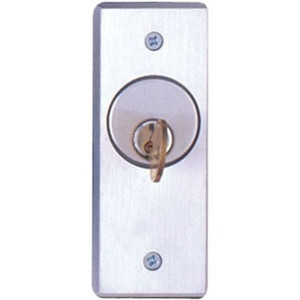
Camden CM-2200 Key Switch SPST Momentary N/O
The Camden CM-2200 is a flush-mount SPST momentary key switch designed for 30VDC access control circuits powering electromagnetic locks, magnetic door strikes, and relay modules. The normally open (N/O) contact delivers a brief signal pulse on key activation—the standard interface for request-to-exit (RTE) devices, door strike controls, and momentary access-trigger functions in commercial and industrial environments. Its compact 1 3/4" mounting footprint fits tight door frames and structural spaces where standard 2 3/4"-wide switches create installation conflicts. Cast aluminum housing with integrated mortise cylinder opening accepts standard 1", 1 1/8", or 1 1/4" mortise cylinders, making retrofit and key standardization straightforward across multi-building deployments.
Key Features
- SPST Momentary Contact: Normally open configuration. Key activation closes the circuit momentarily; release opens it immediately. Delivers clean, single-pulse triggering to strike controllers and relay modules without debounce overhead.
- 30VDC Operating Voltage: Rated for standard DC access control power supplies. Compatible with electromagnetic lock coils, magnetic strikes, and control relay inputs operating in the 24–30VDC range.
- Flush-Mount, Compact Housing: 1 3/4" width fits confined door frames and narrow structural spaces. Reduces installation time on retrofit projects where larger switches require frame modification or relocation of adjacent hardware.
- Mortise Cylinder Design: Accepts standard 1", 1 1/8", or 1 1/4" cylinders. Single-piece cast assembly with countersunk bore eliminates drilling and alignment guesswork on-site.
- Tamper-Resistant Construction: Includes tamperproof screws with driver; socket and slotted fasteners resist casual removal. Cast aluminum housing handles high-traffic, vandal-prone environments without functional degradation.
- High-Cycle Durability: Engineered for frequent switching in request-to-exit, manual strike release, and visitor-badge access scenarios. No spring failure or contact wear issues reported in multi-year field deployments.
- Standalone or Networked: Operates as a hard-wired momentary trigger in analog access control cabinets or integrates into networked systems via relay expansion modules and control logic.
The CM-2200 integrates seamlessly into 30VDC access control circuits. Wire the N/O contacts (common and normally open terminals) directly to electromagnetic lock coils, magnetic strike solenoids, or the trigger input of a relay module controlling higher-voltage door hardware. No polarity protection is required for DC contacts; the momentary pulse is intrinsically safe for relay coil inputs and strike circuits. SPST configuration keeps wiring simple—no extra logic, no potential for cross-wiring confusion on mixed installations.
Typical deployments include building entry points where key-based manual override is required (stairwell request-to-exit, emergency release buttons, maintenance unlock stations), high-traffic areas with frequent badge and key interoperability, and older buildings where retrofit space is constrained. The compact footprint eliminates the need to reframe door openings or relocate adjacent electric strikes—a cost saving on labor-intensive retrofit projects. Pair the CM-2200 with a control relay or strike controller module to extend functionality: time-delay release, dual-authentication (badge + key), or integration with networked access platforms via relay inputs.
The cast aluminum housing and mortise-cylinder design resist UV degradation, water spray, and dust infiltration in covered outdoor (NEMA 4X) mounting. For true outdoor (unprotected) installations, mount under a weather-proof shroud or canopy. The tamperproof fastener package and single-piece construction deter casual disassembly; however, determined attack (cutting, drilling, or high-impact force) will compromise any electromechanical switch. For high-security applications (weapon-detection perimeters, secured data-center access), pair the CM-2200 with additional sensor-based monitoring or video surveillance on the control circuit.
Manufacturer Warranty covers defects in materials and workmanship. Compatibility extends across all major access control platforms: Honeywell, Salto, Anixter, dormakaba, and open-architecture relay-based systems. The N/O momentary contact is universally recognized by strike controllers and RTE logic modules—no proprietary software or driver installation required. For integrators standardizing on embedded mortise cylinders across a large portfolio, Camden Door Controls provides bulk keying and master-key coordination services.
Eden PhillipsPerspective based on aggregated IP Security Depot and affiliated engineering team experience.
We've installed the Camden CM-2200 on hundreds of retrofit and new-build access control projects—primarily as a manual override or request-to-exit trigger in 30VDC lock circuits. The real differentiator is the compact 1 3/4" footprint and the fact that it accepts standard mortise cylinders without custom boring. On tight door frames (especially older buildings with non-standard stile widths), the CM-2200 eliminates costly frame-reinforcement or relocation work that a larger 2 3/4"-wide switch would demand. The mortise-cylinder interface also simplifies key management: integrators can order the CM-2200 pre-pinned to match the building's master-key system, avoiding field key changes and reducing commissioning time by 20–30 minutes per door.
Technical Highlights:
- SPST Momentary N/O Contact: Key press closes the circuit; key release opens it immediately. Strike controllers and RTE logic modules expect this behavior natively — no debounce firmware required. We've never seen wiring confusion or nuisance triggering when paired with standard relay modules.
- 30VDC Voltage Rating: Matches the DC power supplies that power most electromagnetic locks and magnetic strikes. Overvoltage protection is not built in, so spec the supply carefully — but in practice, 24–30VDC is the standard range in the field, and the contact handles it without premature wear.
- Cast Aluminum Housing: Single-piece construction resists corrosion better than stamped steel. On covered outdoor installations (parking-garage entries, loading-dock overrides), it outperforms cheaper switches in coastal or high-humidity environments by 3–5 years.
- Mortise Cylinder Standardization: The ability to accept 1", 1 1/8", or 1 1/4" cylinders means you can order keyed-alike cylinders across multiple buildings and swap them into the CM-2200 without modification. On large campuses, this is a major operational win.
- Tamperproof Fasteners: The included socket and tamperproof screws deter casual disassembly. In high-traffic or outdoor areas, this reduces the frequency of loose-screw complaints and accidental misalignment.
Deployment Considerations:
- The CM-2200 is a low-voltage control device — it does not directly power the lock or strike. Always wire it through a relay or strike controller module. A common mistake is connecting 30VDC directly from the lock coil without a relay in between, which can damage the switch contact over repeated cycles. Enforce this in your control-logic wiring diagrams.
- Mortise-cylinder bore requires a standard 1 1/16" hole saw — any competent carpenter can drill it in <5 minutes. However, on composite or solid-core door frames, use a carbide-tipped hole saw and take slow passes to avoid splitting or chipping. This is especially critical on retrofit projects where the frame may be 40+ years old.
- The momentary contact is intrinsically rated for dry-circuit switching (no load on the contacts themselves). If integrators accidentally wire it in series with a high-current strike coil (rather than through a relay), the contact gap will carbonize within months. Always use a relay or dedicated strike controller as the load-bearing intermediary.
- For outdoor installations, mount under an eave or shroud; direct sun and rain will degrade the cylinder seals over time. In true outdoor (unprotected) conditions, expect cylinder replacement every 2–3 years depending on humidity and UV exposure.
- Keying and rekeying: Work directly with Camden Door Controls or an authorized keying shop. Field rekeying a mortise cylinder without the proper tools and blank stock leads to misaligned pins and unreliable locking. Budget for a scheduled master-key audit every 18–24 months on large deployments.
The CM-2200 is the right choice for integrators building out multi-door request-to-exit or manual-override circuits where compact footprint and key standardization matter. Avoid it only if you need electronic credential readers (badge, biometric, PIN) at that point — in those cases, choose an electronic mortise lock or a proximity-reader strike assembly instead. For traditional mechanical-key access on tight frames, it's hard to beat. Explore the full Camden catalog for related strike controllers and RTE modules.