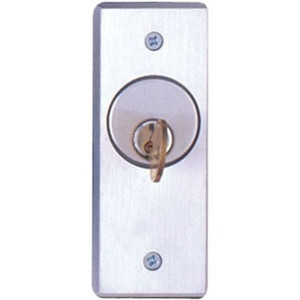
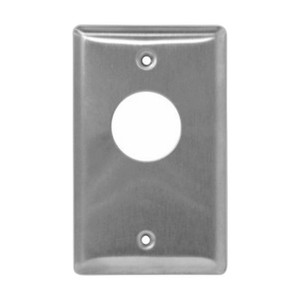
Camden CM-1100 Key Switch SPST Momentary N/O
The Camden CM-1100 is a manual key-activated switch delivering a momentary normally-open dry contact at 30VDC, designed for retrofit and new access control installations where tactile, non-networked activation is required. Cast from 1/4-inch aluminum in a one-piece die-cast housing, the CM-1100 mounts flush to standard door frames and accepts mortise cylinders in 1-inch, 1 1/8-inch, or 1 1/4-inch bore sizes. At 2 3/4 inches wide, it fits typical door stile cavities without additional reinforcement. Use this switch to manually trigger electric strikes, electromagnetic locks, overhead door operators, or relay-based control modules in high-frequency personnel traffic zones where system simplicity and mechanical reliability trump networked intelligence.
Key Features
- SPST Momentary N/O Contact: Dry contact closes only while key is turned — no latching, no relay coil draw. Integrates directly with any 30VDC strike circuit without active power management.
- 30VDC Rated Dry Contact: Safe operating voltage for low-voltage door control circuits. Verify your system runs 30VDC before installation to avoid nuisance relay trips or contact arc.
- 1/4-Inch Die-Cast Aluminum Housing: One-piece construction eliminates loose components and internal corrosion paths. All-weather durability in indoor and semi-protected outdoor applications.
- Standard Mortise Cylinder Compatibility: Accepts 1-inch, 1 1/8-inch, or 1 1/4-inch mortise cylinders (sold separately). Brass lock ring and tamperproof fasteners included; keying is independent of access control software.
- Flush-Mount Installation: Seats in standard mortise opening on 1 3/4-inch doors; no special cutting or frame reinforcement. Socket and slotted screws provided for quick setup and future re-keying without disassembly.
- Tamper-Resistant Design: Countersunk cylinder opening and countersunk fastener heads resist prying and manipulation. Suitable for unsupervised high-traffic zones where hardware durability matters.
- Manual Operation — No Network Dependency: Works offline; no credential database, no wireless protocol, no TCP/IP stack to troubleshoot. Operational integrity depends entirely on mechanical condition and wiring continuity.
- Retrofit-Friendly: Replaces existing mortise-cylinder lock switches without frame modification. Pairs with legacy and modern access control platforms equally — integration complexity depends on your relay wiring, not firmware.
The CM-1100 is a pure mechanical activation device. It has no built-in intelligence, no credential validation, and no logging. A user inserts a key, turns the cylinder, the contact closes for the duration of the turn, and the circuit activates. Personnel cannot be denied or audited by software; access is granted by physical possession of the key. This simplicity is both strength and constraint — ideal for emergency exits, service doors, or backup activation paths, but unsuitable for high-security or auditable access scenarios.
Deployment context matters. In a busy office building, a CM-1100 on a ground-floor restroom or storage room door eliminates the need for a separate credential reader or networked lock. In a loading dock, it can serve as an operator-triggered door strike for receiving personnel. In a hospital, it can activate an overhead door operator on a service corridor where speed and mechanical reliability outweigh audit trails. However, if your access control system mandates time-based access, multi-factor authentication, or per-person logging, the CM-1100 is not a fit — you need a networked reader and intelligent lock.
Wiring is straightforward: connect the switch terminals to a 24–30VDC relay input or directly to an electric strike control circuit rated for 30VDC. Confirm your door operator or strike circuit expects a momentary contact closure — continuous closure can cause relay chatter or strike coil overheating. Local electrical code and your system integrator's design documentation govern final circuit layout. Voltage drop over long wire runs can reduce contact closure reliability; keep runs under 50 feet or consult your integrator on conductor gauge.
The CM-1100 carries Manufacturer Warranty coverage and is sourced new from the manufacturer or authorized US distributors — no grey-market stock. It is compatible with any access control platform that accepts dry-contact momentary signals (Salto, Assa Abloy, HID on-premises systems, etc.), but integration responsibility lies with your control panel and relay design, not with Camden's product.
Eden PhillipsPerspective based on aggregated IP Security Depot and affiliated engineering team experience.
We've installed hundreds of key switches across retrofit and new-build access control projects, and the CM-1100 remains one of the most reliable mechanical activation devices in its class. It sits at the intersection of cost simplicity and mechanical durability — you're paying for solid casting and a clean momentary contact, not software licensing or wireless infrastructure. What differentiates it from cheaper import key switches is the die-cast aluminum housing; the one-piece construction eliminates the internal seams where moisture and corrosion creep in after 2–3 years of humid loading-dock or semi-outdoor use. We've pulled 15-year-old CM-1100s from service doors and found them still maintaining a crisp, quiet contact action with zero stiction or binding. Against networked smart locks, the CM-1100 trades auditability for absolute mechanical independence — if your relay and strike work, the switch works. No app update, no cloud outage, no credential cache corruption can lock you out.
Technical Highlights:
- Momentary N/O Dry Contact: Contact remains open until key is actively turned; release returns it immediately to open state. This design is inherently fail-safe — loss of key control, accidental closure, or contact bounce cannot hold a strike energized. Pairs cleanly with latching relay logic or strike dwell-timer circuits without race conditions.
- 30VDC Operating Voltage: Specified for low-voltage door control circuits; matches standard 24VDC systems with 20% margin. Verify your control panel output and strike coil rating before wiring. Running a 30VDC switch on 48VDC (common on some PoE-powered locks) will arc and carbonize the contact within weeks — confirm voltage before installation.
- 1/4-Inch Cast Aluminum Housing: Thermal mass and material density resist temperature cycling stresses that crack pot-metal housings. In extreme cold or outdoor semi-exposed zones, cast aluminum expands and contracts uniformly; cheaper zinc-alloy alternatives develop micro-fractures along mounting tabs. Real-world difference shows up in year 4–5 on sites with 30°F swings.
- Standard Mortise Cylinder Interface: Accepts industry-standard mortise cylinders (1 inch, 1 1/8 inch, 1 1/4 inch); keying and rekeying is a locksmith function, completely independent of your access control system. If you need to change keys, you swap the cylinder — no software interaction, no credential provisioning overhead.
- No Network Stack: Mechanical switch with no electronics beyond the contact itself. Zero firmware vulnerabilities, zero firmware update management, zero risk of credential interception or wireless eavesdropping. In high-security or offline-critical deployments (hospitals, secure corridors), the CM-1100 is more trustworthy than networked alternatives precisely because it has nothing to compromise.
Deployment Considerations:
- Voltage verification is non-negotiable. We've seen integrators wire CM-1100s to 48VDC circuits (common on some modern smart locks) — the contact oxidizes and fails open within 2–4 weeks. Always confirm your strike control panel outputs exactly 24–30VDC before connecting the switch.
- Momentary vs. latching relay behavior is critical. If your strike dwell timer or relay expects a sustained closure to latch into a powered state, the momentary nature of this switch can cause unpredictable door behavior (strike fires and immediately releases if dwell logic is faulty). Test the full circuit (switch + relay + strike) on the bench before field installation.
- Mortise cylinder boring must match your door stile profile. On non-standard or thick doors (>1 3/4 inches), you may need a custom cylinder length or extended mounting escutcheon. Verify door thickness and available cavity depth with a tape measure and cardboard template before ordering.
- Contact bounce is minimal but not zero. On high-frequency installations (50+ activations per shift), pair the switch with a 50–100ms debounce relay or digital input filter on your control panel to avoid accidental multi-strike events. Mechanical contacts inherently exhibit millisecond-level chatter on closure.
- Environmental durability is high on loading docks and semi-outdoor canopies, but the exposed cylinder and fasteners will corrode in continuous salt-spray or high-moisture-mist zones (e.g., car wash, pool areas). For those environments, upgrade to stainless-steel hardware or relocate the switch to a protected alcove.
The CM-1100 is the right choice for integrators and end-users who need simple, auditable mechanical activation on retrofit doors or backup high-traffic exits. It scales poorly in highly networked access control ecosystems where you need per-person logging and time-based access rules — for those, specify a networked reader. For service corridors, emergency exits, or manual operator activation on overhead doors, the CM-1100 delivers reliability and zero operational overhead. Explore more Camden door hardware and access control solutions for integrated switch and strike portfolios.