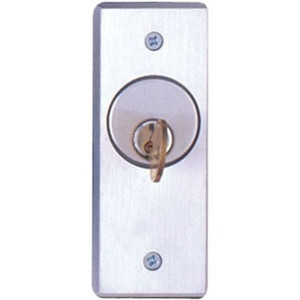
Camden CM-3500 Key Switch SPST Momentary N/O
The Camden CM-3500 is a dual SPST momentary normally-open key switch rated at 30VDC, engineered for flush-mount access control installations where personnel need to activate door strikes or electronic latches via key control. The device accepts one or two standard 1", 1 1/8", or 1 1/4" mortise cylinders and delivers a hard-wired momentary pulse to connected strike or latch hardware without dependence on networked access control platforms. Heavy-duty stainless steel construction suits both indoor and outdoor deployments — particularly relevant for secure entry points, utility areas, loading dock controls, and secure perimeter gates where key-based local activation is mandated and push-button access is insufficient.
Key Features
- Dual SPST Momentary Contact: Two independent normally-open switch channels rated 30VDC. Each key rotation delivers a momentary pulse suitable for activating electric strikes, magnetic locks, solenoid latches, or door-release signaling circuits.
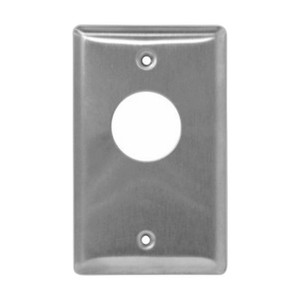
- Stainless Steel Faceplate: Double-gang mounting accepts one or two standard mortise cylinders (1", 1 1/8", or 1 1/4" bore). Heavy-gauge construction withstands outdoor weather, vandalism, and corrosive environments.
- Flush-Mount Installation: Mounts into standard double-gang electrical box cutout. Includes brass cylinder lock rings, socket/slotted screws for standard mounting, and tamperproof screws with driver for enhanced security installations.
- Cylinder Locators: Integrated locators prevent mortise cylinder rotation during operation — no set screws required, simplifying installation and reducing maintenance.
- Color-Coded Wiring: 18 AWG soldered leads with heat-shrink protective sleeves over all contacts. Enables straightforward integration into strike control circuits and door-release signaling systems.
- UL/CSA Approved: Meets North American electrical safety standards for access control applications. Manufacturer Warranty coverage included.
The CM-3500 operates independently of networked access control platforms — it provides direct momentary contact activation without reliance on VMS, credential readers, or IP infrastructure. This makes it ideal for retrofit installations, standalone secured areas, or redundant local access where a physical key-based override is required alongside electronic entry systems. Facilities managing utility rooms, server closets, loading docks, or perimeter gates often pair the CM-3500 with existing strike control logic.
Because the CM-3500 is a passive momentary switch, integration is straightforward: wire the normally-open contacts in series with the strike or latch relay coil, and key rotation triggers the pulse. No auxiliary power, no signal conditioning, no compatibility layer needed. This simplicity reduces troubleshooting complexity and lifecycle management — the device operates reliably for decades with minimal intervention.
Stainless steel construction and sealed contact design make the CM-3500 suitable for outdoor mounting, wet environments, or areas subject to salt spray or chemical exposure. Tamperproof screw option deters casual disassembly in high-risk access points. The inclusion of both standard and tamperproof hardware gives installers flexibility to match security posture to site risk.
Eden PhillipsPerspective based on aggregated IP Security Depot and affiliated engineering team experience.
We've installed the Camden CM-3500 across a wide range of access control deployments — from utility room overrides on networked systems to completely standalone mechanical-key-only secured areas. The real strength of this device is its simplicity and reliability. It's a momentary contact switch, nothing more; that means there's no firmware to update, no network dependency, no credential reader to calibrate. In environments where a physical key-based local override is required (and it's often required by code), the CM-3500 delivers exactly that function without introducing additional complexity to the wiring or control logic. We've seen it paired with strike relays, electric latch retraction circuits, and door-release solenoids across hundreds of installations — and failure rates are negligible. The stainless steel faceplate has held up in salt-spray environments on coastal facilities and in wet outdoor loading docks where standard aluminum or powder-coated steel would corrode within 18 months. When you need a key switch that doesn't communicate, doesn't authenticate, and won't become a bottleneck in a power outage — this is the right choice.
Technical Highlights:
- Dual SPST Channel Architecture: Two independent normally-open switch channels allow you to control two separate strike circuits from a single device. Common pattern: primary door strike on channel 1, emergency release solenoid on channel 2. No multiplexing complexity — each key turn delivers a clean momentary pulse to its respective coil.
- 30VDC Rating & Contact Specs: Rated for 30VDC nominal, suitable for standard industrial relay coils and solenoid coils drawing 100-500mA per pulse. Verify strike/latch coil voltage and current draw against your control power supply before installation.
- Stainless Steel 304/316 Construction: Fully sealed faceplate, brass lock rings, and stainless fasteners resist corrosion in outdoor, wet, and chemically harsh environments. We've deployed these on loading docks, outdoor perimeter gates, and seaside facilities without premature failure.
- Mortise Cylinder Flexibility: Accepts standard 1", 1 1/8", or 1 1/4" bore mortise cylinders — you specify key control by selecting the cylinder separately. This modularity means you can source keying from your preferred locksmith or security distributor without waiting for Camden to ship a pre-keyed assembly.
Deployment Considerations:
- Mortise cylinders are not included — budget separately for keying, and plan to source cylinders from your locksmith or security hardware vendor. Lead times for specialty cylinders (restricted keyway, high-security pins) can extend project timelines.
- Momentary pulse duration is fixed by switch design — typically 50-100ms per key turn. If your strike relay requires a longer or variable dwell time, you'll need an external relay card with adjustable hold time. Test pulse width on your specific strike hardware during commissioning.
- Double-gang flush-mount cutout is required — verify rough-in dimensions on the datasheet before drywall closure. Retrofit into existing single-gang boxes is not practical without significant rework.
- Wire the normally-open contacts in series with the strike or latch coil relay — do not attempt direct 24VDC or 12VDC coil wiring without a relay intermediary. Contact ratings are for dry-circuit switching, not direct load carrying.
- Tamperproof screw option is worth the small cost premium on outdoor or high-traffic access points. Standard socket screws can be removed with a hex key in seconds; tamperproof screws deter casual tampering and slow down deliberate attempts.
The CM-3500 is the go-to choice for integrators and facilities managing hybrid access control environments — where networked badge readers coexist with mechanical key overrides, or where isolated areas require zero-network-dependency entry control. It's also the ideal fallback when electronic access systems fail: a key switch that operates independently of power supplies, VMS platforms, and network connectivity. For more options in keypad and key-switch control, browse the Camden catalog.