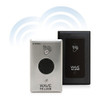
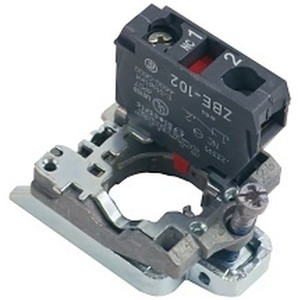
Camden CM-4000/61N Additional N/C Circuit Module
The Camden CM-4000/61N is a normally-closed (N/C) circuit expansion module designed to add discrete strike and lock control outputs to existing Camden access control installations. This accessory extends door and zone capacity without requiring a separate control unit, making it the cost-effective path to multi-door deployments and credential-agnostic access management. Install this module when your host controller's onboard outputs are exhausted or when you need to isolate strike control across separate zones or facility wings.
Key Features
- N/C Circuit Output: Normally-closed relay contact rated for 30VDC operation. Powers magnetic locks and electric strikes across the facility without additional control logic.
- Multi-Credential Support: Works with DESFire, MIFARE, HID, SEOS, and 125kHz proximity readers. Credential type is managed at the host controller level — this module simply extends the relay capacity.
- TCP/IP Ready: Integrates into networked Camden deployments. No serial cables or standalone power supplies needed — expansion happens through the host controller's network connection.
- Hot-Swap Expansion Slot: Mounts directly into CM-3000, CM-4000, CM-5000, CM-7000, or CM-8000 series controllers. No cabling between module and host — strike wiring connects only to the module's N/C terminal.
- 30VDC Operation: Aligns with standard access control power architecture. Confirm your power supply has headroom for the additional N/C circuit load before installation.
- Flexible Mount Options: Host controller can be wall-mounted, pole-mounted, or recessed. Module inherits the installation footprint of the parent unit.
Deployment Scenarios & Integration
The CM-4000/61N solves the expansion ceiling problem in multi-tenant and multi-zone facilities. If you've deployed a CM-4000 controller at the main entrance and credential demand has grown to a second stairwell or emergency exit, this module eliminates the capex and management overhead of installing a second standalone controller. The N/C output is credential-agnostic — it triggers whenever the host controller authorizes an access event, regardless of reader type or credential format on the connected device.
TCP/IP communication keeps the module synchronized with your access control platform's authentication engine. Zone-level access policies are defined once at the host controller and propagate to all expansion modules; there's no per-module configuration overhead. In distributed facilities (office parks, healthcare campuses), multiple CM-4000/61N modules can be chained to the same CM-5000 or CM-7000 controller, centralizing credential and audit-log management while distributing strike control across dozens of doors.
The module's 30VDC design integrates seamlessly into existing strike and lock infrastructure. Standard electromagnetic strikes draw 0.3–0.6A at 30VDC; most facility power supplies (24/30VDC, 10–20A) have overhead for 2–4 additional N/C circuits. Pre-audit your power draw during the planning phase — a site with a 10A supply and three CM-4000/61N modules running simultaneous unlocks can trip the breaker. Stagger your credential policy or upgrade to a higher-capacity supply if you anticipate high-frequency parallel door unlocks.
Lifecycle & Total Cost of Ownership
The expansion-module approach preserves your existing controller investment. Instead of replacing a CM-4000 with a more expensive CM-7000, you add modules as the facility grows. Over a 5-year cycle, this scales cheaper than multi-unit deployments — one master controller + N modules is simpler to audit, backup, and maintain than N independent units. Credential policy changes (e.g., revoking access for a terminated employee) apply instantly across all connected modules, eliminating the risk of orphaned doors running on outdated credentials.
Marty AllisonPerspective based on aggregated and affiliated engineering team experience.
We've deployed the CM-4000/61N across office parks, retail chains, and healthcare facilities where credential-driven access control has outgrown single-door or dual-door footprints. The real operational win isn't just the additional N/C output — it's the consolidation of authentication logic into one master controller. When you've got a CM-4000 or CM-5000 managing credentials across eight readers fed by four CM-4000/61N modules, a single policy change (e.g., temporary access grant for a contractor) propagates instantly to all eight doors. No juggling separate boxes, no audit gaps. That's where the ROI lives: operational simplicity and compliance certainty.
We've also seen this module bought by integrators doing renovation or expansion work. A client extends their facility and needs three additional access points — adding three CM-4000/61N modules to an existing CM-5000 costs significantly less than installing a standalone CM-7000, and it keeps the credential database centralized. The trade-off is that expansion is limited by the host controller's capacity. A CM-4000 might support four modules; a CM-5000, six. Once you're at capacity, you need a second master controller and a bridging strategy. Know your growth ceiling upfront.
Technical Highlights:
- N/C Relay Contact (30VDC): Rated for both continuous and momentary loads. Works with standard 12/24VDC magnetic locks wired through a 30VDC/12VDC buck converter, or direct 30VDC electric strikes. Verify lock/strike voltage compatibility before spec — common mistake is assuming 12VDC everywhere.
- Multi-Credential Agnosticism: The host controller handles credential decryption and policy lookup. This module is purely a relay — whether the upstream reader is MIFARE, DESFire, or HID, the N/C output behavior is identical. Credential type is irrelevant to the module's function.
- TCP/IP Sync: Network integration means zero-latency policy propagation. If your host controller denies access, the relay never energizes. Network lag is measured in milliseconds; this is not a critical-path bottleneck for access control.
- Hot-Swap Design: Module inserts into an expansion slot on the host controller — no reboot, no reconfiguration, no loss of service on existing outputs. Useful for phased rollouts or emergency expansion.
- Power Efficiency: Relay logic draws minimal standby current. Real power consumption is driven by the N/C load (strike duty cycle), not the module itself. Budget 0.3–0.6A per simultaneous strike activation.
Deployment Considerations:
- Verify host controller expansion slots before ordering — not all CM-series models support the same number of modules. Check the datasheet or call your equipment provider. A CM-3000 might support two modules; a CM-7000, six. Ordering blindly is a cost re-plan trigger.
- Pre-audit your 30VDC power supply capacity. If you're adding four N/C modules and each can draw 0.5A during simultaneous unlock, you need 2A headroom on top of existing readers and controller load. Under-powered supplies cause intermittent relay failures — hard to diagnose on site.
- Strike wiring is independent per module — no daisy-chaining relay contacts. Each module has its own N/C terminal block. Run separate conduit runs to each strike location to avoid cross-talk and simplify troubleshooting.
- Module expansion is limited by host controller capacity. Once you've maxed out, you need a second controller and a network-level access policy bridge. Plan your credential database scaling upfront — don't discover this constraint mid-deployment.
- In multi-building campuses, consider the credential database topology. If Building A and Building B both need access to a shared entrance, a single CM-5000 + modules is simpler than two independent CM-4000s — but it introduces a single point of failure. Network redundancy becomes critical.
This module is ideal for integrators managing growth in existing Camden deployments or architects designing medium-sized multi-door facilities that want credential centralization without the capex of a full-scale networked access control platform. For expansions, budget modules 18–24 months before you hit capacity; lead times on expansion gear can surprise you. See the Camden catalog for compatible host controllers and credential readers.