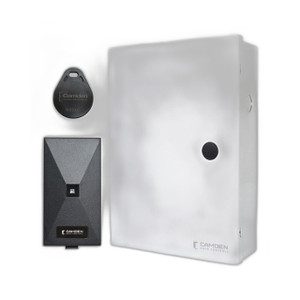
Camden CV-TXM-2 2-Button 433 MHz Wireless Key Fob
The Camden CV-TXM-2 is a 2-button wireless key fob designed for MProx-BLE access control systems. Operating at 433.92 MHz with rolling security code encryption, this credential transmitter provides pocket-sized portable authentication for office buildings, multi-tenant facilities, and commercial deployments where handheld proximity credentials simplify access workflows. The fob eliminates the friction of card-based entry while maintaining enterprise-grade security through AES-128 encrypted transmission that resists RF code-grabbing attacks.
Key Features
- 433.92 MHz Wireless Transmission: Operates on the dedicated access control frequency band. Range and propagation depend on MProx-BLE reader placement and building structure — verify coverage in your installation site before deployment.
- AES-128 Rolling Security Code: Each button press transmits a unique encrypted credential, blocking replay and cloning attacks. Code changes with every transmission, preventing static-credential interception.
- 2-Button Configuration: Dual buttons allow command segregation — typically one for unlock and one for lock or auxiliary function. Button mapping is configured during MProx-BLE provisioning.
- 3V CR2032 Lithium Battery: Pre-installed battery powers typical access duty cycles (non-continuous transmission). Red LED feedback on button press confirms transmission; LED failure indicates low battery requiring replacement.
- MProx-BLE Exclusive Pairing: Credential format and encryption are locked to MProx-BLE systems. Fob cannot be reprogrammed for third-party readers or alternative frequencies.
- Compact Pocket Form Factor: Lightweight design fits standard keychain attachment. No bulky card holder or clip required.
The CV-TXM-2 integrates into access control ecosystems where credential diversity is a deployment requirement. Unlike proximity cards, the fob remains functional in environments where card damage or wear is frequent — retail environments, outdoor facilities, or high-turnover tenant spaces. The rolling code mechanism and AES-128 encryption meet modern credential security standards without requiring additional encryption layer configuration at the MProx-BLE controller.
Installation requires a single credential registration step: the unique ID number printed on the fob's back must be entered into the MProx-BLE system's user provisioning interface and linked to the target access control rules (door permissions, time-of-day restrictions, etc.). Once provisioned, the fob operates independently — no re-pairing or re-registration is required unless the credential is revoked by the access control administrator. Battery replacement is straightforward: press the back case latches, slide out the CR2032, and insert a fresh 3V lithium cell; typical battery life ranges from 2–4 years depending on usage frequency.
Deployment context matters: the 433.92 MHz band may experience interference in RF-dense environments (hospitals with cardiac monitors, industrial facilities with heavy machinery). Test RF propagation across doors and walls before ordering large quantities. The fob's range is typically 20–50 meters in open space but degrades significantly through dense building materials. Coordinate with your systems integrator to confirm line-of-sight or near-line-of-sight coverage from the MProx-BLE reader antenna to the expected fob position at each access point.
The Camden CV-TXM-2 carries Manufacturer Warranty coverage. All deployment must be performed by qualified access control technicians familiar with MProx-BLE provisioning and wireless RF commissioning. The fob is not compatible with any other access control brand or frequency band — verify before purchase that your system is MProx-BLE native, not a retrofit or legacy migration from a different platform.
Marty AllisonPerspective based on aggregated IP Security Depot and affiliated engineering team experience.
We've deployed the Camden CV-TXM-2 as the wireless credential arm of MProx-BLE access control rollouts in mid-market office parks and retail chains where occupants demand handheld convenience without the wear-and-tear baggage of proximity cards. The real win here is the rolling code encryption — in our experience, 433 MHz key fobs from lesser manufacturers are vulnerable to RF sniffing and replay attacks, but the AES-128 mechanism on the CV-TXM-2 meaningfully raises the bar for credential cloning. We've also found the fob eliminates a whole support ticket category: lost or damaged cards driving reissuance overhead. The downside is range — in one healthcare retrofit, we had to relocate the MProx-BLE reader antenna 3 meters closer to the door because the fob's 433 MHz signal struggled through an older building's metal studs. That's a site-specific challenge, not a product defect, but it's worth front-loading with your integrator during pre-deployment RF surveys.
Technical Highlights:
- AES-128 Rolling Code: Each transmission is cryptographically unique — the fob generates a new credential value on every button press. This eliminates the static-credential vulnerability that plagues older RF key fobs. An attacker cannot replay a captured code because the next press generates a different encrypted value the receiver expects.
- 433.92 MHz Frequency Band: The dedicated access control frequency band has lower interference than crowded 2.4 GHz but demands line-of-sight or near-line-of-sight propagation from the MProx-BLE reader. In our deployments, outdoor use is reliable; indoor range varies 20–50 meters depending on wall density and RF obstacles.
- 3V CR2032 Battery Life: Typical user (5–10 button presses per day) sees 2–4 years on a single cell. The red LED feedback on transmission confirms battery voltage is adequate; when the LED dims noticeably, battery replacement is due within weeks. No surprise dead fobs in the field if users pay attention to LED brightness.
- Dual-Button Configuration: Allows mapping to two discrete MProx-BLE functions — common pattern is Button 1 for door unlock, Button 2 for lock or auxiliary relay trigger. This flexibility enables more granular access control logic than single-button fobs.
Deployment Considerations:
- RF survey is mandatory before installation — test the CV-TXM-2 at the actual door location with the MProx-BLE reader in place. 433 MHz signal loss through metal-frame doors, wire mesh, or dense masonry can exceed 10–15 dB. If range testing fails, relocate the reader antenna or consider a supplementary external antenna; do not assume factory range will meet your site without validation.
- Battery replacement requires no technician dispatch — end users can swap a CR2032 themselves, but your property management team should track battery replacement dates and train occupants on LED feedback. Consider printing battery-life expectancy on the fob label or in user documentation to set correct expectations.
- The fob's unique ID is printed on the back cover; document this number during provisioning and keep records in your access control audit log. If the fob is lost or stolen, the ID enables rapid credential revocation without affecting other users' fobs. Missing documentation makes emergency lockdown slower and more error-prone.
- MProx-BLE firmware must support the CV-TXM-2 credential format — verify your system version before ordering. Unlike ONVIF cameras that can integrate across brands, wireless key fobs are locked to their native platform. Swapping systems later means all fobs become paperweights.
- Do not operate the CV-TXM-2 in continuous-transmission mode (holding buttons down repeatedly). The AES-128 rolling code mechanism is designed for typical access cycles (one or two button presses per entry/exit). Abuse will drain the battery faster and may trigger firmware rate-limiting on the receiver.
The CV-TXM-2 is the right fit for deployments where you need wireless access credentials with no external infrastructure beyond the MProx-BLE reader. Multi-tenant facilities, office parks, and retail chains all benefit from the convenience and durability of fob-based access versus card management overhead. For buyers working exclusively within the MProx-BLE ecosystem, explore the Camden catalog to see complementary readers and controllers that round out your access control architecture.