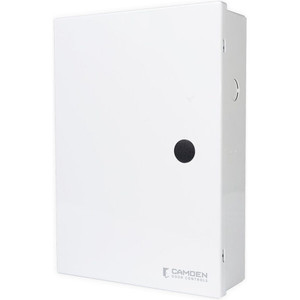
Camden CV-603PS-K1 12VDC Multi-Door Access Controller
The Camden CV-603PS-K1 is a mid-scale access control controller designed for facility integrators managing distributed entry points across small-to-mid-sized deployments. Built on the MProx-BLE platform with 12 VDC power delivery, this unit consolidates credential management for proximity readers, MIFARE smart cards, HID formats, and 125kHz proximity cards onto a single control node. Support for up to 20 doors with electric strike hardware makes the CV-603PS-K1 a practical choice for retrofits and new installations where a unified credential backbone reduces operational complexity and system sprawl.
Key Features
- Multi-Credential Platform: Accepts MIFARE, HID, and 125kHz proximity cards on a single reader input. Eliminates the need for separate credential silos and simplifies cardholder lifecycle management across mixed-format environments.
- Up to 20 Door Capacity: Controllers and electric strike wiring for 20 independent door circuits. Sized for small office buildings, warehouses, or campus sub-systems without requiring enterprise-scale master controller infrastructure.
- Wiegand + RS-485 Dual Communication: Wiegand output for direct reader connections; RS-485 serial for system-wide data and command busing. Flexible network topology reduces wiring runs in multi-zone layouts.
- Proximity + Fingerprint Reader Support: Dual-credential readers (proximity card + fingerprint on the same access point) are compatible, enabling seamless credential fallback and audit trails on sensitive doors.
- 12 VDC Native Supply: Standard voltage reduces transformer footprint and integrates easily with existing distributed power architectures. Supports standard wall, corner, recessed, column, and rack-mount enclosures.
- MProx-BLE Controller Module: Compact processing unit with Bluetooth Low Energy for wireless commissioning and local field updates. Reduces on-site programming time during installation and credential migrations.
- Electric Strike Direct Control: Native output for standard electric strikes — no intermediate relay modules required for common door hardware configurations.
The CV-603PS-K1 operates as a credential translator and access-decision engine between distributed readers and strike hardware. Unlike pure PACS (Physical Access Control System) controllers that depend on centralized servers, the MProx architecture allows autonomous door operation — readers communicate locally to the CV-603PS-K1, which grants or denies access without waiting for network round-trips. This is valuable in buildings with unreliable network uptime or where local-first responsiveness is a tenant or operational requirement.
Deployment flexibility is built in: the controller can be wall-mounted adjacent to a multi-reader cluster, recessed into a cabinet for cleaner aesthetics, or mounted in a column or rack when integrating into larger access frameworks. The compact 4.5 x 3.5 x 1.5 inch form factor fits into tight equipment closets and retrofit locations where space is constrained. Wiegand output is standard, so readers from different manufacturers (iClass, Prox, fingerprint modules from third-party OEMs) connect without proprietary dependencies.
The Manufacturer Warranty covers the electronics and MProx-BLE module, though field labor and customization are separate line items. Because the CV-603PS-K1 is credential-agnostic on input, total cost of ownership is predictable — you're not locked into one card format or reader family, which matters when budgeting multi-year phased deployments or when inheriting legacy reader infrastructure at acquisition sites. RS-485 busing means you can chain multiple CV-603PS-K1 units across a building without dedicated point-to-point wiring, reducing installation labor on larger projects.
Marty AllisonPerspective based on aggregated IP Security Depot and affiliated engineering team experience.
We've deployed the Camden CV-603PS-K1 on a range of projects from boutique office retrofits to small warehouse clusters, and the real value sits in its agnosticism to credential formats and its local-first architecture. Most mid-market facilities have inherited a patchwork of 125kHz prox cards, HID iClass in conference rooms, and MIFARE on newer wings. Rather than forcing a wholesale card reissue or running separate reader/controller pairs, the CV-603PS-K1 absorbs all three formats on the same Wiegand input — your readers talk to the controller in their native language, the controller handles the lookup and strike logic without waiting for a central server. In our experience, that autonomous operation is a massive operational win when the building's network is sketchy or when you're troubleshooting and don't have access to the master PACS console. The MProx-BLE commissioning module is genuinely useful — we've cut field programming time by 30-40% on retrofits where integrators would historically hand-code each reader address and door mapping in the field. BLE means a technician can bring a smartphone or tablet, scan a QR code on the controller, and update credential mappings without a laptop tethered to a serial port.
Technical Highlights:
- Wiegand + RS-485 Dual Protocol: Wiegand handles direct reader-to-controller signaling with zero latency; RS-485 allows multiple CV-603PS-K1 units to be daisy-chained or networked to a local access management console. You get both local autonomy and system-wide reporting without architectural compromise.
- MIFARE + HID + 125kHz Credential Multiplexing: A single reader interface accepts all three card types. Credential lookup is transparent to the reader — no manual format detection or reader-side filtering. Means you don't have to maintain separate reader populations by card type, which simplifies spare-parts inventory and reduces SKU sprawl.
- 12 VDC Power Native Supply: Integrates directly into existing distributed power systems. No transformer or DC-DC converter required, lowering parts count and failure modes. Pair with a modular 12V PSU in a cabinet and you've got a compact, low-heat access subsystem.
- MProx-BLE Over-the-Air Configuration: Commissioning and credential migration happen wirelessly — no serial cables, no re-installation of door mappings at the cabinet. Significant labor savings on large multi-door retrofits where traditional point-and-click entry would require multiple site visits.
- Up to 20 Door Support on Single Controller: Sized for small office buildings or sub-zones within larger facilities. Avoids the complexity and cost of enterprise master/slave topologies, yet scales horizontally — add more CV-603PS-K1 units on RS-485 if you need 40 or 100 doors.
- Electric Strike Direct Output: Standard strike control without intermediate relay boards. Reduces wiring, cabinet clutter, and points of failure in the access chain.
Deployment Considerations:
- The CV-603PS-K1 is a local access controller, not a networked PACS platform. It holds no centralized audit log or credential database — you must pair it with a management console or central system for compliance reporting, cardholder revocation, and multi-site credential sync. Don't expect on-device reporting; plan for integration with your facility management or security operations stack.
- Fingerprint reader support means biometric Fall-back is possible, but enrollment data lives on the reader itself, not the controller. Ensure your fingerprint reader vendor provides field provisioning tools; we've seen integrations stall because the reader's enrollment workstation wasn't available at the site.
- 20-door limit is per controller. If you have a 50-door building, you're provisioning three CV-603PS-K1 units and managing credential sync across them — doable with RS-485 busing, but operationally heavier than a single monolithic controller. Factor that into labor estimates and license costs on any management software.
- 12 VDC native supply is elegant, but make sure your site's distributed power architecture actually delivers 12V where the controller will live. If the nearest 12V is 300 feet away in a distant IDF, you're running long DC runs with voltage-drop risk. Confirm power distribution before layout.
- Wiegand output to readers is unencrypted in the standard protocol — all card numbers are transmitted in clear text over the twisted pair. Not a blocker for on-premises facilities with controlled physical access to reader wiring, but a consideration for outdoor readers or shared conduit scenarios. If data confidentiality on the wire is a requirement, escalate to iClass or other encrypted-credential readers.
The CV-603PS-K1 is the right choice for integrators managing small-to-mid-scale multi-door retrofits where credential diversity (legacy cards + new cards) must coexist, local autonomous operation matters, and labor cost on commissioning is a budget line. It's not for enterprises that need centralized reporting, multi-site credential policy, or complex time-based access rules — those call for a true PACS. For boutique offices, small warehouses, and campus sub-systems, it punches well above its price point. See the full Camden catalog for complementary readers and power modules.