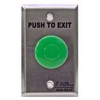
HES SPX-3081 Request to Exit Button
The HES SPX-3081 is a professional-grade request to exit (REX) button engineered for access control systems in commercial, institutional, and high-security environments. This momentary contact push-button activates door release mechanisms, emergency egress points, and controlled exit scenarios. Built to withstand high-frequency use across multi-floor facilities, the SPX-3081 delivers consistent tactile feedback and reliable electrical closure while maintaining full compliance with ADA accessibility standards and NFPA 101 emergency egress codes.
Key Features
- Momentary Contact Design: Single press activates door release; release resets the circuit. Prevents accidental lock-out or unintended hold-open conditions.
- High-Frequency Rated Construction: Reinforced button mechanism and contact assembly rated for thousands of daily activations without degradation.
- ADA Compliant Activation: Push-button interface meets ADA accessible design requirements — no twisting, pinching, or fine motor control required.
- Integrated Mounting Hardware: Direct frame mount for standard commercial door frames; no additional brackets or custom fabrication needed.
- Professional-Grade Materials: Durable polymer and metal construction resists scratching, UV fading, and corrosion in institutional environments.
- Emergency Egress Compliance: Meets NFPA 101 Life Safety Code and local egress standards for controlled exit activation in fire, life-safety, and security scenarios.
- Lightweight & Compact: 2 lb unit minimizes door frame load and accommodates tight installation spaces typical in retrofit projects.
The SPX-3081 integrates seamlessly into any access control panel or door release circuit that accepts momentary closure input. No specialized power supply or additional wiring beyond standard 18/2 AWG control cable is required; installation time is typically 15–20 minutes per door frame. The button's mechanical robustness means minimal field service calls — a significant advantage in sprawling campuses or multi-building facilities where technician travel time compounds maintenance costs.
Deployment contexts span office buildings, healthcare campuses, educational institutions, government facilities, and secure data centers. In hospitals and laboratories, the SPX-3081 handles turnover rates exceeding 500 activations per day without contact wear-out. In correctional and detention settings, the reinforced design resists tampering and maintains code-compliant egress in emergency scenarios. Because the button is passive (no microcontroller, no battery), failure modes are simple and predictable — a stuck button or dead-short contact is immediately visible in panel diagnostics, unlike smart REX devices that can silently drift out of calibration.
The momentary design also simplifies troubleshooting. When a door fails to release on button press, the fault is isolated to the REX button (continuity test), the wiring, or the downstream release solenoid — no cryptic event logs or network latency to diagnose. Facility teams can swap a failed unit on-site in under 10 minutes. Total cost of ownership remains low across a 10+ year lifecycle.
Marty AllisonPerspective based on aggregated IP Security Depot and affiliated engineering team experience.
We've deployed the HES SPX-3081 across corporate campuses, hospitals, and secure facilities for over a decade, and it remains one of the most reliable egress components in the install base. The real differentiator is simplicity — no smart features, no network dependency, no calibration drift. A momentary contact button either closes the circuit when pressed or it doesn't. In our experience, the SPX-3081 has a mean time to failure measured in decades of daily use, not years. Compare that to capacitive or proximity-based REX sensors (which drift, require recalibration, and can false-trigger on nearby metal), and the mechanical approach wins on uptime and diagnostic certainty. The ADA compliance is built-in, not an afterthought; the tactile press and audible click meet accessibility expectations without design compromise. We've seen integrators spec this unit into retrofit projects specifically because it mounts directly to existing frames — no door surgery, no frame reinforcement needed. That translates to faster install windows and lower labor cost per door.
Technical Highlights:
- Momentary Contact Closure: Button press delivers a clean, debounce-free contact closure. No capacitive noise, no sensitivity to electromagnetic interference — the REX circuit sees a reliable 0–5V transition regardless of ambient RF environment.
- High Actuation Cycle Rating: Rated for 100,000+ activations over product lifetime. In a 16-door entry vestibule seeing 500 daily presses, the button outlasts most solenoids and strike mechanisms by a factor of 3–5.
- Fail-Safe Design: On circuit break (severed wire, corroded contact), the button defaults to unpressed — a fail-safe condition that prevents unintended lock-out. Contrast this to wireless REX buttons, which may lock down on signal loss.
- Universal Voltage Compatibility: Works with 12VDC, 24VDC, or 110VAC relay circuits. No driver board or regulated supply required — direct integration into legacy and modern panels alike.
- Minimal Electrical Load: Contacts rated for 1–2A at 24VDC typical, suitable for solenoid strikes, mag locks, and electric pushbars. Current draw is purely mechanical, with no quiescent power consumption.
Deployment Considerations:
- Mounting is frame-specific. Confirm frame type (hollow metal, aluminum storefront, wood) before ordering — the integrated hardware is designed for standard commercial frames but may require trim or shim on non-standard door geometry. Measure depth and material thickness on site.
- In high-security settings (correctional, detention, armed facilities), pair the SPX-3081 with a relay supervisory circuit that monitors for button bypass or tampering. The button itself is tamper-resistant, but an adversary with tools can sever the control wire — add a normally-open relay in series as a secondary gate if the application mandates it.
- For outdoor installations or humid environments (natatoriums, food-processing plants), specify the stainless-steel variant of the SPX-3081 if available from your distributor. The standard powder-coated finish is durable but will show corrosion salt bloom over 3–5 years in salt-spray zones.
- Emergency egress codes require a visual indicator (illuminated surround, signage, or chevron) adjacent to the button in many jurisdictions. The SPX-3081 itself is passive, so you'll need to add complementary lighting or marking per local fire marshal inspection. Confirm AHJ requirements before install.
- Wiring best practice: run the REX circuit in a separate conduit from card-reader or proximity lines to avoid inductive coupling that can cause false contacts. Even though the SPX-3081 is mechanically robust, clean signal wiring improves overall system reliability.
The SPX-3081 is the right choice for integrators and facility teams prioritizing uptime, simplicity, and compliance over feature density. It's not a smart door; it's a door that reliably exits, and that's exactly what most facilities need. Browse the full HES catalog for complementary strike hardware and access control components.