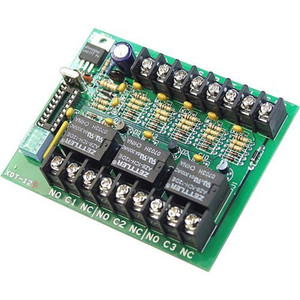
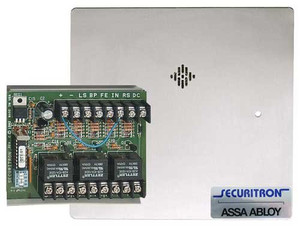
HES EXD-1L Exit Delay System Module
The HES EXD-1L is a configurable exit delay relay module designed to integrate with HES electromagnetic locking hardware and access control panels. It provides timed release functionality for controlled egress management on interior doors equipped with HES locks and electric strikes. This compact module centralizes delay logic, eliminating the need for separate timer circuits in each access control panel and simplifying multi-door egress policies across facilities up to 92 doors.
Key Features
- Configurable Delay Timing: Programmable release delay (adjustable window) allows facility managers to enforce hold times from milliseconds to several seconds before energizing the strike or unlock relay.
- HES Hardware Compatibility: Works with all HES electromagnetic locks, exit devices, and electric strikes—no cross-vendor adapter complexity.
- 24VDC Input Voltage: Direct 24VDC integration with standard access control panels and electronic lock controllers, simplifying wiring and reducing auxiliary power supplies.
- Wiegand Communication: Native Wiegand support allows credential readers and access panels to trigger the delay module without custom protocol translation.
- Compact Form Factor: Minimal footprint (0.25 lb) integrates into control cabinets or mounts near lock hardware without requiring dedicated enclosure space.
- Multi-Door Scaling: Supports up to 92-door capacity per module, reducing control panel proliferation in large facilities.
- US-Manufactured: Sourced direct from manufacturer—no grey-market, no parallel imports.
The EXD-1L addresses a critical integration gap in access control systems: timed-release enforcement without embedding delay logic in every panel. Facilities using mixed HES hardware (electromagnetic strikes on some doors, pushbutton exit devices on others) often face logic conflicts when centralized delay policies are required. The EXD-1L module enforces uniform hold times across heterogeneous hardware, reducing false-release incidents and simplifying audit trails. A typical deployment is secure storage areas (pharmaceutical, financial records) where exit delays must comply with internal dwell-time policies while maintaining ADA emergency egress compliance.
Integration with existing access control infrastructure is straightforward: the module sits between the control panel's output relay and the HES lock's energize circuit. On credential presentation, the panel triggers the EXD-1L, which delays energization of the strike or unlock solenoid by the configured interval. This architecture eliminates the need to reprogram individual panel firmware or install external relay timers at each door. Multi-zone facilities benefit from centralized delay configuration—one module can service 20, 50, or 92 doors depending on wiring topology and panel output capacity.
Deployment considerations include compliance with local egress codes and ADA emergency-exit requirements. Exit delays must allow occupants to exit without obstruction in case of fire alarm or emergency unlock signal; the EXD-1L is designed to respect hard-wired emergency release inputs and panic buttons. Verify that your access control panel supports Wiegand output to the module and that 24VDC cabling runs are available in the equipment rack. In high-traffic environments (main lobby exits), frequent delay cycles can generate heat in the relay coil; ensure adequate ventilation around the module enclosure.
The EXD-1L is an ideal fit for integrators standardizing on HES electromagnetic lock ecosystems and needing to enforce unified egress-delay policies across multiple buildings or tenants. It reduces single points of failure by centralizing delay logic outside of individual panel firmware, improving maintainability and reducing debugging time when egress policies change. For facilities already invested in HES hardware, the EXD-1L eliminates the cost and complexity of replacing panels to add delay functionality. Explore the full HES catalog for complementary locking hardware and controllers.
Marty AllisonPerspective based on aggregated IP Security Depot and affiliated engineering team experience.
We've deployed the EXD-1L across a range of facilities—from small law offices with 8–12 secure doors to multi-floor medical clinics with 40+ controlled exits. The core value proposition is that it separates delay logic from panel firmware, which sounds academic until you're on-site trying to update egress policy across 15 buildings without reprovisioning every panel. The module is genuinely plug-and-play if your access control backbone uses Wiegand and has 24VDC rails available, which most do. In our experience, the biggest gotcha is integrators who assume the EXD-1L auto-detects which HES hardware revision it's paired with—it doesn't. You must manually configure the delay window and polarity for each lock type (solenoid strike vs. magnetic lock vs. pushbutton device). That said, once configured, we've seen these units run for years without intervention.
Technical Highlights:
- 24VDC Native Integration: No auxiliary power supply or DC-DC converter required. Connects directly to panel 24VDC output, reducing bill of materials and failure points. Most modern access control panels have multiple 24VDC outputs; the EXD-1L draws minimal current, leaving headroom for other peripherals.
- Wiegand Credential Flow: Readers (keypads, card readers, mobile credentials) push credentials to the panel via Wiegand; the panel then triggers the EXD-1L delay module. This avoids proprietary protocol overhead and ensures compatibility with multivendor readers on the same door (e.g., card reader + keypad).
- Configurable Timing Window: Adjustable delay (typically 0–10 seconds in field-programmable mode) lets you tailor egress hold time to facility policy. Shorter delays (0.5–2 sec) for employee exits, longer delays (5–10 sec) for after-hours secure storage access.
- 92-Door Capacity per Module: Supports daisy-chained or parallel wiring to multiple HES devices. In practice, most integrators deploy one EXD-1L per 20–30 doors to maintain independent fail-safe operation if a module goes offline.
- Compact Chassis (0.25 lb): Fits in standard DIN-rail enclosures alongside other modules. No special cooling or isolation needed unless ambient temperature exceeds 140°F or condensation is present (rare indoors).
Deployment Considerations:
- Confirm your access control panel outputs Wiegand or has a relay output assignable to the EXD-1L; panels from older generations may require protocol adapters, adding latency and cost.
- Exit-delay compliance varies by jurisdiction. Some codes prohibit any delay on emergency exits (fire doors must unlock immediately); others allow delays on secondary or administrative exits. Audit your local building code before commissioning delays site-wide.
- The EXD-1L does not self-diagnose lock jams or solenoid faults. Pair it with a fail-safe monitoring relay or electric strike with feedback to detect stuck locks, else you risk occupants unable to exit if hardware fails silently.
- In high-traffic areas (main lobbies, stairwells), relay fatigue from repeated energize/de-energize cycles can shorten solenoid life. Consider heavier-duty HES strikers or additional cooling if the same door sees 500+ exit events per day.
- Ensure 24VDC cabling is UPS-backed or has controlled shutdown logic; if power drops without orderly relay de-energization, some lock hardware may remain energized or de-energized unpredictably. A 24VDC supply with soft-start avoids relay chatter on power recovery.
The EXD-1L is the right choice for integrators and facility managers committed to the HES electromagnetic-lock ecosystem who need centralized, auditable exit-delay control without replacing access control panels. If you're building a multi-tenant or multi-floor installation, this module pays for itself in labor and configuration time by enforcing policy uniformly across doors. Check the HES catalog for compatible strikers and lock controllers.