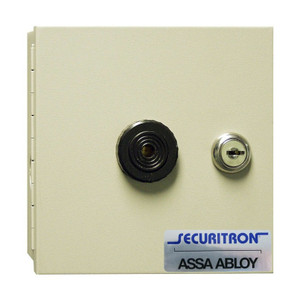
HES KS-DPS Surface Mount Delayed Egress System
The HES KS-DPS is a surface-mounted delayed egress accessory engineered to retrofit onto HES KS series cabinet locks without requiring internal modifications to existing installations. This accessory provides controlled door release timing, enabling security professionals to implement access delay protocols on server racks and secure equipment cabinets in data centers, server rooms, and controlled-access facilities.
Key Features
- Surface mount form factor: Mounts externally on HES KS series cabinet lock hardware, eliminating the need to disassemble or modify the lock mechanism itself — reduces installation time and avoids downtime on production equipment.
- Retrofit compatibility: Works with existing HES KS series locks, meaning you can add delayed egress capability to deployed cabinets without replacement or internal restructuring.
- Controlled egress delay timing: Implements facility security policies that mandate access delay — critical in data centers where compliance requires a timed window between access request and door release, allowing alert systems to trigger and security personnel to respond.
- External deployment architecture: The mounting design sits outside the cabinet assembly, preserving the original lock's internal function and allowing straightforward installation on new or existing cabinet setups.
- Server room and equipment cabinet focus: Purpose-built for secure storage environments where controlled access and delay protocols are mandated by regulatory or organizational policy — not a general-purpose lock enhancement.
Integration and Compatibility
The KS-DPS is purpose-designed for the HES KS series cabinet lock family. Verify your cabinet lock model before ordering to confirm compatibility. If you are deploying multiple lock types or mixed cabinet hardware, confirm all locks are HES KS variants; mixing lock families may require separate accessory solutions. Installation requires no specialized tools beyond standard mounting hardware — typical retrofit takes 15–30 minutes per cabinet depending on access and cable routing.
When evaluating delayed egress solutions across your facility, consider whether all target cabinets use the same lock model. If your data center or server room contains a mix of HES locks and third-party hardware, a phased rollout may be necessary, or you may need to evaluate the KS-DPS alongside alternative egress control systems from other manufacturers.
Deployment Considerations
The delayed egress feature is most effective when integrated into a broader physical security and alarm strategy. Confirm that your facility's security monitoring system (alarm panel, access control gateway, or security operations center) can receive and act on the timed release signals from the KS-DPS. If your facility does not have a coordinated access and alarm infrastructure, the delayed egress timing may not deliver full value — the lock will release after the programmed delay, but no escalation or alerting occurs unless manually configured.
For facilities that retrofit the KS-DPS onto existing cabinets, label the cabinet exterior to indicate delayed egress is active — end-users unfamiliar with the delay protocol may attempt to force the door or trigger alarms unnecessarily. Brief your IT and physical security teams on the timing sequence and how to coordinate with facility monitoring during the rollout.
Frequently Asked Questions
Q: Is the KS-DPS compatible with all HES cabinet locks?
A: The KS-DPS is designed for HES KS series locks. Verify your cabinet lock model number is in the KS family before purchasing — it will not work with other HES product lines or non-HES hardware.
Q: Can I install the KS-DPS myself, or does it require a locksmith?
A: The surface-mount design is intended for field installation by facility or IT personnel. No specialized locksmith training is required, though familiarity with cabinet hardware and basic mounting is assumed.
Q: What happens if the power or signal to the KS-DPS is lost?
A: Consult the HES documentation for the specific failure mode of your KS-DPS revision. Most delayed egress systems default to a known-safe state (either lock or release) in the event of power loss — confirm this with HES or your reseller before deployment.
Q: Can the delayed egress timing be adjusted after installation?
A: Timing configuration depends on the specific KS-DPS revision and control interface. Check the product documentation or contact HES technical support for configuration options.
Q: Does the KS-DPS log access attempts or provide audit trails?
A: That capability depends on the broader access control system (panel, gateway, or VMS) that receives signals from the lock. The KS-DPS itself is a passive hardware accessory; logging and reporting must be managed by your facility's security management infrastructure.
Q: What is the warranty on the KS-DPS?
A: Warranty terms are set by HES. Confirm the warranty period with your reseller or check the HES product documentation.
Ted PerryPerspective based on aggregated IP Security Depot and affiliated engineering team experience.
The KS-DPS (often searched as KS DPS) is a straightforward retrofit accessory — no firmware, no sensors, just controlled relay logic on top of your existing cabinet lock hardware. That simplicity is both its strength and its limitation. Because it mounts externally on HES KS series locks, you avoid the cost and complexity of replacing hardware or hiring a locksmith for internal modifications. But that also means the KS-DPS is only as intelligent as the lock beneath it and the control signal it receives from your facility's access management system.
Technical Highlights:
- Surface-mount retrofit design: No internal lock disassembly required, reducing installation labor and cabinet downtime. A single cabinet retrofit typically takes 15–30 minutes, versus several hours if internal modifications were needed.
- HES KS series lock dependency: The accessory is purpose-built for HES KS hardware only. If your facility is a mixed environment (HES plus third-party or older locks), you'll need to segment your rollout or source separate solutions for non-KS cabinets.
- Controlled delay timing: The delayed egress window is the core feature — allows your alarm or access control system time to detect the access request and alert security personnel before the door physically releases. Without proper integration to your monitoring infrastructure, the timing alone delivers limited security value.
Deployment Considerations:
- Integration requirement: The KS-DPS must connect to your facility's access control panel or gateway. If that infrastructure is absent or outdated, you'll need to upgrade the control side before the accessory becomes functional. Don't retrofit the hardware first and assume control will follow — plan the full system integration before rollout.
- Failure-mode verification: Confirm with HES what the KS-DPS does if power or signal is lost. Most delayed egress locks default to a safe state, but some may default to release on power loss (which defeats the purpose of controlled access). Verify the failure behavior matches your facility's security policy.
- User training: If your IT or facility team is unfamiliar with delayed egress protocols, brief them before going live. End-users who encounter the delay and don't understand it may trigger false alarms or attempt to force the door.
Deploy the KS-DPS in data centers, server rooms, or secure equipment cabinets where access delay is mandated by compliance policy (e.g., PCI DSS, SOC 2, or internal security standards) and where you have a functioning access control infrastructure in place. If you're retrofitting a single cabinet or a handful of cabinets in an unmonitored closet, the value drops — the delay becomes a minor inconvenience without backing security measures.