Quick Answer
A 16-channel video encoder turns a coax-fed analog camera plant into sixteen IP streams your VMS or NVR records like any other network camera. The right one depends on what your coax is actually carrying.
- Best 16-channel for HD analog (TVI/CVI/AHD): Axis P7316 — 1080p at 30 fps on all sixteen inputs, H.265 with Zipstream, two-way audio, SFP fiber slot.
- Best 16-channel for standard-definition cameras: Axis M7116 — same 1U chassis and Zipstream at a lower cost when every camera is plain composite.
- Best 16-channel with a local HDMI monitor and 5MP analog support: Hanwha SPE-1630 — auto-detects CVBS/AHD/CVI/TVI up to 5MP, sixteen alarm inputs, 16-way HDMI output.
- Best 4-channel for small sites: Axis P7304 (PoE, HD analog, audio) or the Hanwha SPE-420 when 5MP analog cameras or a local HDMI view matter more.
This guide is for integrators and facility teams sitting on a working coax camera plant who need those cameras inside a modern VMS without re-pulling every run. It covers the 16-channel and 4-channel encoders we stock and ship today, what separates them, and the channel, power and storage math that decides which one belongs in your rack. If you are still deciding whether to encode or replace, start with why encoder retrofits beat rip-and-replace on coax-heavy sites, then come back here to pick the hardware.
First, Find Out What Your Coax Is Carrying
Every encoder decision starts at the camera end, not the rack. Analog surveillance shipped in two very different generations over the same 75-ohm coax, and encoders are built for one or both.
Composite (CVBS, NTSC/PAL). The original standard-definition signal. Maximum useful resolution is 720×480 in NTSC territory, which is roughly a third of a megapixel. Cameras installed before about 2013 are almost always composite.
HD analog (TVI, CVI, AHD). Three competing formats that push 720p, 1080p and in newer cameras 4MP or 5MP down the same coax. They are not interchangeable at the signal level, so an encoder has to explicitly support each one. Cameras from roughly 2014 onward are usually one of these, and a mixed site is common.
Why it matters. A standard-definition encoder connected to a 1080p TVI camera will show nothing, or a rolling, unusable image. An HD-capable encoder handles both generations, which is why the HD units cost more. Before buying anything, pull the model number off a sample of cameras on each floor or building and confirm the format. If the cameras are unlabeled, a handheld test monitor that auto-detects TVI/CVI/AHD settles it in a minute per drop.
How We Picked
We limited the field to encoders that are in our warehouse today and shortlisted on the criteria that actually change an install outcome:
Full frame rate on every channel at the same time. Some encoders quote 30 fps but only deliver it on a few inputs at once. Every pick here holds full rate on all channels at 1080p (HD units) or full standard-definition resolution (SD units).
H.265 with a bitrate-reduction engine. Sixteen streams of analog video add up fast. H.265 alone roughly halves the bitrate of H.264, and Axis Zipstream cuts further by spending bits only on the parts of the scene that change. The bandwidth and disk this saves is real money over a five-year retention plan.
A PTZ control path. Legacy analog PTZ cameras take commands over RS-485 or, on some HD analog units, up the coax itself. If the site has PTZs, the encoder needs the matching serial port and protocol, or those cameras become fixed.
Power, storage and outputs that fit the room. Whether the unit is PoE-powered or needs a mains supply, whether it can record to an SD card when the network drops, and whether it drives a local monitor all decide where it can live.
Axis P7316 — Best 16-Channel Encoder for HD Analog Cameras
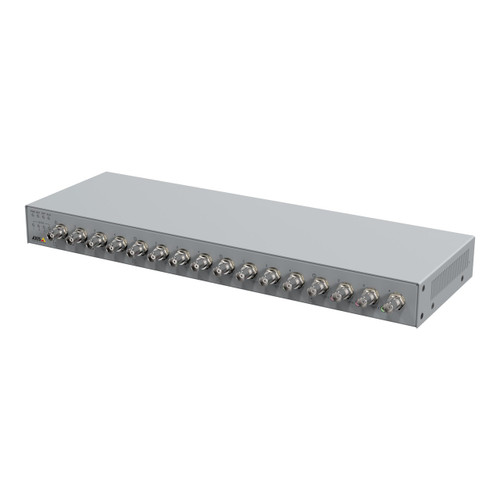
Inputs: 16 BNC, composite plus HD TVI/CVI/AHD at 720p and 1080p · Frame rate: 25/30 fps on all channels up to 1080p · Compression: H.264, H.265, Motion JPEG with Zipstream · Audio: two-way, four 3.5 mm line outputs · Serial: four RS-485/RS-422 terminal blocks · Network: RJ45 plus a 1 Gbps SFP slot · Power: mains supply included, max 32 W · Storage: microSD and NAS recording · Form: 1U metal chassis, rack, wall or standalone
The P7316 is the encoder to specify when the coax plant is HD analog or a mix of HD and composite. It is organized as four independent four-channel blocks, each with its own IP address, which is how it manages sixteen full-rate 1080p streams. The trade-off worth knowing before you count channels: any one block can run a single input above 1080p, at Quad HD up to 30 fps or 4K at 15 fps, but doing so disables the third input of that block. In practice that means a maximum of four 4K or QHD cameras alongside eight 1080p cameras, not sixteen of everything. The SFP slot is a quiet advantage on campus sites where the head end is a fiber run away from the switch, and the four serial ports plus configurable I/O mean legacy PTZs, door contacts and relays come across in the same box. Zipstream and H.265 keep the sixteen-stream aggregate manageable on a single gigabit uplink.
Axis M7116 — Best 16-Channel Encoder for Standard-Definition Cameras
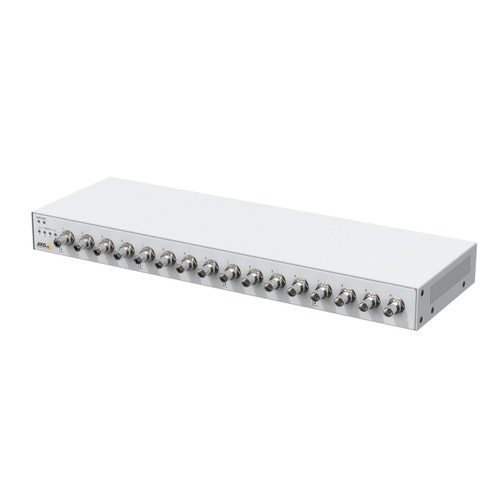
Inputs: 16 BNC composite (NTSC/PAL), 176×120 up to 720×480 NTSC / 720×576 PAL · Frame rate: 25/30 fps on all channels · Compression: H.264, H.265, Motion JPEG with Zipstream · Serial: four RS-485/RS-422 terminal blocks for analog PTZ · Power: mains supply included, max 26 W · Storage: microSD and NAS recording · Form: 1U metal chassis, rack, wall or standalone · Integration: ONVIF Profiles G, M, S and T
When every camera on the coax is plain composite, the M7116 delivers the same chassis, Zipstream engine, edge storage and PTZ control as the P7316 without paying for HD analog decoding you will never use. It does not accept TVI, CVI or AHD, so it is only the right answer when you have confirmed the plant is standard definition end to end, or when the HD cameras are on a separate encoder. Motion detection and active tampering alarm run on the encoder itself, so old cameras with no intelligence of their own still generate useful events in the VMS. If a future phase will swap composite cameras for HD analog on the same coax, buy the P7316 now instead and avoid a second head-end change.
Hanwha SPE-1630 — Best 16-Channel Encoder With a Local Monitor and 5MP Analog Support
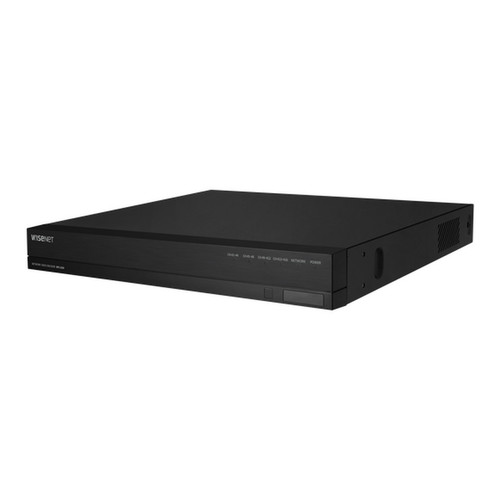
Inputs: 16 BNC, CVBS/AHD/CVI/TVI auto-detect at 1, 2, 4 and 5MP · Frame rate: 1080p/720p 30 fps, 4MP 15 fps, 5MP 12 fps per channel · Compression: H.265, H.264, MJPEG · Audio: four line in, one line out · Alarm I/O: 16 in, 4 out · Serial: RS-485 (Samsung-T, Pelco) plus coaxial PTZ control · Output: HDMI, 16-way split at 1080p · Power: 12 V DC, max 20 W · Form: 44 mm tall chassis, 370 × 320 mm
The SPE-1630 wins two specific cases. The first is a plant that has already been upgraded to 4MP or 5MP HD analog cameras: it decodes those natively, at 15 and 12 fps respectively, where the Axis units top out at 1080p per channel except for the limited above-1080p mode on the P7316. The second is a site that wants a guard-desk monitor straight off the encoder. The HDMI output shows all sixteen cameras in a split view without a workstation or a VMS client, which suits a small lobby, loading dock or plant floor. Sixteen alarm inputs and coax-based PTZ control also make it the more natural fit for legacy Samsung and Pelco PTZ domes. It pairs most cleanly with Hanwha's own NVRs and Wisenet software, though it streams standard H.265 and H.264 that any current VMS will ingest.
Axis P7304 — Best 4-Channel Encoder for Small Sites
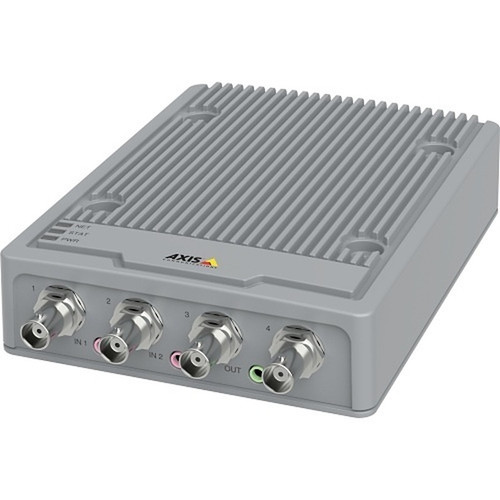
Inputs: 4 BNC, composite plus HD TVI/CVI/AHD at 720p and 1080p · Frame rate: 25/30 fps on all channels up to 1080p · Compression: H.264, H.265, Motion JPEG with Zipstream · Audio: two mic/line in, one line out · I/O: four configurable ports, two RS-485/RS-422 · Power: PoE (802.3af/at Class 3) or 8–28 V DC, max 8.2 W · Storage: microSD and NAS · Form: 187 × 37 mm, 650 g, wall mount, IP30
Not every retrofit is a rack job. A retail branch, a clinic or a single warehouse door with four coax cameras is better served by a PoE-powered encoder mounted in the ceiling or the telecom closet next to the coax terminations. The P7304 draws under 9 W on standard PoE, so it hangs off the same switch that feeds your IP cameras with no wall adapter to fail or unplug. It takes both composite and HD analog inputs, shares one IP address across the four channels, and includes the audio, I/O and serial ports the 16-channel units offer, scaled to a small site. Four of them distributed around a building often beat one 16-channel unit when the coax home-runs never converged in one place. If the four cameras are composite only, the smaller Axis M7104 does the same job at standard definition.
Hanwha SPE-420 — Best 4-Channel Encoder for 5MP Analog and a Local View
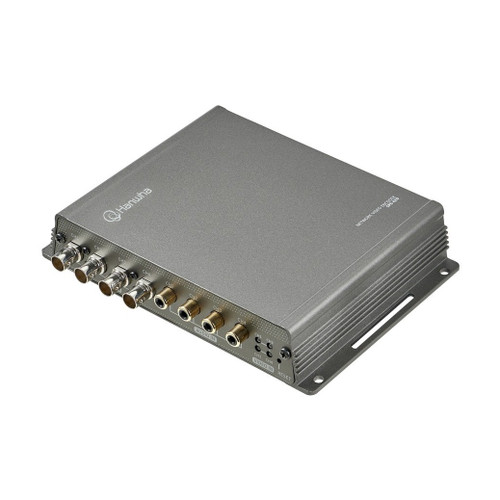
Inputs: 4 BNC, CVBS/AHD/CVI/TVI auto-detect at 1, 2, 4 and 5MP · Frame rate: 1080p 30 fps, 4MP 15 fps, 5MP 12 fps per channel · Compression: H.265, H.264, MJPEG dual stream · Audio: four line in, one line out · Serial: RS-485 (Samsung-T, Pelco-P/D) plus coaxial Pelco-C control · Output: HDMI, 4-way split at 1080p · Power: 12 V DC or PoE (802.3af), max 5 W · Weight: 520 g
The SPE-420 is the four-channel version of the SPE-1630 argument. It decodes 4MP and 5MP HD analog cameras that the Axis P7304 cannot, it drives a small local monitor over HDMI, and it will still run on standard PoE at only 5 W. It is the encoder for a small site that already spent money on 5MP HD-over-coax cameras and does not want to throw that resolution away at the head end. Per-channel frame rate does drop at 4MP and 5MP, so if you need full 30 fps at the highest resolution, plan on running those cameras at 1080p or choose the camera resolution to match.
Every Pick, Side by Side
| Encoder | Channels | Analog inputs | Max per channel | PTZ control | Power | Local output / storage | Best for |
|---|---|---|---|---|---|---|---|
| Axis P7316 | 16 | CVBS, TVI, CVI, AHD | 1080p @ 30 fps (one input per block up to QHD 30 / 4K 15) | 4× RS-485/422 | Mains, 32 W max | microSD, NAS, SFP fiber | Mixed or HD analog plants at the head end |
| Axis M7116 | 16 | CVBS only | 720×480 @ 30 fps | 4× RS-485/422 | Mains, 26 W max | microSD, NAS | All-composite plants, lowest cost per channel |
| Hanwha SPE-1630 | 16 | CVBS, AHD, CVI, TVI to 5MP | 1080p @ 30 fps, 4MP @ 15, 5MP @ 12 | RS-485 + coax | 12 V DC, 20 W max | HDMI 16-split, 16 alarm in | 5MP analog cameras, guard-desk monitor, Samsung/Pelco PTZs |
| Axis P7304 | 4 | CVBS, TVI, CVI, AHD | 1080p @ 30 fps | 2× RS-485/422 | PoE Class 3 or DC, 8.2 W | microSD, NAS | Small sites, ceiling or closet mount, PoE-only power |
| Hanwha SPE-420 | 4 | CVBS, AHD, CVI, TVI to 5MP | 1080p @ 30 fps, 4MP @ 15, 5MP @ 12 | RS-485 + coax | PoE 802.3af or 12 V DC, 5 W | HDMI 4-split | Small sites with 5MP analog cameras |
The Channel, Bandwidth and Storage Math
Count channels by block on the P7316. Its sixteen inputs are four blocks of four, each a separate device on the network with its own IP address. That is convenient for VLAN and multicast planning, and it is the reason a 4K camera on one input costs you a second input in the same block. Map which cameras land on which block before the coax gets terminated, and keep any above-1080p cameras to one per block.
Budget bandwidth per stream, then add them up. A 1080p H.265 stream of a typical indoor scene runs on the order of 1 to 2 Mbps with Zipstream or an equivalent bitrate control active; busy outdoor scenes run higher. Sixteen of those on one gigabit uplink is comfortable. Sixteen H.264 streams at the same quality roughly double that figure, which is the practical case for choosing H.265 on day one even if the VMS can decode both.
Storage follows the same arithmetic. Sixteen 1080p streams at 1.5 Mbps average, recording continuously, write about 260 GB per day and roughly 7.8 TB for 30 days. Motion-based recording and Zipstream's dynamic frame rate cut that substantially on quiet channels. Run the full retention calculation in how to size NVR hard drives with retention math before you order disks, because standard-definition streams from an M7116 need a fraction of that while 5MP streams from an SPE-1630 need more.
Licensing counts channels, not boxes. Most VMS platforms license each encoder input as one camera channel. A 16-channel encoder is sixteen licenses, and on the P7316 it also appears as four devices. Confirm your VMS treats encoder channels the way you expect before finalizing the license count.
Power, Placement and Coax Reach
The 16-channel units are mains powered. The P7316 (max 32 W), M7116 (max 26 W) and SPE-1630 (12 V DC, max 20 W) all ship with or require a power supply and belong in the rack or head end, ideally on the same UPS as the switch and recorder. The 4-channel P7304 and SPE-420 run on standard 802.3af PoE, which is what makes them practical to distribute around a building. If you go that route, add their draw to the switch budget the same way you would a camera, per PoE power budget planning for IP camera deployments.
Coax length still applies. Encoding does not extend the analog run. For composite over RG59, Axis recommends a maximum of about 250 m to the encoder input. HD analog formats lose resolution with distance faster than composite does, so a 1080p TVI camera at the far end of a long run may only deliver a clean image at 720p. Test the longest runs before the encoder is racked so the frame-rate and resolution settings match what the coax can carry.
Termination matters. The Axis units let you enable or disable 75-ohm termination per input from the web interface. Leave it on unless the signal is looped through to another device, such as the loop-out on a legacy DVR, in which case only the last device in the chain terminates.
Deployment takeaway: If the coax plant is HD analog or mixed and the home-runs land in one head end, put an Axis P7316 in the rack. If every camera is composite, the Axis M7116 does the same job for less. If the cameras are 4MP or 5MP analog or the site wants a monitor straight off the encoder, choose the Hanwha SPE-1630. If the coax never converged, distribute PoE-powered Axis P7304 or Hanwha SPE-420 units where the runs actually end.
FAQ
Does an encoder make my analog cameras look like IP cameras?
No. An encoder digitizes and compresses whatever the camera sends. A composite camera stays standard definition; a 1080p TVI camera stays 1080p. What changes is that the stream now travels over the network, records on your VMS or NVR, supports motion events and analytics at the encoder, and can be viewed anywhere an IP camera can. Image quality is set by the camera and the coax, not the encoder.
Can I mix composite and HD analog cameras on one encoder?
On the Axis P7316, P7304 and both Hanwha units, yes: each input detects its own signal type. On the Axis M7116 and M7104, no, they are composite only. On a mixed site with mostly composite cameras and a few HD ones, it is often cheaper to put the HD cameras on a 4-channel HD encoder and the rest on an M7116.
What about the Hikvision DS-6916UDI?
It is a common search result for 16-channel encoders, but Hikvision equipment is covered under Section 889 of the NDAA, which bars federal agencies and federally funded projects from purchasing it, and many state, education and healthcare buyers have adopted the same restriction. We do not feature it in this guide for that reason. The Axis and Hanwha encoders above are the compliant choices for those projects.
Do I still need an NVR or VMS?
Yes. An encoder produces streams; it is not a recorder. Every unit here can also write to a microSD card or, on the Axis units, a NAS share as a fallback when the network or recorder is down, but that is edge redundancy rather than a replacement for central recording. See how to decide between edge storage and centralized recording for where each belongs.
Will my old analog PTZ cameras still pan and tilt?
If the encoder has the right control path, yes. Analog PTZs take commands over RS-485 (Pelco-D and Pelco-P are the most common protocols) or over the coax on newer HD analog domes. The Axis units expose RS-485/RS-422 terminal blocks and load PTZ drivers from a library; the Hanwha units support Samsung-T and Pelco over RS-485 plus coaxial control. Check the protocol on the dome before assuming it will work.
How many encoders can one gigabit uplink carry?
At 1080p H.265 with bitrate control, a 16-channel encoder produces roughly 20 to 35 Mbps in aggregate, so a single gigabit link can comfortably carry several. The limit is usually the recorder's write throughput and your retention target, not the switch. If the head end is a long way from the recorder, the SFP slot on the P7316 lets you run fiber directly rather than adding a media converter.
Updated September 2026