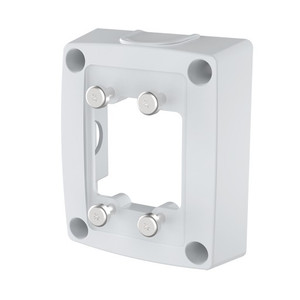
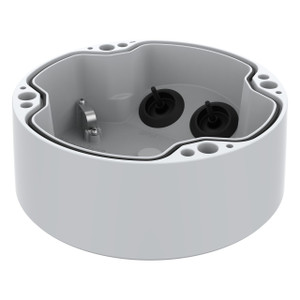
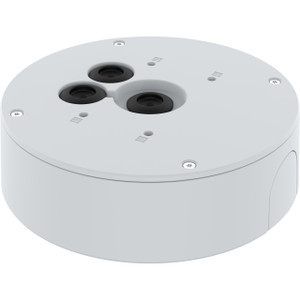
Axis 02750-001 TP4601-E Conduit Back Box
The Axis 02750-001 is a weatherproof conduit back box engineered to centralize and protect cable connections at outdoor and semi-outdoor camera mounting points. It addresses a specific installation pain point: exposed conduit entries, cable bundles, and splice points are vulnerable to moisture ingress, dust, and physical damage — especially in industrial, warehouse, and coastal environments. This accessory seals those weak spots without requiring custom fabrication or elaborate conduit rework.
Key Features
- IP66/67 Environmental Sealing: Direct rain, dust, and moisture won't penetrate the box interior. This matters most in exposed roof or fascia mounts where cable entry points would otherwise be the leak vector. IP66 handles sustained spray and jet wash; IP67 adds brief submersion tolerance — adequate for most outdoor surveillance work, but inadequate if the box itself will be underwater.
- Dual 3/4" / M25 Conduit Interfaces (Side and Back): Eliminates the need for bulky right-angle adapters or custom elbows. Route conduit from the wall side and exit toward the camera, or vice versa, depending on your mounting geometry. Reduces parts count and potential leak points at each connector.
- Multiple Cable Entry Points: Supports organized internal routing for mixed cable runs — power, PoE, coax, fiber drop loops — without forcing everything through a single grommet. Cleaner internal geometry also eases future maintenance and swaps.
- Robust Engineered Material Construction: Weather-resistant housing with sealed compartment design. Resists UV degradation and thermal cycling better than consumer-grade plastic. Suitable for long-term exposure on rooftops, warehouse perimeters, and parking structures.
- Compact Form Factor: Low profile maintains the clean sightlines of recessed or semi-flush camera installations. Doesn't add bulk that would invite wind loading or require secondary structural support.
- Compatible with Axis IP Cameras: Designed as part of the Axis surveillance ecosystem, reducing design friction during system layout. Works alongside Axis mount brackets, weatherproof connectors, and conduit strain-relief fittings.
Typical Deployment Contexts
Mount this conduit back box at the point where field conduit terminates at a camera head or NVR input enclosure. Common scenarios include rooftop installations (where cable entry is exposed to rain and UV), industrial facilities (where dust and vibration are factors), and high-moisture environments (loading docks, cold storage, spray wash bays). The dual entry ports let you configure conduit approach from either side — useful when building layouts that must route around obstacles or follow existing cable trays without sharp bends.
Integration with broader camera installation plans is straightforward: use the 02750-001 as a pressure-equalization and moisture-barrier point in your conduit runs, particularly where the run transitions from outdoor to indoor or terminates at a wall-mounted enclosure. Pair it with appropriate conduit nipples, locknuts, and sealant (per your local electrical code) to ensure water won't wick along the conduit interior or accumulate inside the box.
Integration & Compatibility
The TP4601-E back box integrates with standard electrical conduit (3/4" NPT or M25 metric threads) and works alongside any Axis IP cameras that mount to standard CCTV brackets. It does not contain active electronics and requires no power, configuration, or network integration. Consult your local electrical code for conduit sizing, grounding, and sealant requirements — those rules vary by jurisdiction and may supersede manufacturer recommendations.
Frequently Asked Questions
Q: Can I use the 02750-001 with non-Axis cameras?
A: Yes. The TP4601-E is a passive conduit termination box with standard 3/4" NPT and M25 threads. It works with any camera brand, as long as your mounting geometry and conduit routing fit the box dimensions and entry ports.
Q: Is the 02750-001 rated for underground or submersed installations?
A: No. IP66/67 rating means protection against sustained spray and temporary immersion in shallow water, but not continuous submersion. For buried or fully submerged conduit runs, consult a conduit-rated junction box designed for that purpose.
Q: What do I need to seal the conduit threads on the 02750-001?
A: Use PTFE thread-seal tape (plumber's tape) or marine-grade silicone sealant on all male NPT connections before threading them into the box. Follow your local electrical code and the camera/conduit manufacturer's installation guide for sealant specifications.
Q: Does the back box reduce cable strain relief at the entry points?
A: The box itself is passive and does not clamp cables. Install the conduit with a proper strain-relief fitting inside or just before the box to prevent cable flexing at the entry. Axis offers dedicated strain-relief adapters compatible with this form factor.
Q: Can I install the 02750-001 on a vertical wall or only on roofs?
A: Either. The box has no orientation requirement. Mount it at any angle — vertical, horizontal, inverted — as long as condensation can drain from the lowest point and the conduit entries don't form U-traps that trap standing water.
Q: What's the maximum temperature range for the 02750-001?
A: Consult the product datasheet for operating and storage temperature ranges. Typical engineered plastic junction boxes operate from -40°C to +60°C (-40°F to +140°F), but confirm with the manufacturer documentation for this specific model.
Ted PerryPerspective based on aggregated IP Security Depot and affiliated engineering team experience.
The Axis 02750-001 solves a real field problem: standard electrical conduit terminates at a camera head or wall enclosure with an open thread and a gap. Water wicks in along the conduit interior, pools at the transition, corrodes connectors, and eventually shorts power or PoE circuits. I've seen that failure mode more often than I'd like in outdoor installs. The 02750-001 adds a sealed compartment right at that transition point, with dual entry ports so you're not forced into awkward conduit geometry to make everything fit.
Technical Highlights:
- IP66/67 Sealed Compartment: Direct spray and dust don't penetrate. For roof-mounted cameras or perimeter wire, this is the difference between a camera that fails after two seasons and one that lasts five years. The trade-off is cost — you're adding a dedicated enclosure to every terminus, which adds labor and materials. Worth it in corrosive or high-moisture zones; less critical in dry climates.
- Dual 3/4" / M25 Conduit Ports (Side and Back): Flexibility to route from either direction. Saves you from buying right-angle adapters or cutting custom conduit runs to force a straight approach. Each extra fitting or bend is a potential leak point, so fewer adapters means fewer risks.
- Multiple Internal Cable Entry Points: Supports mixed cable runs (power, PoE, signal, fiber drop loops) without forcing everything through a single grommet. Cleaner internal organization also reduces pressure on individual cables and makes future maintenance less disruptive.
Deployment Considerations:
- The 02750-001 is passive — it's not a junction box that splices or terminates circuits. All actual connections (terminal blocks, PoE injectors, splitters) must be mounted inside or fed through pre-drilled ports. Plan your internal layout before assembly.
- Thread sealing is your responsibility. PTFE tape or marine silicone on every male NPT entry is non-negotiable. Oversights here will undermine the IP66/67 rating. Electrical code in your jurisdiction may mandate specific sealant types or bonding requirements.
- The box does not include strain relief. If cables flex at the entry point, you'll see eventual wire fracture. Install proper conduit strain-relief fittings inside the box to prevent that.
Use the 02750-001 at every outdoor or semi-outdoor camera mount where conduit runs expose themselves to rain, dust, or thermal cycling. Rooftop camera arrays, perimeter fence lines, industrial facility exteriors, and parking structure mounts are the sweet spots. Skip it only if your conduit is fully buried or your mounting enclosure already has integrated environmental sealing.