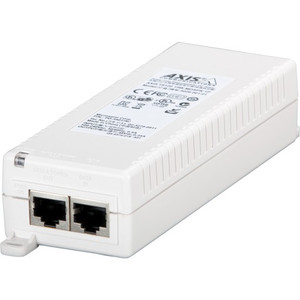
Axis T8120 1-Port 15W PoE Midspan 10-Pack
The Axis T8120 is a single-port PoE midspan designed for extending power delivery to network devices that lack built-in PoE support. This 10-pack configuration enables rapid multi-site deployment across surveillance systems, access-control networks, and IoT installations where existing switch ports are data-only or where PoE infrastructure doesn't yet exist. By injecting 15W (48V DC) onto the same Ethernet cable that carries data, the T8120 eliminates the need to run separate power lines while maintaining full Gigabit speeds—ideal for retrofits and budget-constrained expansions.
Key Features
- 15W Power Output: 48V DC at max 15.4W per port. Sufficient for standard IP cameras, wireless access points, and compact PoE endpoints without auxiliary power.
- Gigabit Passthrough: 10/100/1000 Mbps data rates on pairs 1/2 and 3/6; power injected on pairs 4/5 and 7/8 (Mode B) so no speed penalty.
- IEEE 802.3af Auto-Sensing: Detects PoE-capable devices automatically and injects power only when needed. No configuration required—plug and operate.
- Compact Form Factor: 33 × 53 × 140 mm (1.3 × 2.1 × 5.5 in), wall-mountable or shelf-mounted. Minimal footprint in network closets and junction boxes.
- Shielded RJ45 Connectors: EIA 568A/568B compatible; Category 5 or higher Ethernet cable recommended for optimal shielding and compliance.
- Front-Panel Status Indicators: AC power LED, per-port channel indicator, and fault/overload alert light for quick troubleshooting.
- Universal AC Input: 100–240V, 50/60 Hz, 0.5A max. Single integrated power supply eliminates regional voltage compatibility issues.
- Low Idle Consumption: 2W standby; 18.9W with device connected. Negligible operational cost across 10-pack rollouts.
The T8120 operates in passive PoE Mode B (pairs 4/5 and 7/8 for power), a standard wiring scheme that avoids data pair interference and works across legacy Category 5 infrastructure. This design choice matters: it means you can retrofit existing camera runs without concern for signal degradation or incompatibility. Operating range of 0–40°C covers most indoor installations and moderate outdoor enclosures; beyond that, verify thermal headroom in sealed equipment cabinets.
Network integration is transparent. The T8120 sits inline between a data-only switch port and the end device; it passes Gigabit frames unchanged while supplying DC power. ONVIF cameras, mesh Wi-Fi nodes, and VoIP phones all recognize the T8120 as a transparent conduit—no VLAN tagging, no DHCP interaction, no management overhead. This is critical for deployments where you want zero additional operational complexity.
For multi-camera retrofit projects, the 10-pack format amortizes per-unit cost and eliminates stocking fragmentation across regional sites. Each unit carries a 3-year manufacturer warranty and cUL/UL, CE, FCC, TUV, and KCC certifications, ensuring compliance with North American and international electrical standards. The optional AXIS T91A03 DIN Rail Clip A allows panel-mount installation in standardized electrical enclosures, a common requirement in commercial and industrial settings.
Total cost of ownership favors the T8120 in retrofit contexts: no network rewiring, no new PoE switches (which cost 2–3× more than a midspan), and minimal labor. For new builds or greenfield deployments where a PoE-capable switch can be specified upfront, a switch-based solution may offer better economics. But for adding 1–5 cameras to an existing non-PoE switch port, or for extending power to a distant camera run without running conduit, the midspan is the pragmatic choice.
Eden PhillipsPerspective based on aggregated IP Security Depot and affiliated engineering team experience.
We've deployed the Axis T8120 across hundreds of retrofit projects—office expansions, parking-lot camera adds, and access-control network extensions. The appeal is straightforward: it solves a real infrastructure gap without requiring a switch upgrade or cabling run. On a recent 8-camera retrofit at a distribution center, the customer had a non-PoE gigabit switch with two free ports; instead of pulling a quote for a $400 PoE replacement switch with six ports (of which only two would be used), we specified four T8120 midspans ($80 each bundled in the 10-pack) and had the system live in half a day. No VLAN commissioning, no firmware updates, no VMS reconfiguration—the cameras came online as if plugged directly into native PoE ports. That simplicity is the real product.
That said, the 15W ceiling matters. Standard Axis M31 and M32 fixed domes draw 5–8W; PTZ domes and heated outdoor boxes frequently exceed 15W and require PoE+ (30W) or higher. We've seen integrators spec the T8120 for a heated turret camera, then discover at commissioning that the heater won't activate below 20W supply. Know your device power budget before ordering. Also, the 0–40°C rating is a real constraint in hot climates or unventilated outdoor cabinets; we've had midspans throttle or shut down in sun-baked enclosures in Phoenix and Las Vegas. Plan thermal margin or move to an active injector with passive cooling if you're in extreme environments.
The Mode B wiring (power on pairs 4/5 and 7/8) is a strength here. Older PoE switches sometimes used non-standard injections that interfered with data pairs; the T8120 avoids that entirely. It's also why Category 5 cable is adequate—you're not pushing power through active pairs. Shielding still matters for EMI rejection in industrial settings (high-frequency welders, VFD drives, etc.), and we always recommend shielded Cat5e or Cat6 with proper grounding at both ends when near electrical noise sources.
Technical Highlights:
- Mode B Wiring (Pairs 4/5, 7/8): Power and data on separate pairs prevent cross-talk and allow Category 5 cable to be used safely. This is why the T8120 works reliably on older campus infrastructure without cabling audits or upgrades—you're not pushing 48V through data conductors.
- IEEE 802.3af Auto-Sensing: The midspan detects whether the downstream device needs power or is already PoE-capable, and only injects when required. This prevents accidental double-powering of PoE devices and protects against non-PoE endpoints that shouldn't receive DC. In heterogeneous networks, that auto-detection eliminates commissioning errors.
- Gigabit Passthrough at 15W: Unlike older Fast Ethernet (100 Mbps) midspans, this unit delivers gigabit speeds without bitrate collapse. For modern IP cameras with H.265 codec and edge analytics, you maintain the bandwidth headroom to push 4-8 Mbps streams per camera without buffering.
- Compact Footprint for Panel Mount: At 140 mm tall and 450 g, ten units can stack in a standard 19-inch rack shelf or mount to DIN rail with the T91A03 clip. We've fit an entire 10-pack into a customer's existing wall-mounted electrical cabinet without adding visible bulk to the entrance.
- Global AC Input (100–240V, 50/60 Hz): Single power supply avoids regional SKU proliferation. Multi-site deployments across US, Europe, and Asia-Pacific don't require inventory stratification by voltage.
Deployment Considerations:
- Power Budget Validation: 15W is a hard ceiling. Verify every endpoint device—camera, access point, thermal module—draws less than 15W under worst-case load (heater on, IR on, max streaming). If you're unsure, request a thermal signature from the manufacturer or run a bench test. We've seen projects delayed because midspans were specified for devices that required PoE+ (30W).
- Thermal Margin in Enclosed Spaces: The 0–40°C spec is operational ambient, not junction temperature. In sealed outdoor cabinets or sun-exposed fiber huts, interior air can exceed 50°C on hot days, pushing the midspan into thermal shutdown. If outdoor or enclosure deployment is required, consider active cooling or a higher-spec injector with heat dissipation.
- Cable Shielding Best Practice: Although Mode B allows Category 5 unshielded (UTP), we spec shielded Category 5e or Cat6 and ground the shield at the network-equipment end whenever possible. Industrial sites with VFD motors, welders, or high-frequency RFID readers benefit from EMI rejection; residential and office retrofits can use UTP without issue, but shielding adds $5-10 per run and is cheap insurance.
- Inline Placement—No Network Loop Risk: The T8120 is a passive device with no spanning-tree capability. It must be placed inline between a switch port and a single endpoint. You cannot daisy-chain units or create network loops. Know your cable topology before installation to avoid confusion about where the midspan sits in the path.
- 10-Pack Inventory for Multi-Site Ops: The bulk pack is economical but requires planning. If you operate 5-10 sites and retrofit 1-2 cameras per location per quarter, a single 10-pack covers a year's small projects. If you spec the full pack for a single large project, you may have surplus units in inventory—confirm project scope before ordering.
The Axis T8120 is the right product for integrators and system architects managing retrofit and expansion projects where a full network refresh isn't justified. It's particularly valuable in organizations with aging infrastructure, distributed sites with heterogeneous switch inventory, and projects where speed-to-deployment and minimal operational overhead are priorities. For new construction or planned system upgrades, a PoE-capable switch is often a better long-term investment. Explore the broader Axis catalog for network infrastructure and switching options if your deployment calls for native PoE delivery at scale.