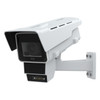
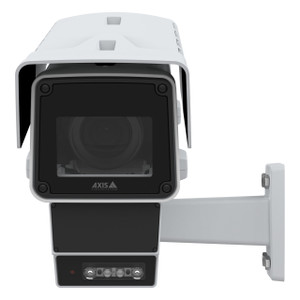
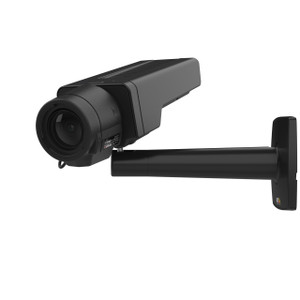
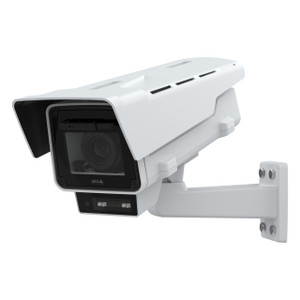
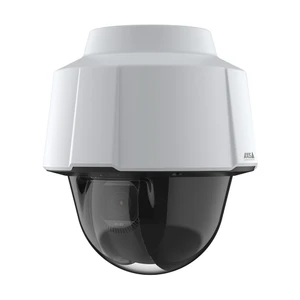
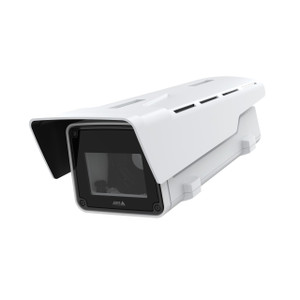
Axis 02420-001 Q1656-DLE 4MP Radar & Video Fusion Outdoor PTZ Bullet IP Camera
The Axis 02420-001 (often searched as 02420 001) combines dual-sensor surveillance architecture—radar and video fusion—in a single outdoor-rated PTZ bullet, designed specifically for perimeter monitoring and wide-area threat detection where both range and positional accuracy matter. Unlike conventional video-only systems, the Q1656-DLE fuses radar object detection (distance, speed, direction) with video analytics to reduce false alarms and deliver forensic-grade verification in a single integrated package.
Key Features
- Radar & Video Fusion with AXIS Object Analytics: Radar measures target velocity and distance while video analytics confirm spatial position through deep learning. This dual-layer approach cuts false positives significantly in dynamic outdoor scenes—parking lots, logistics yards, industrial perimeters—where purely video-based detection struggles with shadows, reflections, and crowded motion.
- 4MP Resolution at 50/60 fps: The 1/1.8" CMOS sensor delivers 2688x1512 pixel imagery fast enough for real-time object classification and forensic review without motion blur. At 4MP, you capture enough detail for facial recognition and license-plate reads at moderate standoff distances—practical for access-control integration at gate points or loading docks.
- 3.9–10 mm Motorized Varifocal Lens (96–44° horizontal FOV): Pan-tilt-zoom control lets you start wide for detection and zoom in for verification without switching cameras. This flexibility reduces camera count in large perimeters—a cost advantage when deploying across 500+ meter boundaries.
- Lightfinder 2.0 Technology with IR Illumination: Achieves 0.05 lux minimum illumination—near-total darkness detection when IR is engaged. Forensic WDR simultaneously handles high-contrast scenes (direct sun + shadowed areas), so you don't lose detail at night or during dawn/dusk transitions. Critical for 24/7 outdoor monitoring without external lighting infrastructure.
- IP66 and IK08 Environmental Rating: IP66 blocks direct rain and dust without restricting airflow; IK08 resists moderate vandalism (up to 5 joules impact). Suitable for rooftop, pole, and wall mounting in uncontrolled outdoor environments. Operating range of −40°C to 60°C handles extreme climate zones—arctic perimeters, desert installations, tropical humidity—without requiring environmental cabinets.
- H.264 Compression with Zipstream Technology: Zipstream dynamically adjusts bitrate based on scene motion and detail, cutting bandwidth 50–70% versus standard H.264 on static backgrounds. On a 24/7 multi-camera NVR, this translates to either halving storage costs or extending retention periods on existing infrastructure.
- PoE+ Power (9.5–25.5 W max): Operates over standard IEEE 802.3at PoE+ (Class 4), avoiding separate power supplies and conduit runs. The wide power range means the camera throttles intelligently—lower watts during daylight, higher during low-light IR operation—reducing demand on the switch's power budget during peak recording.
- Secure Boot and Signed Firmware: Enterprise-grade firmware authentication prevents unauthorized firmware replacement, meeting compliance requirements for critical infrastructure and NDAA-adjacent deployments. Remote management and firmware updates happen over secure, authenticated channels.
Integration & Compatibility
The camera supports ONVIF Profile S, T, and G, ensuring compatibility with industry-standard video management systems. Audio input enables two-way communication for gate intercoms or alarm announcements. Remote pan-tilt-zoom and focus control integrate into existing control systems via AXIS Camera Station or third-party VMS platforms. The Q1656-DLE's analytics output (radar detections, video object events) can feed into SIEM systems or custom automation rules via AXIS Event API.
When to Choose a Different Model
If your deployment requires higher resolution (above 4MP) for fine detail over extreme distances, consider a higher-megapixel variant in the Axis PTZ line. If you need indoor-only coverage without radar fusion, a standard 5MP or 8MP Axis PTZ bullet will reduce cost. If your site has reliable external lighting and false-alarm tolerance is low, a simpler video-only fixed or PTZ camera may suffice—radar fusion adds value primarily where detection range and speed-based threat classification are non-negotiable.
Deployment Context
Common deployments: critical infrastructure perimeters (power plants, water treatment, telecom sites), transportation hubs (rail yards, truck depots), warehouse and logistics complexes, border and boundary monitoring, and municipal smart-city surveillance where false-alarm reduction and automated threat response matter. The radar component's ability to classify motion by speed makes it particularly effective for detecting intrusion patterns (slow, deliberate movement) versus weather or animal activity (erratic, fast).
James EverettPerspective based on aggregated IP Security Depot and affiliated engineering team experience.
The 02420-001 closes a real gap in outdoor surveillance. Video-only systems miss slow intruders in shadows; radar-only systems can't verify what they detect. By fusing both, the Q1656-DLE gives you distance and speed from the radar—crisp threat classification—and spatial proof from the 4MP video feed. That combination is worth the investment when your deployment can't tolerate false alarms.
Technical Highlights:
- Lightfinder 2.0 + 0.05 lux minimum: Detects human-sized objects in near-total darkness when IR fires. No external floodlights needed; saves installation cost and power draw on large perimeters.
- Zipstream reduces bandwidth 50–70%: On 24/7 recording, a single camera saves 1–2 TB/month compared to standard H.264. Multiply across 10–20 cameras and you're looking at halving NVR storage costs or doubling retention windows.
- PoE+ at 25.5W max: Draws enough power for zoom, focus, and IR but won't overload a standard 60W PoE+ port. Most enterprise switches support 4–8 cameras per port; this camera behaves predictably within that envelope.
Deployment Considerations:
- Radar fusion adds value primarily in detection-heavy scenarios (perimeters, boundary monitoring). If your site has predictable, low-traffic patterns, video-only PTZ is simpler and cheaper.
- The 4MP resolution is appropriate for standoff distances up to ~150 meters for facial detail. Beyond that, expect license-plate reads to degrade—size the lens and distance accordingly during site survey.
- Zipstream works best on stable backgrounds (static perimeter). High-motion scenes (crowded parking lots, traffic) get less compression benefit because the algorithm keeps detail constant across moving objects.
Bottom line: The Q1656-DLE is built for security teams that need detection certainty and fear false-alarm fatigue. Perimeter and logistics sites where every intrusion event must be validated before dispatch—not speculative detection—will justify the cost and deployment complexity.
Frequently Asked Questions
Q: Does the 02420-001 support ONVIF?
A: Yes. The Q1656-DLE supports ONVIF Profile S, T, and G, enabling integration with any ONVIF-compliant VMS platform (Milestone XProtect, Genetec, Bosch, etc.). Radar event output is available via AXIS Event API for custom automation.
Q: What is the maximum IR illumination range?
A: The camera supports OptimizedIR with built-in 850nm illumination. Combined with Lightfinder 2.0, it achieves detection (human-sized object recognition) in near-total darkness. Specific throw distance depends on environmental reflectivity and scene contrast; expect reliable coverage to 30–50 meters in typical outdoor settings.
Q: Can the 02420-001 be powered by standard PoE (802.3af)?
A: No. The Q1656-DLE requires PoE+ (IEEE 802.3at, Class 4, minimum 30W per port) because zoom, focus, pan-tilt, and IR operation demand up to 25.5W peak. Standard 802.3af (15.4W) is insufficient. Confirm your PoE+ switch has enough per-port power budget before deployment.
Q: Does the radar component reduce false alarms compared to video-only PTZ?
A: Yes, significantly. The radar measures object velocity and direction; the video confirms spatial position. This synergy eliminates many false positives from shadows, reflections, and dynamic lighting that plague video-only systems. Radar also detects motion through fog and light rain where video degrades, though not through heavy obstruction.
Q: What is the operating temperature range?
A: −40°C to 60°C (−40°F to 140°F). This range covers arctic and tropical deployments without active heating or cooling enclosures. Mechanical components (lens, pan-tilt motor) are rated for the full range; no seasonal shutdown required.
Q: Is the 02420-001 NDAA Section 889 compliant?
A: Axis products are generally compliant with NDAA restrictions on Huawei, ZTE, and other listed entities. For government or contractor deployments, confirm current NDAA status with your compliance team or reseller, as designations can change.
Key Specifications:
Field of View: 96-44°
Color: White