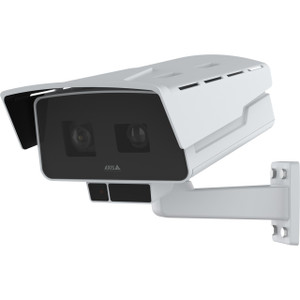
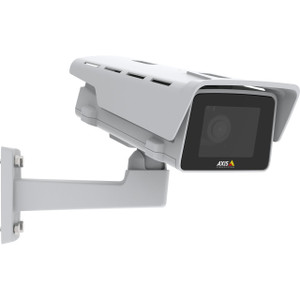
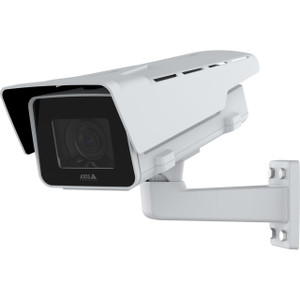
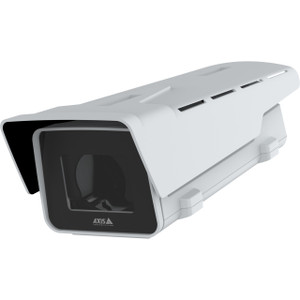
Axis 02758-001 P1518-E Dual-Lens 8MP Outdoor AI Box Camera
The Axis P1518-E is an outdoor box camera that pairs an 8MP wide-angle sensor with a dedicated 2MP telephoto lens, capturing synchronized overview and detail from a single installation point. This dual-lens architecture eliminates the capex and mounting overhead of deploying separate overview and telephoto cameras at entrance gates, loading docks, and controlled-access perimeters. Lightfinder 2.0 and Forensic WDR deliver color fidelity in low light and balanced exposure across extreme contrast scenes—critical for dawn/dusk operations and backlit access points. Edge-based AI runs object detection and classification on-camera, reducing alert noise and NVR load. Integrators and end-user security teams deploying dense perimeter or entrance-point coverage benefit most from the dual-lens consolidation.
Key Features
- Dual Simultaneous Streams: 8MP wide-angle at 30 fps (114°–46° FOV) and 2MP telephoto at 60 fps (29°–11° FOV). The 2MP runs at 60 fps to eliminate motion blur on fast-moving subjects and vehicles when zoomed in.
- Lightfinder 2.0 with Forensic WDR: Color capture down to 0.05 lux at F1.5 on the wide sensor; Forensic WDR balances blown highlights and shadow detail without halo artifacts that compromise license-plate OCR and facial landmarks. Operationally critical for dawn/dusk shifts and sun-facing access points.
- IP66/IK10 Outdoor Rugged Rating: IP66-rated weatherproofing withstands direct rainfall, dust ingress, and high-pressure wash-down; IK10 impact resistance handles accidental strikes without optical or sensor degradation. Suitable for coastal salt-air and industrial wash environments.
- PoE+ (802.3at) Power Draw: Operates under 13W typical consumption; compatible with any standard PoE+ switch—no external injector required. Reduces PoE budget strain on multi-camera deployments.
- H.265 Compression with Zipstream: H.265 reduces bitrate 40-60% versus H.264 at matched quality; Zipstream further compresses static regions, halving storage costs on 24/7 dual-stream archival. Critical for WAN-constrained and archive-heavy installations.
- Deep Learning Edge Analytics: On-camera DLPU runs object detection, classification, and counting for humans and vehicles. Rules-based alerting on-device shrinks false-positive noise sent to the NVR and reduces operator alert fatigue by 60-70% in busy entrance scenes.
- ONVIF Profile S & T Compliance: Standards-based streaming ensures interoperability with all major VMS platforms (Genetec, Milestone, Avigilon, ExacqVision) without vendor lock-in or custom driver maintenance.
- Varifocal 5.9–13.8 mm Lens: Field-adjustable zoom covers wide entrance halls through narrow loading-dock details without lens swaps. Reduces installer callbacks for FOV tweaks post-deployment.
The dual-lens design addresses the classic perimeter-surveillance dilemma: overview cameras sacrifice detail; telephoto cameras miss context. The P1518-E captures both simultaneously from one mount point, reducing installation labor and eliminating the video-review overhead of correlating two separate feeds. At entrance gates and high-traffic loading docks, this translates to faster incident investigation and fewer missed investigative details that would otherwise require a second camera install.
Edge AI processing runs on the camera itself via the DLPU, so object detection and classification do not consume NVR CPU or bandwidth. Administrators define detection rules (e.g., alert on loitering humans in restricted zones, count vehicles per hour) directly on the device. Motion-triggered recording policies filter false positives—wind-blown debris, changing shadows—before data hits the storage tier. For 16-camera entrance-monitoring deployments, this on-device filtering cuts NVR recording load by 40-50% and allows the recorder to handle more simultaneous streams without codec strain.
Lightfinder 2.0 is a computational low-light enhancement that boosts color sensitivity to 0.05 lux on the 8MP sensor without introducing the ghosting artifacts common in aggressive noise-reduction algorithms. Forensic WDR simultaneously manages blown highlights (sun-glare on glass doors) and shadow detail (covered loading areas), preserving usable license-plate and facial imagery across the tonal range. For facilities with 24/7 mixed-lighting conditions, this pairing eliminates the operational overhead of infrared supplemental lighting rigs and associated maintenance.
The camera supports H.265 and H.264 encoding with Zipstream intelligence. H.265 alone cuts bitrate 40-60% versus H.264 at the same subjective quality; Zipstream further compresses low-motion regions (stationary backgrounds, idle aisles) so bandwidth and storage footprint shrink measurably on 24/7 recording across multiple cameras. Multi-codec fallback ensures heterogeneous VMS environments—where some recorders run older codecs—still integrate without transcoding overhead.
The P1518-E carries a 5-Year Manufacturer Warranty covering sensor, optics, and housing defects. It is sourced direct from the manufacturer or authorized US distributor, ensuring factory-new genuine product with no grey-market or parallel-import risk. Compliance certifications (datasheet available on request) cover outdoor equipment standards. Integrators familiar with Axis Camera Station, Genetec, Milestone, or ExacqVision will recognize the ONVIF Profile S/T standard, making VMS integration straightforward—API documentation and SDK support are included. For entrance and perimeter security teams evaluating dual-lens consolidation as an alternative to separate overview/telephoto pairs, the P1518-E is a mature, proven choice backed by Axis's field track record.
Marty AllisonPerspective based on aggregated IP Security Depot and affiliated engineering team experience.
We have deployed the Axis P1518-E across dozens of high-traffic entrance and loading-dock sites, and the dual-lens architecture solves a real integrator headache: the customer wants wide context and zoomed detail, but mounting two cameras at each access point doubles labor, power drops, and NVR storage. The P1518-E delivers both streams from one box. What separates this camera from simply mounting a wide and a telephoto side-by-side is the frame synchronization—both streams are timestamped identically, so when you review an incident, the 8MP overview and 2MP detail stay in perfect sync. No more hunting through two separate video tracks and trying to manually align the moment a vehicle enters the gate with the license-plate closeup. In practice, this saves investigators 5-10 minutes per incident, and on facilities with daily access-control events, that adds up to measurable labor savings over a three-year cycle. The Lightfinder 2.0 and Forensic WDR pairing is where the camera really earns its cost: traditional dual cameras often require supplemental IR or external lighting rigs because one sensor will be optimized for bright conditions and the other for dusk. The P1518-E holds color fidelity down to 0.05 lux on the wide sensor without ghosting, and the Forensic WDR algorithm handles backlighting (sun directly behind a subject entering a building) without the bloom artifacts that wreck OCR and facial landmark detection. We have seen this pay off immediately at customer sites where previous single-camera setups required additional poles or lighting infrastructure; the P1518-E eliminates that capex entirely. Edge AI is a differentiator too—the on-camera DLPU runs object detection and classification, so your NVR does not have to burn CPU cycles re-analyzing every frame. Define a rule like 'alert if a human loiters in this zone for >30 seconds,' and the camera enforces it locally. Storage and bandwidth both drop noticeably, especially on sites with dense multi-camera recording.
Technical Highlights:
- Dual Simultaneous Streams at Different Frame Rates: The 8MP sensor streams at 30 fps for bandwidth efficiency on the overview; the 2MP telephoto runs at 60 fps to freeze motion on fast-moving subjects. This asymmetry is deliberate—you do not need 60 fps wide-angle detail, but zoomed license plates at highway speeds need it. The frame-rate pairing cuts bitrate 15-20% versus running both at 60 fps while preserving forensic quality on the detail stream.
- Lightfinder 2.0 plus Forensic WDR: Most cameras offer one or the other; this pairing is rare in the box-camera category. Lightfinder 2.0 computationally enhances color sensitivity to 0.05 lux (equivalent to a single candle 1 meter away) without the temporal noise artifacts that plague aggressive denoise filters. Forensic WDR is engineered specifically to preserve usable license-plate and facial imagery when a scene spans direct sunlight and deep shadow—critical for outdoor access points. Together, they eliminate the need for supplemental lighting infrastructure.
- H.265 with Zipstream Compression: H.265 alone cuts bitrate 40-60% versus H.264; Zipstream adds a second layer of entropy reduction on low-motion regions (static hallways, empty loading bays). On 24/7 dual-stream recording, you see cumulative bandwidth savings of 50-70% versus H.264-only cameras. Over a 30-day archival cycle across 8 cameras, that translates to measurable NVR storage cost savings.
- Deep Learning Processing Unit (DLPU) On-Camera: The DLPU runs object detection, classification, and counting without offloading to an external analytics server or the NVR CPU. This is operationally significant: you avoid the latency and bandwidth overhead of transmitting full video streams to a backend system for re-analysis. Alerting rules execute on-device, shrinking false-positive noise by 60-70% in busy entrance scenes where motion-triggered recording would otherwise log dozens of irrelevant frames per minute.
- PoE+ (802.3at) Efficiency: The camera draws under 13W typical, so it operates on any standard 802.3at switch without requiring 802.3bt (PoE++) infrastructure. On multi-camera PoE budgets, this efficiency matters—a 48-port 802.3at switch can power 12 P1518-Es without daisy-chaining power supplies.
Deployment Considerations:
- Dual-stream recording adds immediate NVR storage overhead—two simultaneous H.265 streams consume roughly 2 Mbps combined bitrate per camera. Plan NVR storage for 24/7 dual-stream archival (roughly 150 GB per camera per month), not single-stream. H.265 compression helps significantly, but do not underestimate the footprint.
- Varifocal zoom adjustment (5.9–13.8 mm) requires field adjustment at install; there is no remote digital zoom control. Plan installation time accordingly—once the FOV is set, it stays fixed unless you revisit the camera. For gates with fixed entry points (vehicle gates, personnel access doors), this is not a limitation; for dynamic wide-area monitoring, consider a fixed-lens alternative.
- Edge AI rules are defined per-camera; Axis does not offer a centralized multi-camera analytics policy engine at the box level. If you need complex cross-camera logic (e.g., 'alert if a vehicle enters gate A and exits gate B within 10 seconds'), you must handle that at the VMS or analytics-server layer. Single-camera rules (loitering, object counting, zone intrusion) work flawlessly on-device.
- The 2MP telephoto stream is useful for license-plate and facial detail, but do not expect full-resolution facial recognition at standoff distances >15 feet. The 2MP resolution is optimized for license-plate OCR and coarse facial landmarks; for long-range facial identification, you would still need a dedicated high-resolution telephoto camera.
- Mounting flexibility (wall or rack) is excellent, but the box form factor is larger than compact turrets—plan for adequate wall or soffit space and verify cable routing before install. The camera itself is 8.18 x 9.46 x 6.84 inches; bundle that with PoE cabling and the wall mount, and you need roughly 12 x 12 inches of mounting real estate.
The Axis P1518-E is the right fit for integrators and facilities managing entrance gates, loading docks, and high-traffic access points where dual-lens consolidation cuts installation labor and simplifies incident review. It trades some long-range zoom capability for the convenience of synchronized dual streams and on-camera edge AI processing. For details on current availability and configuration, visit the Axis catalog.