
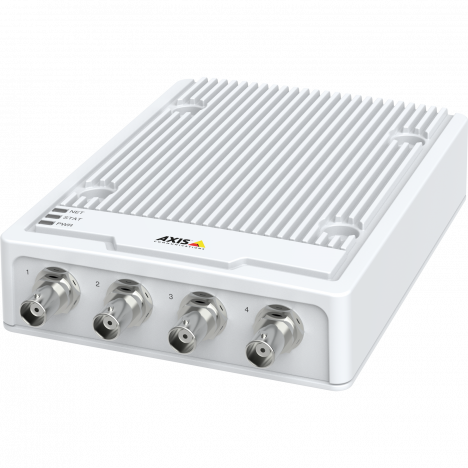


Product images are provided for reference and may not represent the exact model, configuration, or included
components.
Overview
SKU:
01679-001
UPC:
7331021066397
Condition:
New
Availability:
Usually Ships Same Business Day
Warranty
3-year warranty

Axis 01679-001 4-Channel Video Encoder
Axis 01679-001 4-Channel Video Encoder The Axis 01679-001 is a compact 4-channel analog-to-IP video encoder that bridges legacy analog camera systems…
Axis 01679-001 4-Channel Video Encoder
$349.00
$344.99
Your recommended setup
Review items below — quantities update pricing automatically.
Item
Qty
Status
Price
Optional Add-Ons recommended
Services optional
Bundle Summary
Bundle Subtotal:
$0.00
Optional Add-Ons:
$0.00
Services:
$0.00
Total:
$0.00
Overview
SKU:
01679-001
UPC:
7331021066397
Condition:
New
Availability:
Usually Ships Same Business Day
Warranty
3-year warranty
Description

Axis 01679-001 4-Channel Video Encoder
The Axis 01679-001 is a compact 4-channel analog-to-IP video encoder that bridges legacy analog camera systems into modern IP networks without requiring full hardware replacement. This approach preserves your existing camera infrastructure investment while unlocking network-based recording, centralized management, and intelligent analytics on video feeds that would otherwise remain isolated on coaxial cable.
Overview
The M7104 consolidates up to four analog composite video signals into a single IP device, converting each to H.264 or Motion JPEG streams over Gigabit Ethernet. The encoder runs on the ARTPEC-7 processor—Axis's in-house silicon for video compression—with 1024 MB RAM and 512 MB Flash, ensuring stable, predictable performance across 24/7 operation. Power arrives via PoE (single Ethernet cable), eliminating the need for dedicated AC outlets or external 12VDC supplies at the encoder location. This single-cable topology reduces installation time and labor cost, especially in retrofit scenarios where running new power to a remote analog camera cluster would otherwise be expensive.
Resolution flexibility spans 176×144 up to 720×576 (PAL) or 720×480 (NTSC)—typical for analog-era cameras. The encoder delivers all four channels simultaneously at 25 or 30 fps, including quad-view at full resolution, so you're not trading frame rate for channel count.
Key Features
- H.264 and Motion JPEG compression — Multiple independent streams per channel allow simultaneous archival (H.264 for storage efficiency) and live playback (Motion JPEG for browser compatibility) without re-encoding penalty. H.264 cuts storage footprint roughly 50% compared to Motion JPEG, a meaningful factor when recording four channels 24/7 for retention periods of days or weeks.
- Axis Zipstream technology — Reduces bandwidth and storage load 30–50% by preserving motion detail while lowering quality in static areas. On a four-channel 24/7 installation over a limited WAN link, this avoids costly bandwidth upgrades.
- MicroSD/microSDHC/microSDXC edge storage with 256-bit AES-XTS encryption — Local card recording acts as a buffer during network outages or as a failover to NAS. Encryption means card data stays protected if the encoder is physically stolen. Cards are user-replaceable and cost far less than upgrading a centralized NVR.
- Comprehensive PTZ support — Drivers for analog PTZ cameras include up to 100 preset positions per camera, guard tour automation, and joystick compatibility. Dual RS485/RS422 serial ports handle multiple PTZ protocols (Pelco-D, Pelco-P, others), so you're not locked into a single vendor's pan-tilt hardware.
- ONVIF Profiles G, M, and S compliance — Ensures compatibility with major VMS platforms (Milestone XProtect, Axis Camera Station, third-party ONVIF-aware systems). This vendor-neutral approach protects your software investment if you later migrate or integrate with different management tools.
- Motion Guard, Fence Guard, and Loitering Guard analytics — Embedded video analytics trigger alerts and conditional recording without separate GPU or external processing. Motion detection on analog feeds, previously limited to crude pixel-change algorithms, now includes configurable intrusion zones and loiter timers—reducing false alarms and storage waste on quiet areas.
- Enterprise-grade security: HTTPS, IEEE 802.1X network access control, OAuth 2.0 ADFS, signed firmware, and secure boot — Protects against unauthorized firmware modifications and network-layer attacks. Certificate-based authentication integrates with Windows Active Directory, so encoder access inherits your existing user provisioning workflow.
- Event-driven FTP, email, and MQTT notifications — Alarms push directly to your monitoring center or mobile device without polling the encoder. MQTT support simplifies integration with modern IoT platforms and custom dashboards.
Integration and Compatibility
The 01679-001 connects to any network video recorder or VMS via RTSP/RTSPS stream ingestion. Axis IP cameras and the M7104 can coexist in the same deployment—mixed analog and native-IP architectures are common during migration phases. The encoder's VAPIX API and ACAP (Axis Camera Application Platform) support enable third-party developers to deploy custom motion detection or object recognition applications directly on the device, offloading processing from your central NVR.
Operating temperature range is 0–50 °C (32–122 °F), suitable for indoor installations and mild climate enclosures. Dimensions are 187 × 37 mm with 650 g weight—wall-mountable in tight spaces behind analog cameras or near a network switch.
What's in the Box
Contact us for detailed package contents and accessory compatibility.
Frequently Asked Questions
Q: Does the Axis 01679-001 require an external power supply?
A: No. The M7104 draws power via PoE (802.3af) over a single Ethernet cable. This simplifies installation and eliminates the need for AC outlets or dedicated 12VDC supplies at the encoder location.
Q: Can I use the 01679-001 with analog PTZ cameras?
A: Yes. The encoder includes dual RS485/RS422 serial ports and drivers for a wide range of analog PTZ protocols (Pelco-D, Pelco-P, and others). You can control pan, tilt, zoom, and presets directly from compatible VMS software or a joystick panel.
Q: What video formats does the M7104 support?
A: H.264 and Motion JPEG. You can configure independent streams per channel—for example, H.264 for long-term storage and Motion JPEG for live web playback, without re-encoding overhead.
Q: Is the 01679-001 ONVIF compliant?
A: Yes. It supports ONVIF Profiles G, M, and S, ensuring compatibility with Milestone XProtect, Axis Camera Station, and other ONVIF-aware VMS platforms.
Q: Can I record video locally on the encoder?
A: Yes. The M7104 supports microSD/microSDHC/microSDXC cards (user-replaceable) with 256-bit AES-XTS encryption. Local recording acts as a buffer during network outages or as failover storage independent of your central NVR.
Q: What is the warranty on the Axis 01679-001?
A: Axis provides a 3-year manufacturer's warranty covering defects in materials and workmanship.
Marty Allison
The Axis 01679-001 is the practical choice when you have 4–20 analog cameras that need to feed a modern VMS but a wholesale camera replacement isn't in the budget. The ARTPEC-7 processor and dual-compression support (H.264 + Motion JPEG simultaneously) mean you're not sacrificing efficiency or flexibility—you're gaining network access to feeds that are currently locked in coaxial silos.
Technical Highlights:
- H.264 + Zipstream on all four channels: Storage overhead drops 50–60% versus Motion JPEG, and Zipstream's motion-preserving bandwidth reduction adds another 30–50% on typical scenes. On a four-channel 24/7 installation over a 5 Mbps WAN link, this difference is the margin between feasible cloud archival and a 'not possible' decision.
- PoE (single 802.3af cable): Eliminates external 12VDC supplies and AC drops. Retrofit labor drops significantly when you're not running new power conduit.
- Dual RS485/RS422 for PTZ control: The 01679-001 handles Pelco-D, Pelco-P, and similar analog PTZ dialects natively. No additional serial-to-IP converter required.
- MicroSD with 256-bit AES-XTS: Local failover recording survives network outages and WAN latency spikes. Encryption prevents physical card theft from becoming a data breach.
- ONVIF Profiles G/M/S: Ensures you can integrate with any major VMS without vendor lock-in—critical if your shop standardizes on Milestone but your customer already has Axis Camera Station deployed elsewhere.
Deployment Considerations:
- Analog resolution ceiling: PAL maxes out at 720×576 (NTSC 720×480). If you need 1080p or higher, you're buying new IP cameras—the encoder won't magically upscale. Know your analog cameras' actual output before specifying the M7104.
- Serial port count: Two RS485/RS422 ports means you can control multiple PTZ chains, but if you're running 4 independent PTZ cameras on a four-channel encoder, verify your PTZ protocol supports multi-drop (most do, but old proprietary systems sometimes don't).
- PoE power budget: At 12.95 W typical draw, the encoder consumes less than half a standard 802.3af allocation. Verify your PoE switch has enough budget if you're also powering analog-to-IP cameras elsewhere on the same circuit.
- Storage overflow: MicroSD cards fail. Edge storage is a failover buffer, not a 30-day archive. Size your card conservatively and test failover scenarios with your NVR to confirm what happens when the card fills or the network reconnects.
Position the 01679-001 for retail, small-office, or educational installations where you're extending an aging analog system for 2–3 years before a full refresh. It's not a long-term permanent solution—but for phased migration, cost recovery, and avoiding wholesale camera replacement, it's efficient and operationally sound.
Specifications
Type:
Encoder
Model:
ARTPEC-7
RAM:
1024 MB RAM, 512 MB Flash, Battery backed-up real-time clock
Video Compression:
H.264
Resolution:
176x144/176x120 (PAL/NTSC) to 720x576/720x480 (PAL/NTSC)
Frame Rate:
25/30 fps in all resolutions; Up to 30 fps in quad view in full resolution
Video streaming:
Multiple, individually configurable streams in H.264, H.265 and Motion JPEG; Axis Zipstream technology in H.264 and H.265; Controllable frame rate and bandwidth; VBR/MBR H.264/H.265; Quad view
Image settings:
Compression, color, brightness, contrast, rotation: 0°, 90°, 180°, 270°, aspect ratio correction, mirroring of images, text and image overlay, privacy mask, enhanced deinterlace filter, video termination, anti-aliasing, sharpness, noise reduction
Pan/Tilt/Zoom:
Wide range of analog PTZ cameras supported, drivers included in the firmware; Up to 100 preset positions/camera, Guard tour, PTZ control queue; Supports Windows compatible joysticks
IP address:
One IP address for four channels
Security:
IP address filtering, HTTPSa encryption, IEEE 802.1Xa network access control, user access log, centralized certificate management
Network protocols:
IPv4, IPv6 USGv6, ICMPv4/ICMPv6, HTTP, HTTPSa, TLSa, QoS Layer 3 DiffServ, FTP, SFTP, CIFS/SMB, SMTP, mDNS (Bonjour), UPnP®, SNMP v1/v2c/v3 (MIB-II), DNS/DNSv6, DDNS, NTP, NTS, RTSP, RTP, SRTP/RTSPS, TCP, UDP, IGMPv1/v2/v3, RTCP, ICMP, DHCP, ARP, SSH
Application Programming Interface:
Open API for software integration, including VAPIX® and AXIS Camera Application Platform; AXIS Video Hosting System (AVHS) with One-Click Camera Connection; One-click cloud conn.; ONVIF® Profile G, ONVIF® Profile M, ONVIF® Profile S and ONVIF® Profil
Features:
Analytics, video loss, edge storage events, MQTT subscribe
Event actions:
File upload: FTP, SFTP, HTTP, HTTPS network share and email; Notification: email, HTTP, HTTPS and TCP; External output activation; MQTT publish; Pre- and post-alarm video buffering; PTZ preset; Status LED
Data streaming:
Event data
Applications:
Included: AXIS Motion Guard, AXIS Fence Guard, AXIS Loitering Guard; AXIS Video Motion Detection, active tampering alarm supported; Support for AXIS Camera Application Platform enabling installation of third-party applications
Edge security Software:
Signed firmware, brute force delay protection, digest authentication and OAuth 2.0 RFC6749 OpenID Authorization Code Flow for centralized ADFS account management, password protection, AES-XTS-Plain64 256bit SD card encryption Hardware: Secure boot
Network security:
IEEE 802.1X (EAP-TLS, PEAP-MSCHAPv2)a, IEEE 802.1AE (MACsec PSK/EAP-TLS), IEEE 802.1AR, HTTPS/HSTSa, TLS v1.2/v1.3a, Network Time Security (NTS), X.509 Certificate PKI, host-based firewall
Documentation:
AXIS OS Hardening Guide; Axis Vulnerability Management Policy; Axis Security Development Model; AXIS OS Software Bill of Material (SBOM)
Casing:
Stand alone, metal casing, wall mount
Sustainability:
PVC free
Power Type:
PoE
Connectors:
Four analog composite video BNC input; RJ45 10BASE-T/100BASE-T/1000 BASE-T PoE; RS485/RS422, 2 pcs, 2 pos, full duplex, terminal block
Storage Capacity:
Support for microSD/microSDHC/microSDXC card; Support for SD card encryption (AES-XTS-Plain64 256bit); Support for recording to network-attached storage (NAS); For SD card and NAS
Operating Temperature:
0 °C to 50 °C (32 °F to 122 °F); Humidity 10-85% RH (non-condensing)
Storage conditions:
-40 °C to 65 °C (-40 °F to 149 °F); Humidity 5-95% RH (non condensing)
Approvals:
EMC; EN 55032 Class A, EN 61000-3-2, EN 61000-3-3, EN 55024, EN 61000-6-1, EN 61000-6-2, FCC Part 15 Subpart B Class A, ICES-003 Class A, VCCI Class A, RCM AS/NZS CISPR 32 Class A, KC KN32 Class A, KC KN35; Safety; IEC/EN/UL 62368-1;
Dimensions:
187 x 37 mm (7.4 x 1.5 in)
Weight:
650 g (1.4 lb)
Included accessories:
Installation guide, Windows® decoder 1-user license, DC input plug, 2 pcs 2-pin RS485/RS422 plugs
Video management software:
AXIS Companion, AXIS Camera Station, Video management software
Languages:
English, German, French, Spanish, Italian, Russian, Simplified Chinese, Japanese, Korean, Portuguese, Polish, Traditional Chinese, Dutch, Czech, Swedish, Finnish, Turkish, Thai, Vietnamese
Warranty:
Axis 3-year warranty
Product Type:
Encoder
Local Storage:
microSD
Max Resolution:
Thermal
Housing Color:
White
warranty:
3-year warranty
Have Questions?
Ask an Expert.
Videos Hide Videos Show Videos
Your recommended setup
Review items below — quantities update pricing automatically.
Item
Qty
Status
Price
Optional Add-Ons recommended
Services optional
Bundle Summary
Bundle Subtotal:
$0.00
Optional Add-Ons:
$0.00
Services:
$0.00
Total:
$0.00
RELATED PRODUCTS



System Design, Deployment & Technical Support
Support services and planning resources for commercial surveillance, access control, and infrastructure deployments.
Fixed scope • Fixed price
System Design Assistance
- Get help validating product compatibility
- Coverage requirements
- Storage planning and deployment architecture before you buy.
Deployment & Configuration Support
- Access fixed-scope support for rollout planning
- User setup guidance
- Migration and system standardization across single-site or multi-site deployments
Guides, Tools & Calculators
- PoE requirements
- Storage retention
- Camera selection and deployment methodology